





By Michael M. Canaris
Because of our nation’s economic, cultural and social dominance, it is often said that “when America sneezes, the world catches a cold.”
That sentiment works in reverse, too, as many Americans think the way things are done around here naturally applies to everyone else. Some can’t imagine Christmas for my Brazilian and Argentinian friends who go to the beach on Dec. 25, not because it’s slightly warmer, but because December is the height of their summer months, with the chill coming in the middle of July. I’ve seen maps with Australia or Ethiopia at the center of things and the United States seemingly distorted off to the side of the globe. And, we still get a lot of raised eyebrows when I tell people that our house operates on a largely European schedule due to my wife’s roots in Spain, so it’s not at all uncommon for our two-year old to be having her dinner at 10 p.m.
The rhythms of the academic year are also contextual. So, while those of us in the United States see the approach to Labor Day as the unofficial end of the summer season, for Romans, they still have a long way to go before heading back to classes in mid-October.
It was the first emperor, Octavian Augustus, who early during his reign from 27 BC-14 AD, insisted on a season of rest and celebration. He called this “feriae Augusti,” or “Augustus’ recess/rest/break.” It was intended to reward workers after the long agricultural demands of the preceding months. Like so much else in Catholic history, the Church didn’t eradicate the pagan roots, traditions or worship spaces when the religion spread across these lands, but instead “baptized” what was already common practice. Thus, the August holidays eventually came to orbit not around imperial successes, but around the feast of Mary’s Assumption. But they remained deeply ingrained in the Roman mindset.
In the sweltering heat of August in the Eternal City, most locals today, including dry cleaners and restauranteurs and dentists and everyone in-between, have chosen to escape the oppressive heat for the coast or the mountains for a few weeks. And while the practice has lessened in recent decades due to the explosion of tourism and/or the economic situation that would demand some to forgo any time away from work at all, it still persists in a very noticeable way. It’s very common, as an example, for Italians in June and July there to say they’ll see one another “after the holidays” in the Fall.
However, there is a more serious message beneath this little history lesson. While our country has many strengths and blessings, slowing our pace down is not one of them, as attested to by our levels of heart disease, anxiety, insomnia and obesity. Untold numbers of Christians have seen benefit to their lives of faith by practicing retreats. Of course, the Lord himself – as other-centered and socially connected as he always was, so often “taking compassion on the multitude” – still often went off alone or with a few of his closest disciples to deserted places for rest and refreshment.
The Italian way of doing things is not perfect. But like any collective people, they have lessons to offer and things to contribute to the global human family. While it is unlikely that a nation as pluralistic as ours might slow down together because of a festival around a Marian dogma, perhaps a more general “August pause” is a custom from which we could all benefit.
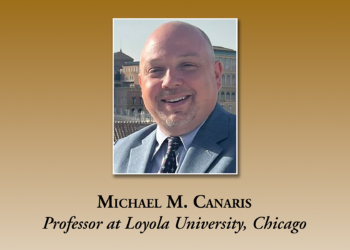
An alumnus of Camden Catholic High School, Cherry Hill, Michael M. Canaris, Ph.D., teaches at Loyola University, Chicago.




 at the bottom and then tap “Add to Home Screen”
