






By Deacon Dean Johnson
In his famous journey, Homer’s Odysseus had to prevail over great challenges – both mental and physical – before he could finally return home. With the help of his guardian from Mount Olympus, the goddess Athena, Odysseus was able to escape the eye of Cyclops, the voices of the Sirens, encounters with the monsters Scylla and Charybdis, and other perilous obstacles. Of all the hardships, however, the hero of the “Odyssey” never had to endure anything so arduous as the elementary playground at recess.
When my oldest son was in fifth grade, he came home one day from school complaining that one of his classmates was annoying him during recess by constantly inflicting a “spider hold” on him. A spider hold, I deduced from his description and rather annoying demonstration, is sort of Vulcan knock-out pinch that Mr. Spock did on “Star Trek.” My son told me that all the kids were constantly giving each other the “spider hold,” but he found it ridiculous.
My heart went out to him. I remember those seemingly innocent, albeit slightly injurious rites of passage in the schoolyard.
“Hey, Chester!” Wham! A full force blow to the upper body. “It’s good to see you back.” Whomp! A breath-taking slug to the back. There were others, too.
I dreaded Tuesdays. In my school, it was referred to as “Toes-day.” On this particular day, someone would walk up to you and stomp his foot down on yours as hard as he could. I would wake up the next morning with mixed feelings. Yes, I had survived another “Toes-day,” but now it was “Weddings-day,” a day wrought not only with physical pain, but emotionally scarring as well. On “Weddings-day,” the nuptials were performed by a blind-sided shove that made you go flying into the nearest girl. Any contact constituted marital mockery for the rest of the day.
Painful though these were, it was merely the light stuff, the work of the underlings.
Those who perpetrated these little annoyances were the henchmen to the archenemy that was Gunter: six-feet forever to my four-foot whatnot, Gunter was the bully’s bully. Gunter had been left back so many times that he had his own parking spot.
At one point or another during my school day, I was either tripped, noogied, ear flicked or just plain punched by Gunter. I had no idea why until one day when he was caught red-handed: that is, he had me in a headlock grimacing in pain when a teacher walked up and told him to stop. “But he’s wearing Bo-bos,” he said about my off-brand sneakers with the tell-tale “BB” on the sole. “That stands for basketball,” I said, repeating the words of my mother. Even my fellow victims laughed.
According to a study in the Journal of the American Medical Association, approximately one-third of schoolchildren have been bullied or have participated in bullying by the time they are in high school. Unfortunately, many children learn to tolerate these unwarranted assaults as a means of self-preservation.
While the Bible does not use the word “bully,” there are quite a lot of them. Abraham’s wife, Sarah, was ridiculed because she could not have any children. Joseph scorned his brothers, and they treated him even worse because he was the favorite. Saul tormented David to the point of trying to kill him because of his jealousy. Shadrach, Meshach and Abednego were all bullied for serving God in Babylon. The list could go on.
In a 2018 homily, Pope Francis said, “When we realize that we harbor within ourselves the desire to attack someone because they are weak, we have no doubt: It is the devil. Because attacking the weak is the work of Satan.”
We know that most bullies bully due to lack of self-esteem, wanting to feel better about themselves, but the issue has a deeper, spiritual origin.
Pope Francis in his homily asked, “What is within these people? What is it within us that pushes us to mock and mistreat others weaker than we are?”
His conclusion is the consequences of original sin and “it is the devil. Because attacking the weak is the work of Satan.”
As parents, we need to pay close attention to our schools, our playgrounds, our neighborhoods and even our own homes for signs of bullying. We need to openly live our Catholic life as examples to children so they won’t become bullies. When we do see or hear signs of bullying, we need to call attention to them with love, peace and compassion.
Childhood has always been an odyssey. Let us pray to our God of compassion that all our children this school year will joyfully find their way home.
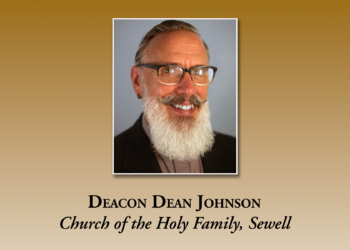
Deacon Dean Johnson serves at Church of the Holy Family, Sewell.




 at the bottom and then tap “Add to Home Screen”
