




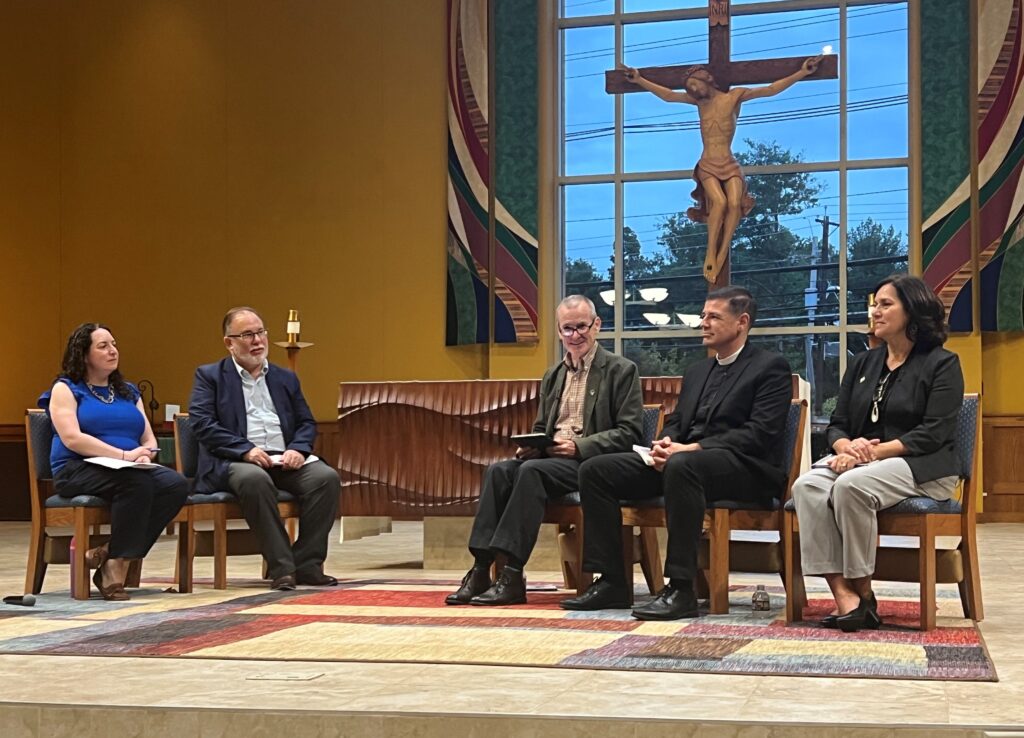
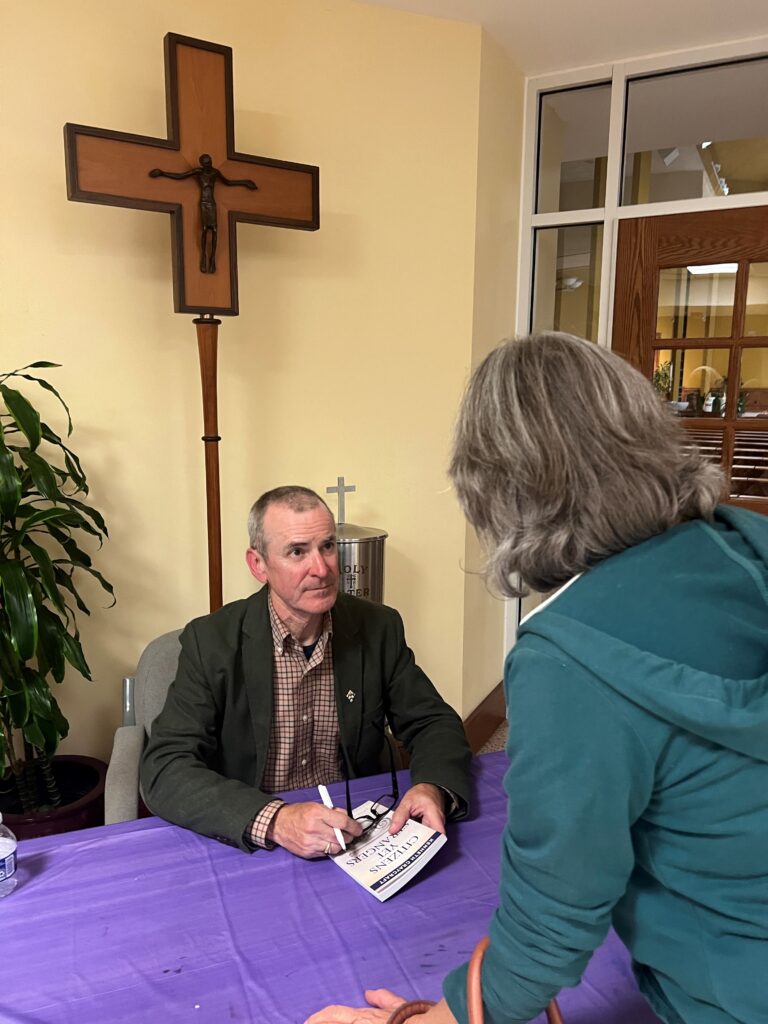
CHERRY HILL – Nearly 100 people came together for honest dialogue the evening of Oct. 2 to hear speakers including Dr. Kenneth Craycraft, author of “Citizens Yet Strangers: Living Authentically Catholic in a Divided America,” discuss civility in matters of politics, social concerns, economics and more.
The panel for the event, held at the Catholic Community of Christ Our Light, also included Dr. Maria Elena Hallion, executive director of Catholic Charities of South Jersey, and Father Jon Thomas, pastor of Christ the King Parish, Haddonfield.
“We have abandoned, or forgotten, the moral language of Catholicism and replaced it with a moral dialect that leads to failure and frustration,” Dr. Craycraft said, reading excerpts from his book.
He said that Catholics have moved away from being formed by the Biblical story of Christianity and have “forgotten the theologies and practices that separate being Catholic from being a certain kind of American. [We] lack a coherent model and political vocabulary, with little hope of articulating principles of freedom and common good to the broader culture, because we don’t even know what that looks like within the Church.”
Indeed, he continued, because U.S. Catholics have “reduced moral commitments to political identity, and political identity to party loyalty … our moral and political lives are more likely formed by partisan identification than Catholic discipleship.”
To rediscover, or discover, one’s authentic Catholic moral language, Dr. Craycraft challenged each and every person to focus on the four pillars of Catholic Social Teaching: human dignity, the common good, subsidiarity and solidarity.
If all are to fulfill the Great Commission – to be witnesses of the Good News of the Gospel – they must learn to speak and act their Catholic story without flinch or fail, he said.
In sharing her experience of living out Catholic Social Teaching, Dr. Hallion spoke about serving on the faculty of Cabrini University in Radnor, Pa., where she focused on social issues such as childhood obesity, its contributing factors, and the affordability and accessibility of healthy foods.
She also stressed the importance of continuing to be intentional in Catholic Charities’ mission to be grounded in Catholic social doctrine.
She posed a question to Dr. Craycraft, asking him to give examples of subsidiarity, a principle stating that social and political issues should be dealt with at the most immediate and local level.
He responded by talking about the Saint Vincent de Paul Society conferences across South Jersey, which are dedicated to helping the poor, vulnerable and those on the margins. The conferences allow each individual to “flourish and fulfill his or her co-creative action, and work as a child made in the image and likeness of God.”
Father Thomas, chaplain for New Jersey’s AFL-CIO, spoke about his time working with the labor unions in Atlantic City, as pastor of the city’s Parish of Saint Monica, and “promoting the dignity of the workers there and using Catholic language to do so.”
When Father Thomas asked how priests and faithful should share the vision of Catholic social doctrine in and outside parish walls, Dr. Craycraft urged all not to translate their Catholic moral language for a secular culture, but instead proclaim it clearly.
“Don’t worry about being a good American; worry about being a good Catholic and learning how to speak in a Catholic idiom and grammar and vocabulary … in a consistent way,” Dr. Craycraft said. “We need to teach our parishioners, teach our seminarians … that we can’t witness to the truthfulness of the Gospel if we don’t know the language.”
As part of the event, the audience was encouraged to ask questions. One person asked about elections and the impact of one’s vote.
“Voting is a moral action,” Dr. Craycraft said. “It’s not just that [a vote] changes some external object or situation, but that it contributes to the development or [diminishment] of our own selves.”
After the discussion, those in attendance said they felt challenged – and hopeful.
Nancy Douglass, director of adult faith formation at the parish, attended with two of her catechumens. “It’s important for them to learn about Catholic Social Teaching and apply it to the decisions that they make,” she said.
Speaking to what she received personally, she said the evening “makes me more likely to have difficult conversations with those who disagree with me.”
Dr. Michael Sims, diocesan Director of the Office of Life & Justice Ministries, said he was pleased that Dr. Craycraft not only shared “what it means to bring our Catholic faith to the political, economic and social spheres of our living,” but challenged all to transformation.
“We’re not about changing the world; we’re about bringing God’s friendship to others. We have to have that boldness of faith,” said Dr. Sims, whose department co-sponsored the evening with Christ Our Light’s Justice and Outreach Commission.




 at the bottom and then tap “Add to Home Screen”
