



In April, Professor Maureen O’Connell and I were interviewed on the Diocese of Camden’s “Talking Catholic” podcast about our plans to bring students to Rome to engage with the “event” of the synod. We both use resources in our classes that tell the broader history of the Second Vatican Council at a particular cultural moment, which far exceeds a list of official published documents. Examples include: meetings of ecumenical theological experts over coffee; bishops in the catacombs pledging to renounce the privileges and elitism of chauffeured limousines; and Pope John XXIII’s famous 1962 moonlight discourse, in which he tells parents to hug their children and inform them that the embrace comes from the pope.
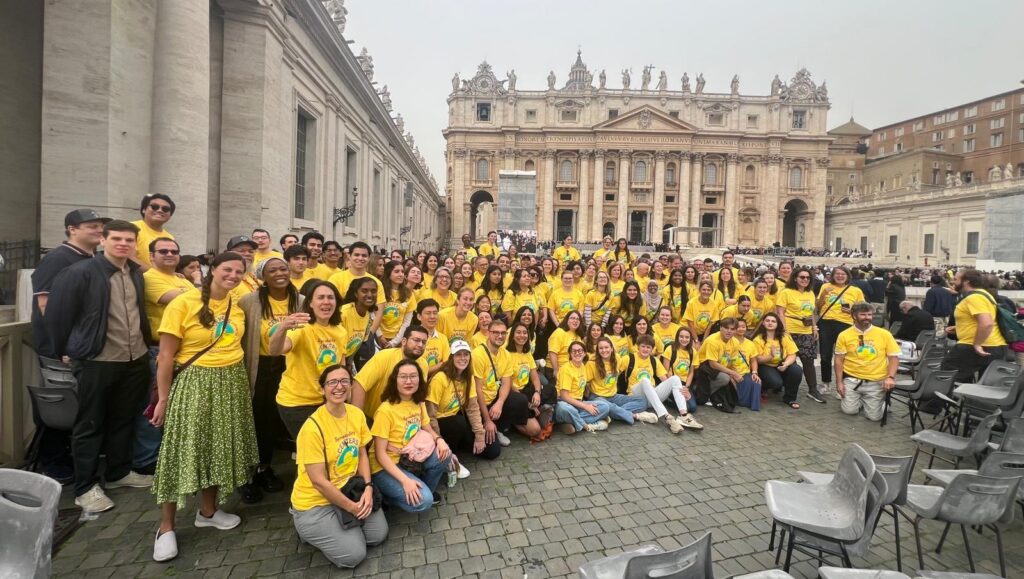
She and I were able, with the tireless coordinating help of a friend, to help gather and work with a team of faculty and staff from 15 universities, collectively succeeding in bringing more than 100 university students to Rome this month for part of the Second Session of the Synod’s General Assembly.
We organized about 40 meetings in plenary, small group and one-on-one formats for students to meet delegates, express their voices and concerns, listen with intention and attention and pray unceasingly for the Church in our day. Our youngest members were in their teens, and our oldest was a professor emeritus in his 80s. This inter-generational and international network coalesced into what we termed CENTERS, the Catholic Education Network to Engage Rome and Synodality. Made up predominantly of students from the United States – though with a relatively large contingent of international young adults studying at our campuses – we also partnered with a German-speaking delegation from Austria, Germany, Switzerland and South Tyrol, in modern Italy.
Of course, the students saw monumental works of art and enjoyed long pasta meals with guests and each other. But we largely framed this as a working trip, more than a tour of the Church’s past eras of glory and influence, or worse yet, a vacation. The weeks culminated with an exceptional invitation: to be the first student delegation to ever enter the halls of the Vatican to engage leaders of the synod from the very tables where discussions about the life of the Church in the 21st century are currently unfolding.
This dialogical exchange – led by Cardinal Grech of Malta, Cardinal Hollerich of Luxembourg, Sister Leticia Salazar of San Bernardino, Calif., and Bishop Flores of Brownsville, Texas – was livestreamed to millions of viewers around the world. Our students made us proud in collectively discerning what was of utmost importance to express, ask, petition and insist upon, while also having eyes to see things anew and ears to hear a message that matters for the whole human race.
One student involved wrote me after our time together and expressed that “this is the type of experience that marks a before and after demarcation line in my life, both in the Church and beyond it.” No educator or Christian believer could be more gratified with a comment.
One of the tangible symbols of our time together was a mosaic we created under the direction and vision of Becky McIntyre, a community artist from the Saint Raphaela Center in Haverford, Pa. Each of our prayers was included as a sort of living stone in the final work, which was displayed in the Synod Hall. Incidentally, as we crafted it, I came to learn quite a few of the participants had in fact gone to various Catholic high schools in South Jersey.
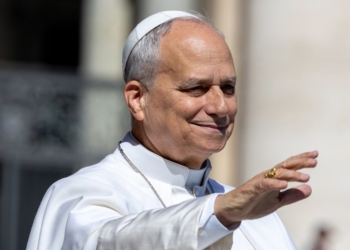
When the students encountered Pope Francis in the piazza of San Pietro, one of the team leaders led them in a chant of “Está es la juventud del Papá,” or “This is the pope’s youth.” He met the students’ exuberance with warmth and engagement. Of course, these undergraduate, graduate and early career leaders embody such a term, but so, too, does the entire community, the “ever ancient, ever young” face of the Church in each epoch or setting.
We do not live and move and have our being in a museum of propositional truths articulated in some distant, exotic, bygone setting. Rather, as every believer says with authenticity and creative fidelity in response to the Gospel in a moment in which no other previous Christians have ever lived – and which became a mantra for our cohort – “We are the now of the Church.”
Listen to the April podcast with Michael Canaris and Maureen O’Connell, author and professor of Christian Ethics in the Department of Religion and Theology at La Salle University in Philadelphia, on the Talking Catholic website.
An alumnus of Camden Catholic High School, Cherry Hill, Michael M. Canaris, Ph.D., teaches at Loyola University, Chicago.



 at the bottom and then tap “Add to Home Screen”
