





One among many iconic images of the current pontificate came in its opening months, when Pope Francis traveled to the island of Lampedusa – the “borderland” of Europe – as it’s among the first places migrants reach when moving northward across the Mediterranean to gain a foothold into the continent. There, he famously used the Cain and Abel story to frame his lament of a “globalization of indifference.”
Almost 12 years later, he has offered an updated and extended coda on this diagnosis of our era. His most recent encyclical, his fourth, is titled “Dilexit Nos.” This Latin phrase comes from the letter’s opening words, “He loved us,” a formulation taken, with slight grammatical reworking, from Saint Paul’s Epistle to the Romans (8:37). Its connection with the Lampedusa visit lies in its conviction that the world seems increasingly to have hardened, or some might even say to have lost, its heart.
A careful reader will note that the subtitle refers to the “human and divine love” that comes from the heart of Jesus. The order of the words matters for Pope Francis, as it roots Jesus’ relationship and solidarity with our race in his Incarnation and immersion in our shared condition. As with most of the pope’s writing, cognates of the word “mercy” dominate the text, appearing 35 times. This word in other languages – like Latin, Italian and Spanish – refers literally to the ability and willingness to share in the anguish of another’s heart (“misericordia” from miser/misery and cor/heart).
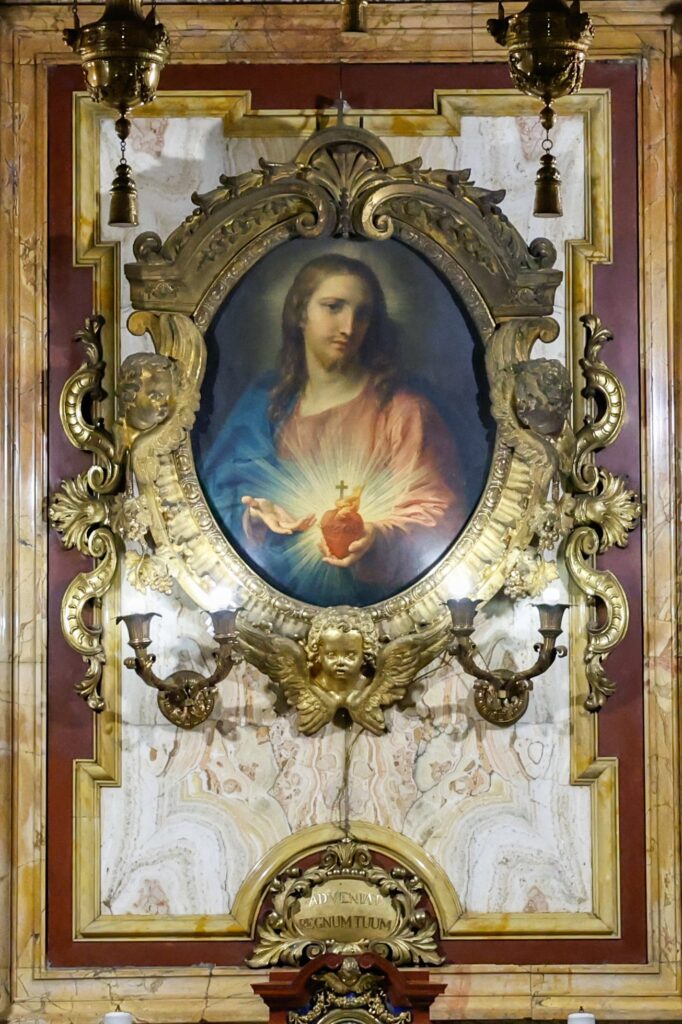
The occasion for the encyclical is the 350th anniversary of the apparitions experienced by the French nun and mystic Saint Margaret Mary Alacoque between 1673 and 1675, along with Saint Claude de la Colombière’s role in disseminating their contents. Jesus’ wounded heart with its flames of fervent love for human beings there established the most common modern depiction of the devotion, though it has older roots in monastic spirituality of the 11th and 12th centuries. It is unsurprising that the current holder of the Petrine Office chose this particular framing of the veneration of Christ’s Passion to serve as the launching point for deeper reflection, as it has long been practiced, promoted and propagated by his order, the Society of Jesus, as is pointed out in the text. (§143-147)
While it can seem overly sentimental to many in the age of romantic comedies and Valentine’s Day candies, the Sacred Heart has relevance to the modern scientific age and what Pope Francis calls “a broad current of the interior life,” as we know well that the heart is physically and socially a means of understanding the holistic person. I am currently working on a book on one of Pope Francis’ many mentors, Father Pedro Arrupe, whose collection of essays called “In Him Alone is Our Hope: Texts on the Heart of Christ” has been on my nightstand for a few months. Father Arrupe extols the devotion as an antidote to many of the ills of our day, which Pope Francis cites directly.
The pontiff says clearly, “As we meditate on Christ’s self-offering for the sake of all, we are naturally led to ask why we, too, should not be ready to give our lives for others.” (§172). Thus, Christ’s love for us comes at the risk of great personal cost, for as he puts it, “Would it please the heart that so loved us, if we were to bask in a private religious experience, while ignoring its implications for the society in which we live?” (§205).
The Sacred Heart never calls us to exalted and soaring spiritual ecstasy divorced from the messy reality of our brothers and sisters who are suffering in our midst, particularly “the poor, the despised and the abandoned.” (§213) Of course, the leader of a 1.4 billion member Church did not write these words specifically for an American audience on the eve of our election, when I type this column. But I pray that our hearts and those of our leaders may be set aflame by the sentiments they call to mind in these trying times, regardless of what the weeks and months ahead hold.
An alumnus of Camden Catholic High School, Cherry Hill, Michael M. Canaris, Ph.D., teaches at Loyola University, Chicago.






 at the bottom and then tap “Add to Home Screen”
