



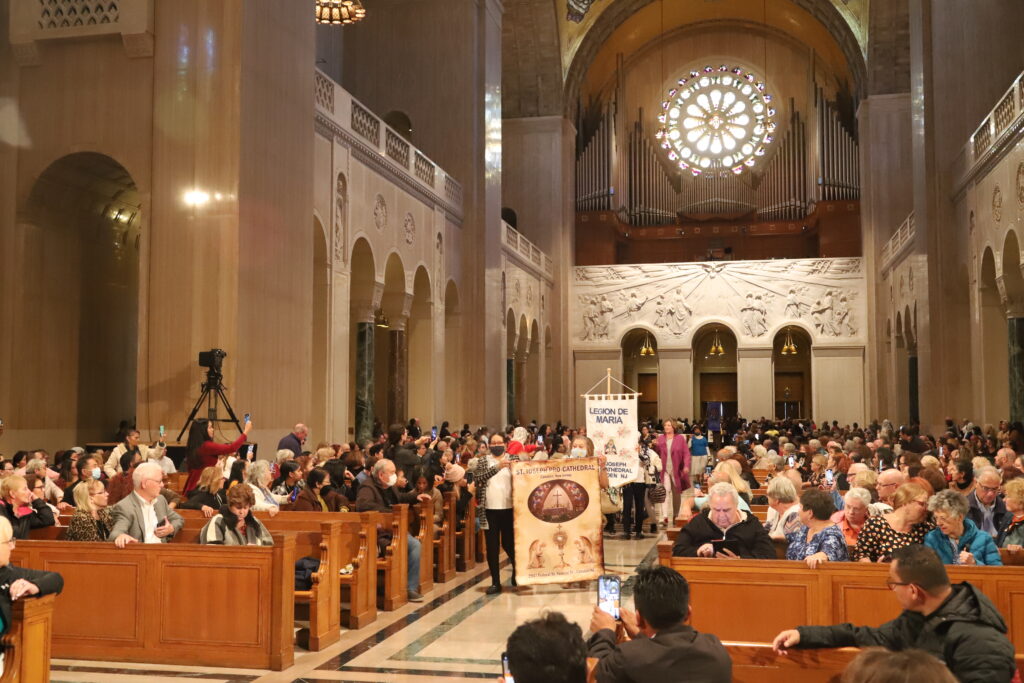
This week marks the 65th anniversary of the Basilica of the National Shrine of the Immaculate Conception, the title under which Mary is venerated as patroness of the United States. It was dedicated Nov. 20, 1959.
Of course, the Diocese of Camden has a special connection to this devotion as well, since Camden’s cathedral dedicated to the same Marian epithet predates the one in Washington, D.C., by a full century.
The National Shrine has a special role to play for every Catholic living across the 196 dioceses in the country. For this reason, Pope Benedict XVI conferred the Papal Golden Rose on it in 2008, a unique honor dating back to the first millennium of Christianity, and one that recognizes the basilica as among the most important in the world. The church itself is the largest in the country, and blends a number of architectural styles, most notably Byzantine and Romanesque. In some ways, this a testament to the historical “two lungs” of the church, East and West.
The church includes one of the world’s largest sculptures, a 37-ton relief titled “The Universal Call to Holiness.” The piece was a suggestion of Cardinal James Hickey, former archbishop of Washington, alluding to the claim in “Lumen Gentium”: “All the faithful of Christ of whatever rank or status are called to the fullness of the Christian life and to be the perfection of charity; by this holiness as such a more human manner of living is promoted in this earthly society. In order that the faithful may reach this perfection, they must use their strength accordingly as they have received it, as a gift from Christ.” (LG 40) Thus, the piece invites us to aspire to emulate the other-centered lives of mystics and saints, no matter what role we play in the church: ordained priest, religious sister or brother, lay believer, infrequent visitor or curious outsider.
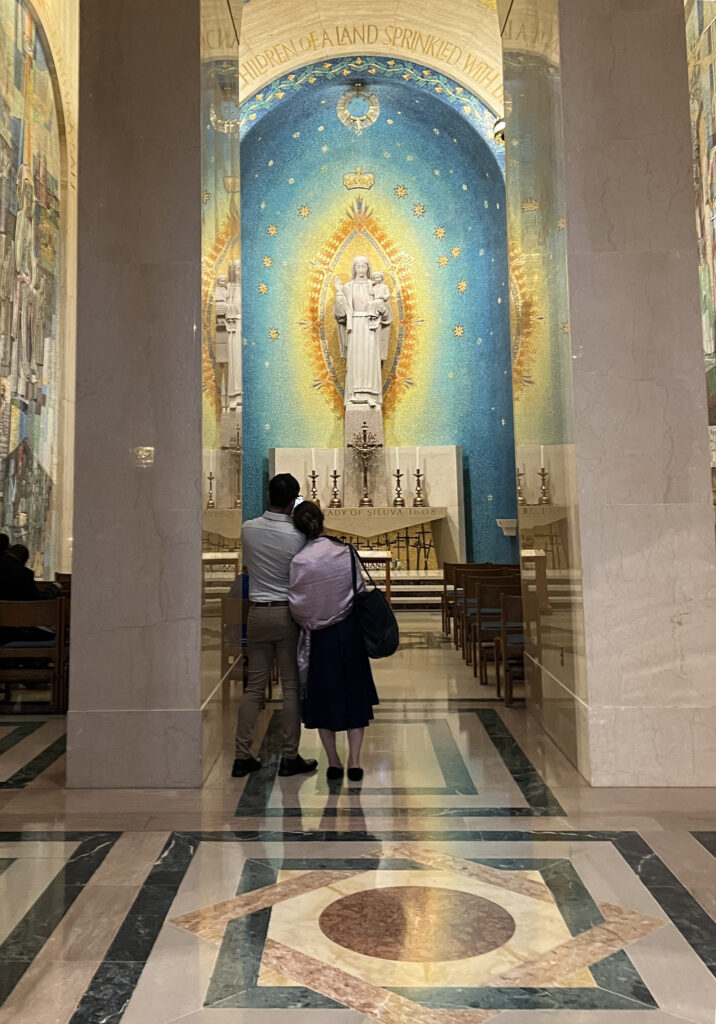
When Pope Saint John Paul II visited on Oct. 7, 1979, he famously said, “The shrine speaks to us with the voice of all America, with the voice of all the sons and daughters of America, who have come here from various countries. … These people, speaking different languages, coming from different backgrounds of history and traditions in their own countries, came together around the heart of a Mother they all had in common.” Of course, this reminds us of the inherent connection between both our national history and our wider ecclesial one, since both are composed almost entirely of migrants.
Natalie Pucillo, a liturgical musician and colleague at the adjacent Catholic University of America’s School of Law, told me this week: “There’s a unique sense of multitude present at the shrine, both in the diverse depictions of Mary in the sacred artwork throughout the 80-plus chapels, and through the shrine’s ample sacramental offerings, including four Masses and five hours of confession a day. It’s truly a fitting space to hold the nickname ‘America’s Catholic Church’! It gives me the feeling that the Church has welcomed me and created space for me, no matter where my spiritual journey takes me.”
The website describes the church as the nation’s “preeminent Marian shrine and patronal church.” Because of that, it is the only place a canonization has ever taken place on United States soil. Obviously, there are a multitude of saints either born in or missioned to the country. But in 2015, when Pope Francis raised Junípero Serra, an 18th century Mallorcan Spanish friar, to the altars for his work in the missions on the West Coast, it was the first time this celebration took place here and not in Rome. (Incidentally, he’s also the reason the San Diego baseball team is called the Padres).
If you have never visited the shrine, I cannot overstate my recommendation that you make the 2.5 hour trip to do so. It is particularly lovely in the Christmas season, with an astonishing array of evergreens and poinsettias adorning the complex. There are six days per year when one can visit and receive for themselves or another departed Christian a plenary indulgence, which is the remission of all temporal punishment in purgatory for previously forgiven sins. The next two are Dec. 8 and June 29.
An alumnus of Camden Catholic High School, Cherry Hill, Michael M. Canaris, Ph.D., teaches at Loyola University, Chicago.



 at the bottom and then tap “Add to Home Screen”
