



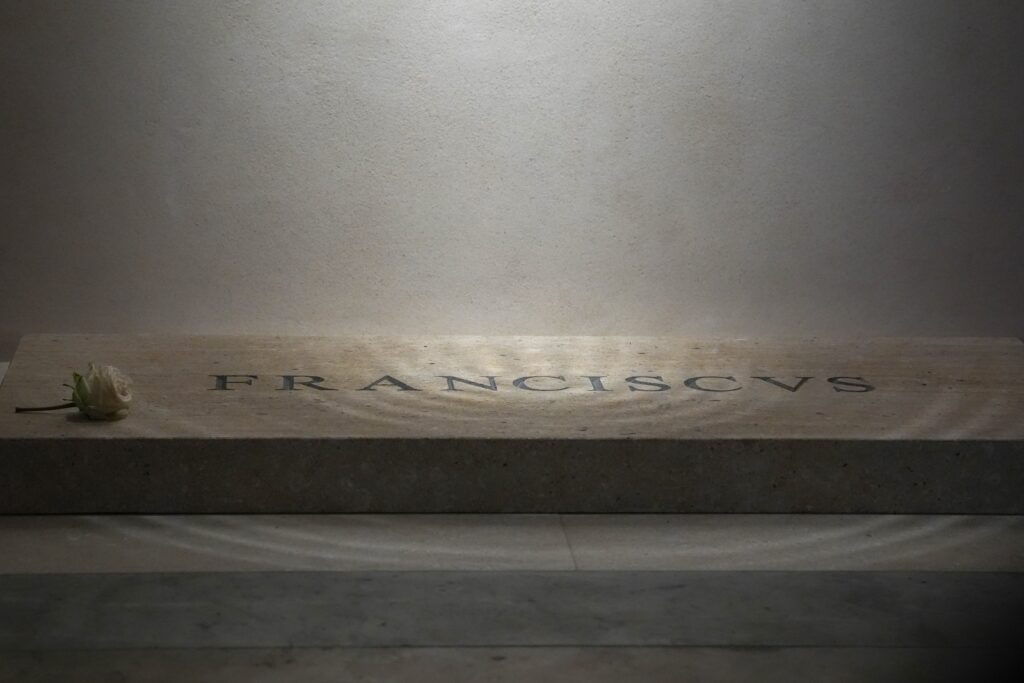
In a week full of striking images and personal tears, it was the one word etched in the Ligurian marble quarried not far from his grandparents’ hometown that resonated most with me – Franciscus.
Ten simple letters to encapsulate an incredibly complex lifetime, and perhaps a whole generation in Church history. Pope Francis was fond of saying that we live not in an era of changes, but in a change of eras. It is, to my mind, impossible to claim that his pontificate didn’t straddle these enormously significant shifting tectonic plates. And from that position, he spoke to us all: in word, gesture and infirmity.
I cannot write dispassionately and impartially about this particular pontificate, married to someone who divided her life between Argentina and Europe, studying or teaching on Jesuit campuses for almost three decades, living in Rome during the early days of his time in office, and coming to love the city largely through the eyes of people in his close orbit as it progressed. I was blessed to be in his presence many times, and to meet him a few. I claim no neutrality. I loved this man in a way that, yes, all Catholics love the Holy Father, but also as one stamped by the rising and falling tides unique to my own soul and life’s journey. But I also know that this is not meant to be a sanitized history. The man who claimed in his first interview to be essentially and primarily a sinner had many blind spots and shortcomings. The Church he was born into was not a perfect place, and it certainly isn’t one now that he’s hopefully interceding for it from realms of higher light. But the mark he left on it was indelible.
How can one imagine a Church engaged in the wise stewardship of creation without “Laudato Si”? How can one fathom a world without a moral leader on the global stage whose heart is pierced by the thorn of migration concerns? How can one forget the call for leaders and ministers both to become “bruised, hurting and dirty” and manifest the “smell of the sheep” around us? How can one carry on without the interrogative and interruptive question if we are cultivating a “globalization of indifference” echoing in his or her conscience? How can we not be moved to continue to journey together on the path of synodality he courageously (and faithfully) proposed? Perhaps you are able to do so, and if that is the case, “Who am I to judge?” But I simply cannot and will not.
It was entirely appropriate then that the first Sunday in 88 years without Jorge Mario Bergoglio in our midst marked not the purity of some speculative doctrine or the sanctity of some revered figure, but the unceasing outpouring of Divine Mercy. If there were one non-negotiable, characteristic quality of the triune God for the man who chose to follow in the footsteps of Ignatius of Loyola and Francis of Assisi in so many ways, it was this. “The face of God is mercy,” as he put it frequently. After the pomp and opulence – even in simplified form – of a papal funeral with 50 heads of state and 200,000 worshippers in attendance, the following Sunday marked in many ways what those first days after another gathering behind lock and key (“con clavus”) represented: the ongoing business of going out into the world to proclaim the Good News to the disfavored, liberty to the incarcerated, new vistas for the visionless, rescue for the tyrannized, peace to the belligerent, and that the Spirit of God is upon us all.
While we can perhaps say that we know a great number of things about our spouse or parents or children or even ourselves, at some level, the profound sense of authentic mystery prevents us from claiming we really comprehend any to their fullest. As my wife says often in Spanish, “Every person is a world.” How much more true is this of the man thousands of miles away who wished to be called first and foremost the Servant of the Servants of God. And yet, the words posted on X by his good friend Dr. Emilce Cuda – one of a cadre of the highest-ranking women in the history of the Vatican serving and enacting his ecclesial agenda – continue to provide me both solace in suffering and inspiration in my life of missionary discipleship in these days: “Hasta pronto, Francisco, te quiero mucho.” “Until I see you soon, Francis, I love you very much.”
An alumnus of Camden Catholic High School, Cherry Hill, Michael M. Canaris, Ph.D., teaches at Loyola University, Chicago.




 at the bottom and then tap “Add to Home Screen”
