




By Mary Stadnyk
Special Contributor
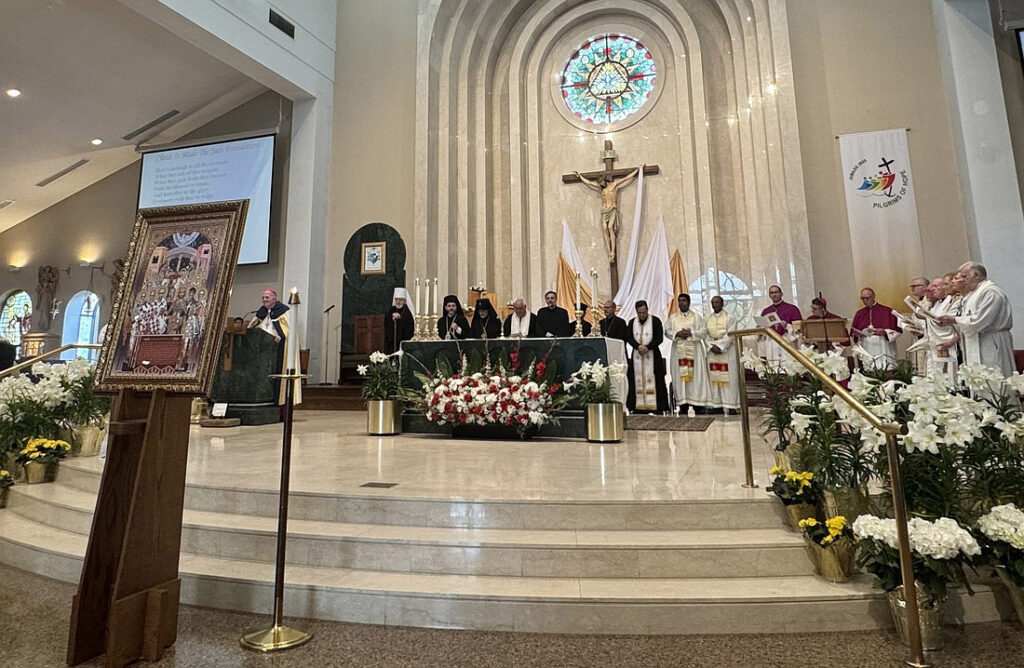
The Nicene Creed, a profession of faith among major Christian denominations, is an example of unity among churches, said those who participated in a statewide ecumenical prayer service May 3 marking the 1,700th anniversary of the Council of Nicaea.
“This milestone invites us to not only look back at history but also to consider its relevance today, as communities continue to seek harmony and understanding in a diverse and interconnected world,” said Bishop David M. O’Connell, CM, of the Diocese of Trenton. “The Council of Nicaea stands as a testament to the pursuit of unity, even in the face of profound differences – a timeless lesson for believers and nonbelievers alike.”
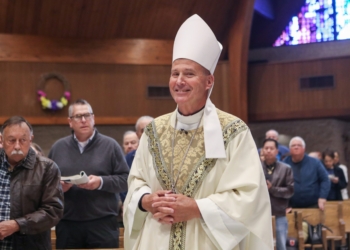
Catholic priests joined religious leaders and laity from Roman and Eastern Catholic traditions, Orthodox, Anglican, Lutheran, Presbyterian, Reform and Methodist churches for the prayer service held at Saint Robert Bellarmine Co-Cathedral, Freehold. The theme of the service was “We Believe In One God,” reflecting Christian unity and the beginning of the Nicene Creed.
Among those in attendance from the Diocese of Camden was Father Joseph Wallace, diocesan director of Ecumenical and Inter-religious Affairs, and seminarians Nicholas Esposito and Benjamin Suarez, who served at the prayer service.
“In this present age of disunity and separation within the historic Christian community, it was refreshing and transformative to join with other Christians to celebrate that link, the Nicene Creed, that sets a foundation for belief in the one true God, Father, Son and Holy Spirit,” Father Wallace said. “The Nicene Creed forged 1,700 years ago still stands as the symbol of agreed doctrine, and given our diversity as Christian denominations, we can say together that which essentially unites us, ‘We believe.’”
Readings were proclaimed from Saint Paul’s Letter to the Corinthians and Saint John’s Gospel. The service included homilies by Auxiliary Bishop James Massa of Brooklyn and Metropolitan Antony of the Ukrainian Orthodox Church of the USA. Verse by verse, Greek Orthodox Metropolitan Apostolos of New Jersey led the Nicene Creed in its original Greek; then the congregation followed, reciting the same words, each in his or her own language of prayer.
Bishop Massa, former executive director of the U.S. Conference of Catholic Bishops’ Secretariat for Ecumenical and Interreligious Dialogue and a former consultor to the Pontifical Council for Interreligious Dialogue, urged those gathered to “listen to what the Spirit is saying to the churches of our times. Hear the summons to continue the noble work filling the Body of Christ and bringing its members to unity, a unity that is not uniformity, but witnessing to peace and justice in our fractured world and the caring of God’s creation. Let us listen humbly and eagerly and be ready always to be surprised, for the Spirit flows where He wills.”
“Only the Spirit can heal our wounds,” said Bishop Massa, who is also rector of Saint Joseph’s Seminary in Yonkers, N.Y. “Only the Spirit can protect us from evil. Only the Spirit can arouse our hope in Jesus, our first love.”
In his homily, Metropolitan Antony urged all to regard the Creed not as an ancient formula but as a call to sacrificial love, unity in truth and courageous witness to the modern world.
“On this day, the 1,700th anniversary, we do not simply recall a historical gathering, we have reawakened a profound vision of unity, truth and love that animated the fathers of that sacred council. The Nicene Creed, born of that council and completed 56 years later, is not merely a liturgical recitation,” he said, referring to the Eastern bishops’ Council of Constantinople in 381. “It is a theological proclamation, a baptismal confession and a moral compass. It not only affirms what we believe but how we are to live. The Creed is not a statement carved in a particular period of time but a living memory and testimony inscribed in the hearts of all believers. It shapes our identity as Christians, of who we are.”
Mary Stadnyk is the associate editor of the Monitor Magazine, the Catholic publication for the Diocese of Trenton.





 at the bottom and then tap “Add to Home Screen”
