



By Ines San Martin, OSV News
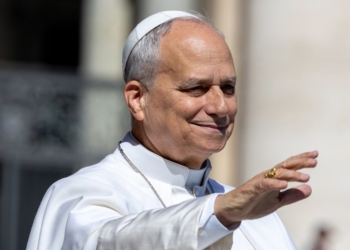
ROME (OSV News) — As the Catholic Church welcomed its 267th pope, Leo XIV — elected May 8 — attention quickly turned to the first moments of his pontificate. The first weeks of a papacy often give a hint as to how the entire pontificate will look.
This is what the seven days of papacy tell about the first American pope and how his predecessors spent their honeymoon in the Vatican.
Pope Leo XIV: the peacemaker
Stepping onto the balcony of St. Peter’s Basilica in an outfit reminiscent of Popes Benedict XVI and St. John Paul II, he greeted the world with words inspired by Pope Francis: “Peace be with you all!”
With that simple phrase, the former Cardinal Robert Francis Prevost set the tone for what many expect to be a papacy marked by humility, global outreach and continuity with his predecessors. That it also will be a papacy marked by supporting those suffering through wars was proved by the applause given to Major Archbishop Sviatoslav Shevchuk of Kyiv-Haluych in war-torn Ukraine when he greeted Pope Leo during the May 14 audience in the Paul VI Hall, — with thousands of Eastern Catholics participating in their Jubilee pilgrimage to Rome.
“The peoples of our world desire peace, and to their leaders I appeal with all my heart: Let us meet, let us talk, let us negotiate!” the pope said.
Perhaps signaling that this weekly tennis player who during the 12 years he led the Augustinian order spent an average of half of the year on the road, less than 48 hours after being elected, Pope Leo XIV got in the front seat of a minivan and traveled 40 miles southeast from the Vatican to pray at a Marian shrine cared for by his Augustinian confreres.
And on his way back to the Vatican May 10, he went to Rome’s Basilica of St. Mary Major, stopping to pray at the tomb of Pope Francis and before the icon of Mary “Salus Populi Romani” (health of the Roman people). On May 11 — Good Shepherd Sunday — he led, singing, the “Regina Coeli” to fervent applause from 150,000 people gathered.
Meeting journalists working in Rome permanently and those who came for conclave coverage, he said: “Thank you, dear friends, for your service to the truth.” He also told the author of this article, who asked him to play a charitable tennis match for Pontifical Mission Societies, that “we can’t invite Sinner,” making an intended Catholic pun on Italy’s No. 1 player — Jannik Sinner.
The people of God didn’t have to wait long for Sinner to actually come visit the pope. The day after advancing to the semi-finals of the top-notch tournament the Italian Open, Sinner paid a visit to a fan — the pope — May 14.
The pope with a sense of humor can certainly be one expected to commit to serious governance days before he inaugurates his papacy May 18 — a Sunday and the feast of St. John I, pope and martyr, and what would have been St. John Paul II’s 105th birthday.
For those wondering what his style of authority will be, Pope Leo gave a hint during his first Mass. He said that: “commitment for all those in the Church who exercise a ministry of authority” is to “move aside so that Christ may remain, to make oneself small so that he may be known and glorified.”
In an interview with OSV News, Father Thomas Joseph White, rector of the Pontifical University of St. Thomas Aquinas, said that in the pope’s doctoral dissertation the spirit of service in authority is “extremely visible.” The 30-year-old Father Prevost writes, quoting his master St. Augustine: “We are put in charge and we are servants; we possess authority, but only if we serve.”
In light of Pope Leo XIV’s early steps and efforts to read the pontificate through that prism, it’s worth revisiting the first week of the last three pontiffs — St. John Paul II, Benedict XVI and Pope Francis — whose inaugural actions shaped their papacies and left a lasting mark on the Catholic Church.
St. John Paul II: A call to open the doors to Christ
Cardinal Karol Wojtyla’s papacy began on Oct. 16, 1978, following the death of Pope John Paul I. His first appearance on the balcony of St. Peter’s Basilica was simple and direct, with a humble request to the faithful: “If I make a mistake, you will correct me!” Despite his stature, this openness would define his papacy.
John Paul’s most memorable moment in his first week came on Oct. 22, 1978, when he celebrated his first Mass as pope in St. Peter’s Square, surrounded by world leaders. He issued a call that would shape his papacy: “Open wide the doors for Christ.”
Father Antonio Pelayo — called “grande vaticanista” — is a Spanish Vatican journalist who flew on all papal trips with all contemporary popes, starting with John Paul. He recalled that an iconic call of the pope from Poland was not just a plea to Catholics and leaders but to all of society, inviting everyone to embrace Christ’s message.
While John Paul did not bring down the Berlin Wall himself, Father Pelayo believes “his call for openness is considered by many to have been a catalyst for the events that led to the collapse of Soviet power.”
Father Pelayo is a correspondent for Antena 3 and the magazine Vida Nueva, while also serving as a religious adviser to the Embassy of Spain to the Holy See.
In his inaugural address John Paul said: “Our time calls us, urges us, obliges us to gaze on the Lord and immerse ourselves in humble and devout meditation on the mystery of the supreme power of Christ himself.” Those words in his early days would prove the Christ-centric nature of his papacy, proved only five months after his election with his first encyclical, “Redemptor Hominis” (“The Redeemer of Man.”)
Benedict XVI: A theologian who came to proclaim the Gospel
Cardinal Joseph Ratzinger’s election on April 19, 2005, was quick — only four ballots, with Benedict XVI becoming the 265th pope. He took the name in honor of St. Benedict, and immediately sought to continue John Paul’s legacy — under whom he worked for decades as the chief of the Vatican’s doctrinal office, with a distinct theological clarity.
His first appearance was marked by an improvised outfit: an altar server’s alb on top of a black sweater, because none of the three white cassocks prepared for the occasion fit properly.
He greeted the faithful humbly: “Dear Brothers and Sisters, After the great Pope John Paul II, the Cardinals have elected me, a simple and humble laborer in the vineyard of the Lord. The fact that the Lord knows how to work and to act even with inadequate instruments comforts me, and above all I entrust myself to your prayers.”
In his first Mass on April 24, 2005, Benedict famously said: “My real program of governance is not to do my own will, not to pursue my own ideas, but to listen, together with the whole Church, to the word and the will of the Lord, to be guided by Him, so that He himself will lead the Church at this hour of our history.”
During his addresses to the diplomatic corps, journalists and the faithful gathered in St. Peter’s Square, his first week was marked by his steady hand in defending the truths of the faith, and it became evident that his papacy would be intellectual, doctrinal and focused on preserving Catholic teaching in a secular world.
Father Pelayo recalled that even though Benedict was in shock from the election, his message was firm: He was there to proclaim the universal truth of the Gospel.
Pope Francis: A break from tradition and a pope for the marginalized
Pope Francis’ first week, following his election on March 13, 2013, was defined by simplicity and humility. His first words, spoken from the balcony of St. Peter’s Basilica, were a simple “Good evening” — a moment of naturalness that immediately set a tone of closeness and accessibility.
Msgr. Guillermo Karcher, who was on the balcony with him, recalls how Pope Francis sought to break away from traditional papal grandeur, signaling a new direction for the church.
Father Pelayo, for his part, reflected on how this greeting, followed by Pope Francis’ rejection of traditional papal attire like the red mozzetta, marked a shift away from the Vatican’s traditions.
Pope Francis early in his papacy rebuked clericalism. In an October 2013 interview, he called the Curia “the leprosy of the Church,” and that he wanted a papacy defined by service, not monarchy. In the process came an admission that in the past, heads of the church “have often been narcissists, flattered and thrilled by their courtiers.”
Following the promulgation of “Praedicate Evanglium” in 2022, he named three women, including a laywoman, to the Dicastery of Bishops, the Vatican office that helps the pope choose bishops. Before the reform, only cardinals and a few bishops were members of the body.
In his first Mass — the one celebrated with the cardinals in the Sistine Chapel the day after his March 12, 2013, election, Francis spoke of the importance of journeying together, building the church and living the mission of Christ. His message focused on serving, not imposing, and was a guiding vision for his papacy, marked by closeness to the poor and synodality understood as walking together.
Msgr. Karcher shared an intimate moment from the first few days of the Francis papacy. “I remember going into his room at Casa Santa Marta. He was reading over his speech for the ‘urbi et orbi’ blessing, and kept saying, ‘Ciao’ — the Italian for ‘hello.’ At that moment, I realized that he had already made his choice — he would speak in Italian, and Spanish, the language of his heart, rather than using multiple languages as his predecessors had done.”
According to the Argentine prelate, it was a symbol of his pastoral approach: “I am the Bishop of Rome, and I will speak in the language of the people.”
Ines San Martin writes for OSV News from Rome. She is the vice president of communications for the Pontifical Mission Societies USA.



 at the bottom and then tap “Add to Home Screen”
