




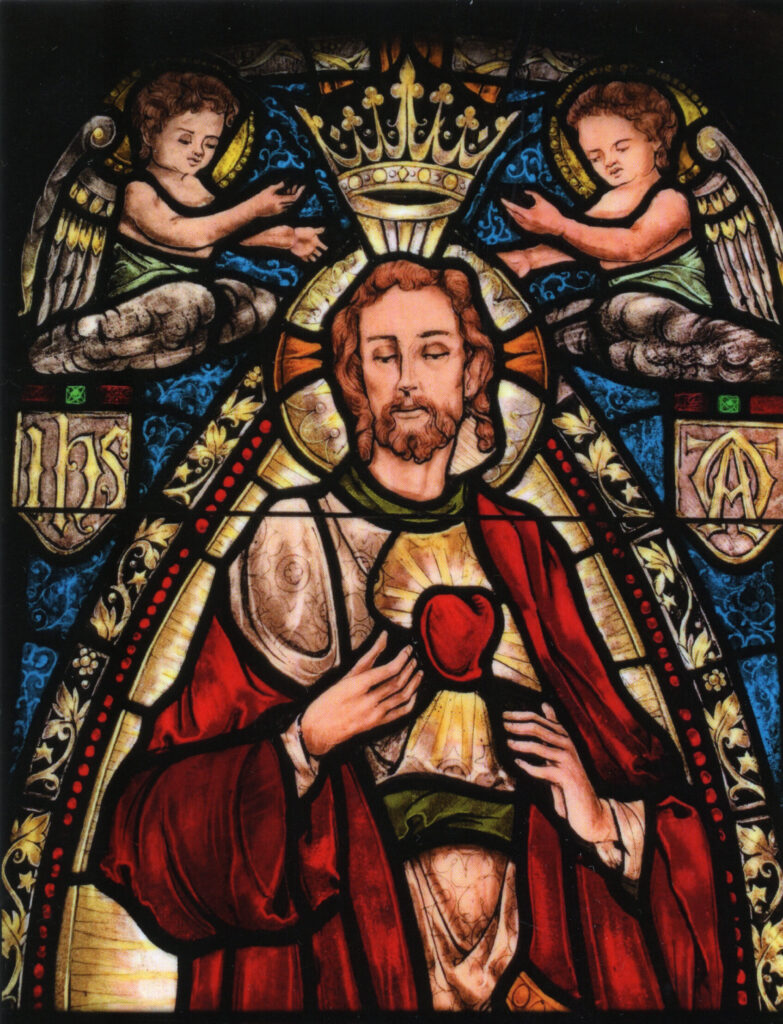
We now know that the last encyclical of Pope Francis’ life is “Dilexit Nos,” his extended reflection on the human and divine love of the Savior. It was clear that he felt the need to draft this letter to the entire planet because of what he deemed the frenetic pace of a “liquid” and exaggerated “rational-technological” world context that had, to his mind, become in many ways “heartless.”
As we transition into a new pontificate – one that seems in the early stages to be emphasizing peace, justice and unity, and their connection with authentic love – we ought not lose sight of the “revolution of tenderness and mercy” that lay at the heart of the recently departed pontiff’s vision, particularly during this coming month.
June has long been associated with devotions to the Sacred Heart of Jesus. Stemming from mystical visions of the French nun, Saint Margaret Mary Alacoque, and long promulgated in particular by the Society of Jesus, the Sacred Heart devotions connect us with that innermost core of the person of Jesus Christ, who is inflamed with charity, affection and forgiveness for the whole human race.
One of the best parts of being in Rome in June, as I am this week with graduate students, is exploring the many aspects of this devotion lived out in the popular piety of the local community here. From processions to alcove paintings in winding alleys to the famed image by Pompeo Batoni in the Church of the Gesù, and a colorful statue there that comes out only at this time of year, it seems the Sacred Heart is everywhere in the city in these weeks. One of my good friends here is a priest of the Congregation of the Sacred Heart from India, who works in one of the Vatican dicasteries. His warmth and commitment to understanding the mission of the Church as read through the lens of this particular image has long inspired me to share its power and impact with others.
Using the heart as a powerful representation of the embodied core of human existence has biblical, and even pre-Christian roots. Pope Francis makes this exceedingly clear in what is in many ways a last will and testament for his vision of God’s role in the life of the people he has called forth and sent out into the world.
“[W]e must never forget that the image of the heart speaks to us of the flesh and of earthly realities. In this way, it points us to the God who wished to become one of us, a part of our history, and a companion on our earthly journey. A more abstract or stylized form of devotion would not necessarily be more faithful to the Gospel, for in this eloquent and tangible sign we see how God willed to reveal himself and to draw close to us.” (DN, §58)
In discussing its connection to reparation, Pope Francis makes his case that sins, “especially” but not only those made at the direct expense of the neighbor, are inherently and intrinsically social realities, harming both the Church and society. (DN, §183)
“Reparation, to be Christian, to touch the heart of the offended person and not to be a simple act of commutative justice, presupposes two demanding attitudes: recognizing oneself as guilty and asking for forgiveness.”
Reparation, in particular, is then an act of the heart, of the ongoing process of metanoia, and of rebuilding inter-personal and social relationships in a commitment to “solidarity born of compunction.” (DN, §190)
This is, perhaps above all else, the ongoing lesson of the month’s dedication left to us from a recently departed father.
An alumnus of Camden Catholic High School, Cherry Hill, Michael M. Canaris, Ph.D., teaches at Loyola University, Chicago.




 at the bottom and then tap “Add to Home Screen”
