




By George P. Jr. Matysek / Catholic Review, OSV News
(OSV News) — One hundred years ago this July, the small town of Dayton, Tennessee, was thrust into the national spotlight in what was pitched as a historic showdown between faith and science.
The so-called “Scopes Monkey Trial” centered on John T. Scopes, a 24-year-old high school science teacher accused of violating a new state law that banned the teaching of evolution in public schools. The Butler Act prohibited instruction that contradicted the biblical account of creation, including the idea that humans descended from lower animals.
The young educator’s trial was no accident. Scopes had been recruited by the American Civil Liberties Union to serve in a test case meant to challenge the law and ignite a national conversation.
Dubbed the “Trial of the Century,” the courtroom drama was the first to be broadcast nationwide over radio. It offered Americans a window into a dramatic clash between two towering figures with opposing world views: William Jennings Bryan — a three-time presidential candidate and vocal Christian fundamentalist, who argued for the prosecution — and Clarence Darrow, an agnostic and well-known civil libertarian, who led the defense.
Newspapers, including the Catholic Review, the newspaper of the Baltimore Archdiocese, carried front-page stories about the case, with the Baltimore Sun’s acerbic H.L. Mencken giving the trial its famous “monkey” moniker.
Although Scopes was ultimately convicted and fined $100, it was Darrow’s aggressive questioning of Bryan — particularly over his literal interpretation of Scripture — that may have been a public turning point in the evolution debate.
Yet for Catholic scholars and theologians, the real meaning of the Scopes trial — decided on July 21, 1925 — is far more nuanced.
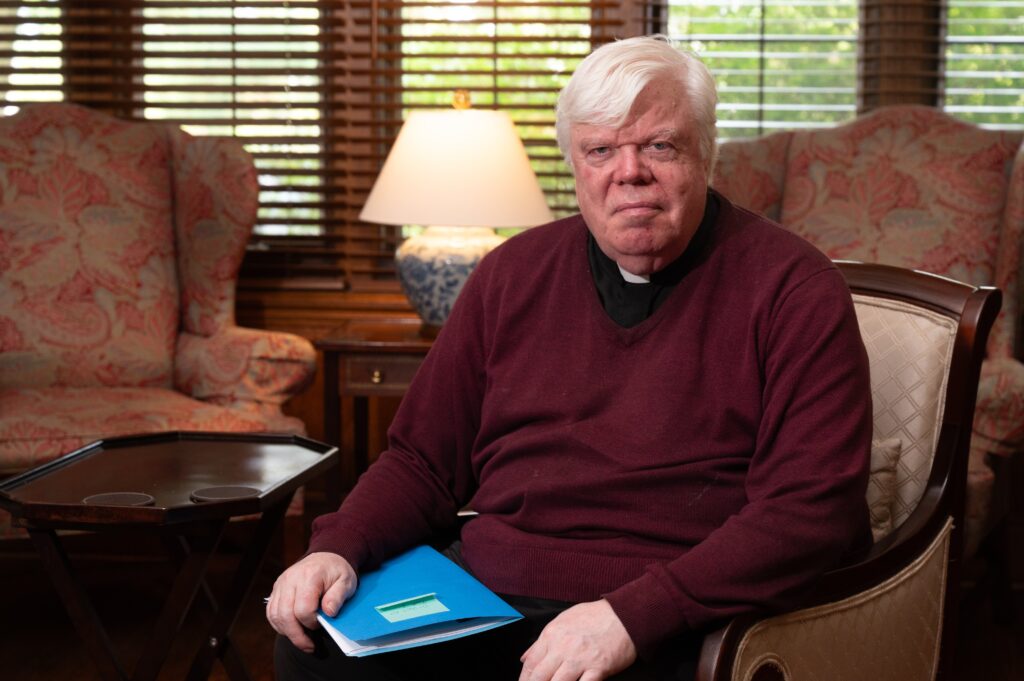
Jesuit Father John J. Conley, Bernard P. Knott Chair of Philosophy and Theology at Loyola University Maryland in Baltimore, told Catholic Review it’s important to understand that beyond repudiating Charles Darwin’s biological theories, Bryan and opponents of evolution were also extremely concerned about the implications of those theories.
Social Darwinism — a belief in the survival of the fittest — contributed to the eugenics movement popular in the 1920s. That movement promoted forced sterilization, separation of the races and restrictions on immigration from certain parts of the world, Father Conley noted.
Even the biology textbook used by Scopes in his classroom had spoken plainly of the value of eugenics.
“That textbook by George William Hunter taught a kind of social Darwinism that said we need to eliminate those who are unfit and we need to privilege the white race,” Father Conley said. “He himself was very much against any integration of the public schools.”
Charles Strauss, associate professor of history at Mount St. Mary’s University in Emmitsburg, Maryland, said Catholic intellectuals of the time — writing in publications such as Commonweal and the Jesuit-run America — were already engaging with evolutionary theory in a more open-minded way. That willingness to dialogue with modern science had roots in the thought of Pope Leo XIII.
“Catholics were trying to negotiate between how to be critical of eugenics and a materialist understanding of the human person and yet also be comfortable with modernist scientific explanations for certain aspects of life, including evolution,” Strauss said.
He added that many Catholics were alarmed by what they saw as the “Protestantization of the American public school related to the teaching of the Protestant Bible.”
John F. Haught, professor emeritus of theology at Georgetown University in Washington and author of several books on faith and evolution, said Pope Leo XIII helped Catholics avoid the kind of turmoil some Protestants experienced over issues such as evolution by clarifying how to read Scripture in his 1893 encyclical “Providentissimus Deus,” published 34 years after Darwin’s famous book “On the Origin of Species.”
“In just a couple sentences, Pope Leo said that when you read Scripture, do not look for scientific information there,” said Haught, noting it was the renowned biblical scholar Sulpician Father Raymond Brown who brought that understanding to his attention while Haught was a seminarian at St. Mary’s Seminary in Baltimore.
“The Bible gives us religious truth,” Haught said. “It answers questions like, ‘Why does anything exist at all?’ and ‘Why does love exist?’ It gives answers that are non-scientific in both cases.”
Strauss added that Pope Leo XIII did not endorse evolution, but he didn’t condemn it either.
Later popes would go further, with Pope St. John Paul II saying in a 1996 speech that “new knowledge has led to the recognition of the theory of evolution as more than a hypothesis” and Pope Francis saying in 2014 that “evolution in nature does not conflict with the notion of creation because evolution presupposes the creation of beings that evolve.”
But the legacy of the Scopes trial is confusion, according to Haught.
“We can’t get anywhere in the discussion between science and religion unless we distinguish carefully what each of them is up to,” he told Catholic Review. “It’s the conflation of science and religion, or science and theology, that causes the problems.”
The Scopes trial had a “tremendous impact” on the United States in the decades that followed, according to Father Conley.
“The United States is the only major nation in which there still seems to be a great political controversy (over the teaching of evolution),” Father Conley told Catholic Review. “In Europe, even in predominantly Catholic nations, even very Catholic nations like Poland, this does not seem to be a controversy at all. Biology teachers do their thing and religion teachers do their thing and the twain just don’t meet.”
Science and religion involve two sets of truth and different methodologies, he said. Religious truth is guided by revelation of faith and empirical scientific truth develops from certain methods proper to biology, genetics and paleontology.
“One doesn’t contradict the other,” he said. “They’re really quite different from each other. And that difference needs to be respected. It shows the range of human reason and the possible range of human knowledge.”
Father Conley called it “striking” that what seemed to be in the 1920s a “very marginal, rural, small-town type of fundamentalism” became a “very major force” in the U.S. in the latter part of the 20th century and beyond.
“Fundamentalist churches, which strongly object to the theory of evolution and the teaching of it in public schools, became a much more powerful political force than they had been in the ’20s when many thought organized religion was on the decline,” he said.
Scopes, who would convert to Catholicism when he married in 1930, saw his conviction overturned on a technicality by the Tennessee Supreme Court. The law against the teaching of evolution, however, remained on the books until 1967. That same year, Scopes told reporters he believed that “no group of people should ever be permitted to use the power of the state to force their beliefs on anybody else.”
During the trial, which took place over eight scorching hot summer days, Bryan warned that overturning the Butler Act would be an attack on Christianity. In a summation published in newspapers but not delivered at the trial, Bryan insisted that if the law was nullified, “there will be rejoicing wherever God is repudiated, the savior scoffed at and the Bible ridiculed.”
Yet, while many Americans agreed with him, the grand orator’s defense of traditional teachings on creation didn’t seem convincing to others — particularly as he seemed to falter when Darrow aggressively went after his literal interpretation of the Bible.
Just five days after winning the trial, Bryan died while still in Dayton.
In a blistering piece published in the Baltimore Evening Sun, Mencken said that although the former secretary of state had come into contact with the “first men of his time,” he “preferred the company of rustic ignoramuses.”
“He seemed only a poor clod like those around him, deluded by a childish theology full of an almost pathological hatred of all learning, all human dignity, all beauty, all fine and noble things,” Mencken barked. “He was a peasant come home to the dung-pile.”
An editor’s commentary in the Catholic Review was more kind, asserting upon Bryan’s death that the crusader was “undoubtedly honest,” but “often he was fanatical, puritanical, egotistical and unwise.”
His fight against evolution, the commentary said, “was an example of honest intention gone wrong.”
“He wished to aid religion,” the Catholic Review column asserted, “but he hurt it instead.”
George P. Matysek Jr. is the managing editor for Catholic Review, the newspaper of the Baltimore Archdiocese. This article was published in Catholic Review and distributed in partnership with OSV News.




 at the bottom and then tap “Add to Home Screen”
