







Editor’s Note: The feast of the Transfiguration is Aug. 6.
Oscar Wilde, the Anglo-Irish author and deathbed convert to Catholicism, wrote “The Picture of Dorian Gray.” It is the story of a young, wealthy gentleman who is exclusively engrossed in himself and worldly pleasures. He commissioned a portrait of himself and wished that the portrait, but not he, would change with the passing of time. Lo and behold, his wish came true.
At first, the changes were slight and subtle: the hint of a wrinkle, a slight receding of the hairline. Later, the changes became much more pronounced, and he could not stand to look at the portrait anymore. So he hid it away in a closet. Of course, those changes in the portrait were consistent with his life of unhealthy excess and debauchery.
After many years of maintaining his healthy, youthful appearance, he wondered how the portrait had changed. He took it out of closet and was so shocked to see how grotesque he appeared that he slashed it to pieces. By that act, he himself was immediately transfigured into the portrait’s likeness, and then, straightaway, he died.
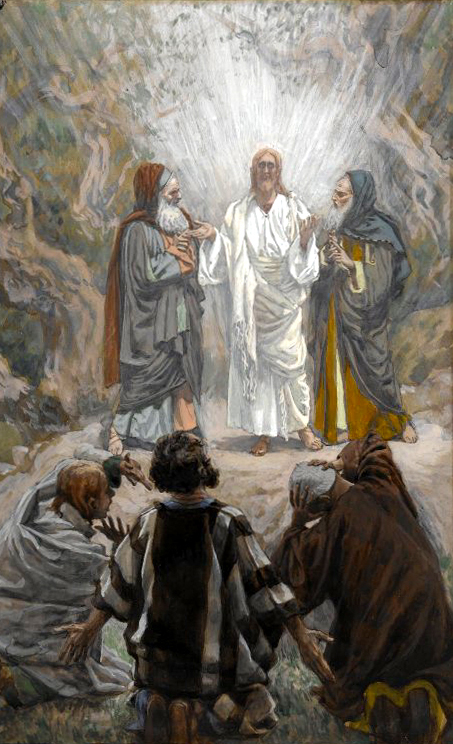
Dorian Gray underwent a terrible, ugly and deadly transfiguration that reflected the sorry, sinful state of his soul. On the other hand, Jesus underwent a beautiful, glorious transfiguration in the Gospel, the very kind we, too, are meant to experience.
So, what was the reason for Jesus’ transfiguration? He had just predicted his Passion and Death shortly before, and he would repeat it later two more times. But the Apostles did not understand that, nor did they wish to. They would dispute it, ignore it or change the subject. So, to encourage them to bear with hardship and suffering, and to give them hope of what to expect for themselves in the end, he was transfigured before them.
Scripture says while Jesus was praying on the mountain, “his face shone like the sun and his clothes became white as light.” (Mt 17:2) Then, Moses and Elijah appeared in glory and conversed with him.
The Transfiguration lasted only a few minutes. As Moses and Elijah were about to depart, Peter interrupted and proposed to erect tents for them and Jesus. “He hardly knew what to say,” since he was “so terrified.” (Mk 9:6). But he was ignored. “Then from the cloud came a voice, ‘This is my beloved son. Listen to him.’” (Mk 9:7) Suddenly, things were exactly as they were before.
There is a wonderful, even humorous icon that depicts the aftermath of the Transfiguration. It shows the three Apostles – Peter, James and John – falling backward, head over heels, down the mountainside back into the nitty-gritty of everyday life. It’s time to face reality again, but with new perspective.
We tend to think of transfiguration as something that happened only once, to Jesus alone, long ago and far away. But in reality, it is something that happens to each one of us every day. Today, we do not resemble the single cell that began our human existence within our mother’s womb; nor do we resemble much the infant, toddler, child, adolescent and young adult we later became. Today finds us somewhere along the continuum of life, still evolving physically and spiritually, too. We either progress or regress in one direction or another, but we never really remain the same.
Spiritually, we are transfigured by God’s grace, especially when we receive the sacraments. The Holy Eucharist in particular is meant to bring us into holy communion with the Most Holy Trinity. Therefore, Saint Paul can say, “All of us are being transformed from glory into glory into God’s very image.”(2 Cor 3:18)
Jesus’ transfiguration was fleeting. The mountaintop experience was momentary. The witnessing Apostles descended from the heights to resume their everyday lives, but they would continue to be transfigured inside and out for the rest of their lives. So for them and for us, transfiguration is neither fleeting nor momentary. It is a lifelong process that will determine the person we shall present to God on the last day. He who set all that in motion years ago with just one tiny cell.
Father Edward Kolla is a retired priest of the Diocese.



 at the bottom and then tap “Add to Home Screen”
