






Editor’s Note: The solemnity of Christ the King is November 23.
With the solemnity of Our Lord Jesus Christ, King of the Universe, the Church fittingly brings to a close the liturgical year of grace 2025.
This celebration is relatively new in the history of the liturgy of the Church. It was instituted by Pope Pius XI in 1925 as a result of the steep rise of secularism and atheism in Europe in the wake of the First World War. Age-old monarchies had been toppled, and totalitarian ideologies such as communism and fascism were filling the void. In the midst of all this change and turmoil, the Holy Father said one truth remains unchangeable: Jesus Christ reigns supreme.
In the middle of Saint Peter’s Square, there stands a huge obelisk – 83 feet high – which was brought to Rome from Egypt by the emperor Caligula in 37 AD. There was originally a golden orb on the top of it, which was meant to honor the sun. It was eventually replaced by a cross, and on the pedestal, there is a Latin inscription: “Christus vincit, Christus regnat, Christus imperat,” which means, “Christ conquers, Christ rules, Christ reigns.” This is the language of triumph celebrating the victory of Christ crucified and risen from the dead over every earthly power.
The contrasting and unique aspects of Christ’s kingship are proclaimed in the scriptural readings for the Mass of the solemnity.
In his letter to the Colossians, Saint Paul paints an awesome divine portrait of the imperial Christ. He is the visible image of the invisible God. All things were created in Him, through Him, and for Him, and all things are held together by Him. (1:15f) Such things are light years away from any notion of human kingship.
On the other hand, Saint Luke paints a very stark human portrait of Christ’s kingship. It is at once pitiful, but powerful.
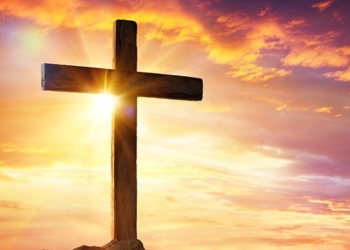
Calvary is Christ’s kingdom. His throne is the Cross. His courtiers are two criminals crucified on his right and on his left. His adoring subjects are the mob, and their allegiance to Him is expressed in insults, curses and blasphemy. All of that, of course, is a parody of kingship.
However, Christ’s true kingship in Luke’s account is confirmed in the powerful influence he had on the good thief. We do not have any details about what led up to the good thief’s request for Jesus to remember him upon entering into his kingdom. Some interaction between them surely must have preceded it. Perhaps the criminal was influenced by Jesus’ gentle demeanor, His extraordinary patience, His dignified language or His wisdom. All we do know is that the good thief’s conversion was total and immediate.
A unique aspect of Christ’s kingship is the ability to change lives from the inside out. No totalitarian government or dictator can do that. They can only coerce from the outside. A generation ago, the minds and hearts of Catholic Poles, Hungarians and Slavs were never won over by communism. Their stalwart allegiance to Christ the King eventually enabled them to defeat it.
Today, however, especially in the West, there are worse threats than communism that seek to control lives. These are the powerful and seductive forces of secularism, materialism and hedonism. They are promoted and extolled by forces such as pop culture and social media.
In the face of such a threat, our love as Christians for Jesus and our allegiance to him as the king and center of our hearts must shine forth more boldly than ever in our words and in our deeds. That is the only way for us to impress others, especially our children, and to overcome the evil forces that threaten our nation and our world today. But no matter how things unfold in our own time, we never cease to proclaim with all boldness: Christ conquers, Christ rules, Christ reigns.
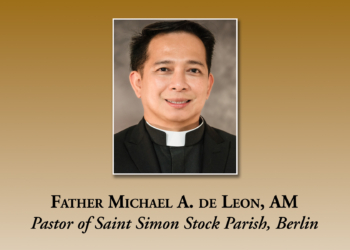
Father Edward Kolla is a retired priest of the Diocese of Camden.




 at the bottom and then tap “Add to Home Screen”
