




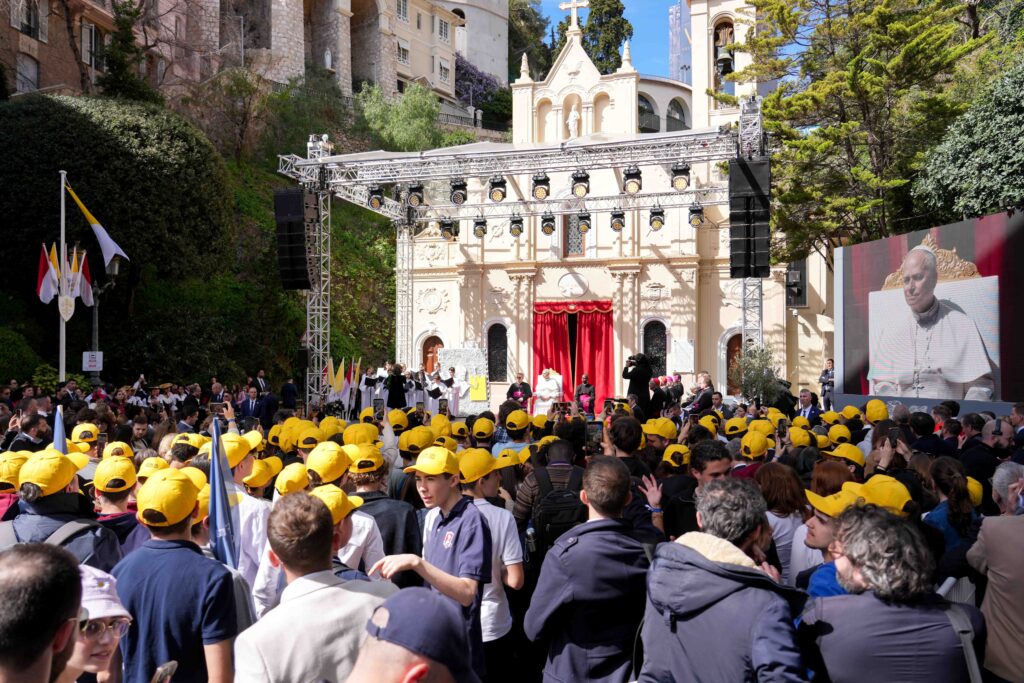
When Pope Leo recently visited the small city-state of the Principality of Monaco on March 28, immediately before the start of Holy Week, he became the first sitting pontiff to visit the Riviera nation since Pope Paul III in 1538.
Part of his visit included veneration of the local patron, Saint Devota. Viewing the images of him there drew my mind to the famous line by C.S. Lewis: “How monotonously alike all the great tyrants and conquerors have been: how gloriously different are the saints.” Like countless others, Saint Devota offers us a unique and faithful mother of the faith to emulate, when “in spite of dungeon, fire and sword … chained in prisons dark, were still in heart and conscience free,” as the 19th century hymn “Faith of Our Fathers” puts it.
Legends claim that Saint Devota, or Dévote in French, was born on the island of Corsica in the closing decades of the third century. Whether her given name was Devota, or possibly Julia, is debated. However, she became known in subsequent centuries for this Latin word, obviously referencing her “vows” to God. As a young woman, she was accused of being a Christian during the great persecution under the Roman emperor Diocletian and was accordingly arrested and imprisoned. Under torture, she refused to deny her faith and was eventually martyred on the rack.
When pious fellow believers – likely moved by the spirit of Joseph of Arimathea, whom we have heard about in this season – saved her body from being burnt or lost, they sent her remains on a boat bound for Africa, intending to bury her there. However, the vessel was nearly shipwrecked in gale winds, though a dove led the crew to safety in Monaco. As a thanksgiving, the central shrine to her was eventually erected there over her remains, and locals ascribed various miracles to her intercession. In the 1600s, she was officially declared the patron saint of Monaco.
To this day, the saint plays a cultural and social role in different elements of Monaco’s public life. A wooden ship is still brought in from the harbor and set on fire on the eve of her feast day in January, with many of the nation’s dignitaries in attendance. The first and most dramatic corner of the Formula One Monaco Grand Prix Circuit is named for the chapel built in her honor. When Grace Kelly married Prince Rainier III in 1956, she deposited her bouquet at the Chapel of Saint Devota’s altar, as did Princess Charlene in 2011.
Pope Leo’s visit to the shrine included a meeting with Monégasque catechumens and youth. “Providentially, [Devota’s] body was brought here from Corsica to what is now the Monégasque coast,” he said. “They had sought to destroy her body and wipe away every memory of her, yet her sacrifice has carried the Gospel message of peace and of love even further. This helps us to reflect on the fact that good is stronger than evil, even though at times, it seems to be losing in the short term. Furthermore, it reminds us that bearing witness to the faith is a seed that can spread and bear fruit in faraway hearts and places, well beyond our own expectations and capabilities.”
In response to one young person named Andreia, he went on to point out that life and our own inner emptiness ought not to be filled with “material and fleeting things, the virtual approval of thousands of likes or temporary, artificial and sometimes even violent relationships. We must clear the doorway of the heart of these things, so that the healthy, life-giving air of grace can return to refresh and revitalize its chambers, and so that the strong wind of the Holy Spirit can once again fill the ‘sails’ of our existence, propelling us toward true happiness.”
“You are the young face of this Church and of this nation,” Pope Leo continued. “Monaco is a small country, but it can be a great place of solidarity and a beacon of hope. Incorporate the Gospel into the choices you make at work and in your social and political commitments in order to give a voice to the voiceless, thereby spreading a culture of care.”
In this way, Pope Leo was undoubtedly encouraging them to be, in their own way, “gloriously different” from the ills of today’s Western culture, and even from Saint Devota herself – since Christ wants us not to be carbon copies of earlier figures, but fully ourselves in our committed discipleship, defined by unswerving devotion to Him and the particular and unprecedented needs of our day.
An alumnus of Camden Catholic High School, Cherry Hill, Michael M. Canaris, Ph.D., teaches at Loyola University, Chicago.



 at the bottom and then tap “Add to Home Screen”
