



For nearly 30 years, I have been blessed to spend a great deal of time in Spain. This of course intensified when I met my wife there, and we now spend summers bringing our two daughters to visit their grandmother in Mallorca. (I assure you, there are worse places to visit a mother-in-law.) This meant I had a front row seat to what many are calling the high point of the young pontificate of Pope Leo in his recent pilgrimage to Spain.
To say that the Spaniards took pride in their historical and cultural ties to Catholicism and the Holy Father during his visit is an understatement. The wall-to-wall national coverage dominated nearly every station during the groundbreaking six days, albeit with due attention also given to the opening games of the World Cup.
Every element of the trip excited people, particularly young adults and adolescents: the 1.5 million people in Madrid turning out for Mass in a city of less than 4 million; the eight-minute unanimous standing ovation he received from a deeply polarized Parliament; the blessing of the Gaudi architectural masterpiece La Sagrada Familia; the striking memorial on the Canary Islands to the many migrants who have lost their lives crossing the Mediterranean – which had echoes of Pope Francis’ famed visit to Lampedusa, Italy. (Incidentally, that is the location where the first U.S.-born pope will spend the 250th anniversary of his native land July 4.)
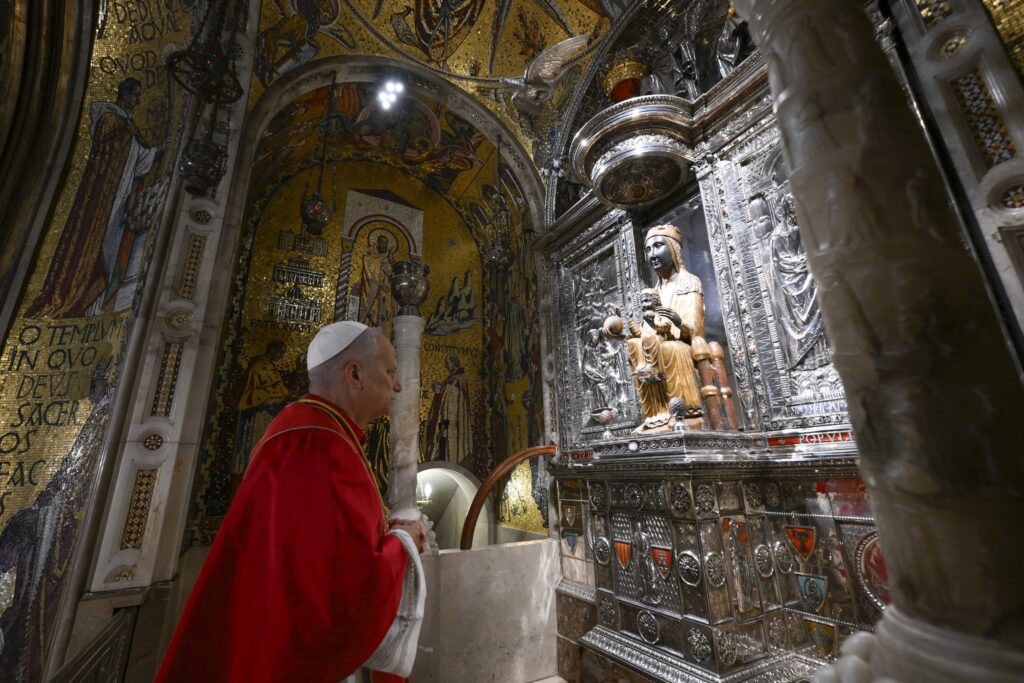
But, for me, the most stirring scene was Pope Leo’s visit to the storied Benedictine monastery of Montserrat. This has personal ties, as the shrine is my first daughter’s middle name, tying together much of my family’s history. Spain welcomed my wife as a migrant from Argentina decades ago; Ignatius of Loyola (at whose schools I have spent more than half my life) renounced the trappings of soldierly life and luxury there in an all-night vigil; it was the name of the ship that brought my own ancestors from Italy to the United States; even the Lay Centre where I lived in Rome was for a time located on Via di Monserrato. So watching the Chicago-born pope pray in front of the Black Madonna in that stunning mountaintop setting and entrust his entire pontificate to her maternal care sent shivers down my spine, in the best sense of the phrase.
The abbey has long been under the protection of the monks of the Order of Saint Benedict, where about 70 still live out the Rule of their founder. A large number of their predecessors there were martyred during the Spanish Civil War. It is also a sign of Catalan pride and traditions, of which Mallorca is also infused. One local I saw said that while tourists visited the beauties of Barcelona, here the pope had instead come to the very heart of their kitchen table, where “el quotidià,” the sacredness of the everyday and the mundane, can be found.
The pope, importantly giving his speech in both the Spanish and Catalan languages, recognized such a sentiment in his words to the gathered crowds: “May we also learn to cherish and nurture love within our families, among friends, in the workplace, on social media, in political debates and in Christian communities, so that hatred may give way to hope and peace.” Like Ignatius long before him, he implored the entire world to “lay at [the Madonna’s] feet today the armor that has gradually hardened our hearts.”
Inculturation is undoubtedly a thorny topic. As Susan Wood puts it, “The ecclesiological challenge lies in how to instantiate cultural diversity and at the same time retain a unity in fundamental identity and belief.” Taking students to Europe often for the first time in their lives, I know well the shock that comes when people experience realities that seem entirely foreign to their familiar patterns. (As an example, I write this having had a normal weeknight dinner lasting well past midnight in a restaurant with tables full of children all around us.)
I also have seen countless examples of how these experiences spark the imagination and ignite a call to search for something more personally and collectively meaningful across cultures, including concrete examples just in the last few weeks of people entering or re-entering the Catholic Church after being immersed in the faith in new ways in its ancestral home, with all of the caveats and troubles that brings with it.
In much the same way, I am entirely convinced that this apostolic visit to Spain will remain a primary interpretive lens to understanding the León pontificate and his devotion to popular piety for many years to come.
An alumnus of Camden Catholic High School, Cherry Hill, Michael M. Canaris, Ph.D., teaches at Loyola University, Chicago.




 at the bottom and then tap “Add to Home Screen”

