



With the celebration of Pentecost a few weeks ago, the Church officially concluded the Easter season and entered back into Ordinary Time.
However, one gets the distinct impression that the Church reluctantly does so because she adds on a few more weeks of celebrations with the solemnities of the Most Holy Trinity, the Most Holy Body and Blood of Christ (Corpus Christi), and the Most Sacred Heart of Jesus. But now that the celebratory white vestments for Sunday Mass have been exchanged for green ones, there is no doubt that Ordinary Time is back in full force.
The Church divides the liturgical year into five seasons: Advent, Christmas, Lent, Easter and Ordinary Time. With 34 weeks, Ordinary Time is by far the longest season the year. The first week in Ordinary Time begins the day after the celebration of the Feast of the Baptism of the Lord, which is the last Sunday of the Christmas season. It continues until Ash Wednesday and resumes the day after Pentecost.
The other four seasons of the liturgical year have their own distinctive character, but the Church teaches that, in Ordinary Time, “no particular aspect of the mystery of Christ is celebrated, but rather the mystery of Christ itself is honored in its fullness.” (Universal Norms, 43) In other words, who Christ is and what He is all about gradually unfolds to the People of God throughout those 34 weeks.
Liturgists seem to go to great pains to emphasize that the word “ordinary” in Ordinary Time does not refer to a certain dullness or boring routine, but rather to the sequential listing of weeks – first, second, third, etc. But I am not convinced, and I don’t think anyone else is either. To speakers of English and many other languages, too, the word “ordinary” means exactly that; in other words, nothing special. The other explanation about ordinary referring to the sequential listing of weeks is forced.
Nevertheless, even if we accept the notion of ordinary as a sequential ordering of time, wouldn’t that be at best a minimalist attempt to convey the idea of a season in which “the mystery of Christ itself is honored in its fullness”?
In the pre-Vatican II liturgy, the season after Christmas was designated time after Epiphany. Epiphany means “manifestation,” and the Sundays after Epiphany were meant to manifest just exactly who the Divine Person born in Bethlehem is. As the Gospels for those Sundays indicate, Jesus of Nazareth is the lamb of God who takes away the sins of the world, a miracle worker who provides for our needs, one who calls disciples to follow Him and a teacher who explains what it means to be truly blessed.
In a similar way, the season after Pentecost Sunday was formerly designated simply as time after Pentecost. We recall that the Holy Spirit came down upon the infant Church at Pentecost to enlighten, to teach and to sanctify. It is also crucial to remember that Jesus said the Holy Spirit will lead the Church to all truth, teaching nothing on His own, but only what has been received from Jesus. (Jn 16:13-15) So, during this time of the year, we are reminded of everything Jesus said and did, and we come to a greater understanding of it through the inspiration of the Holy Spirit.
We are all familiar with the old adage, “If it ain’t broke, don’t fix it!” Perhaps, at some point in the future, liturgists will reconsider their lackluster decision and return to the old designation of time after Epiphany and time after Pentecost as more appropriate for conveying “the mystery of Christ in its fullness.” Ordinary Time is woefully inadequate to express that idea.
Besides, Jesus Christ is risen from the dead! And we, too, are destined to rise from the dead on the last day! So, in no way then, can any time in the future ever be called ordinary.
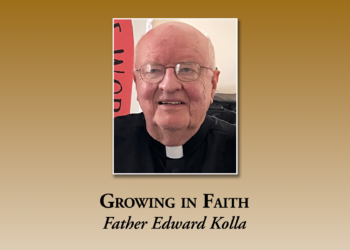
Father Edward Kolla is a retired priest of the Diocese of Camden.




 at the bottom and then tap “Add to Home Screen”

