







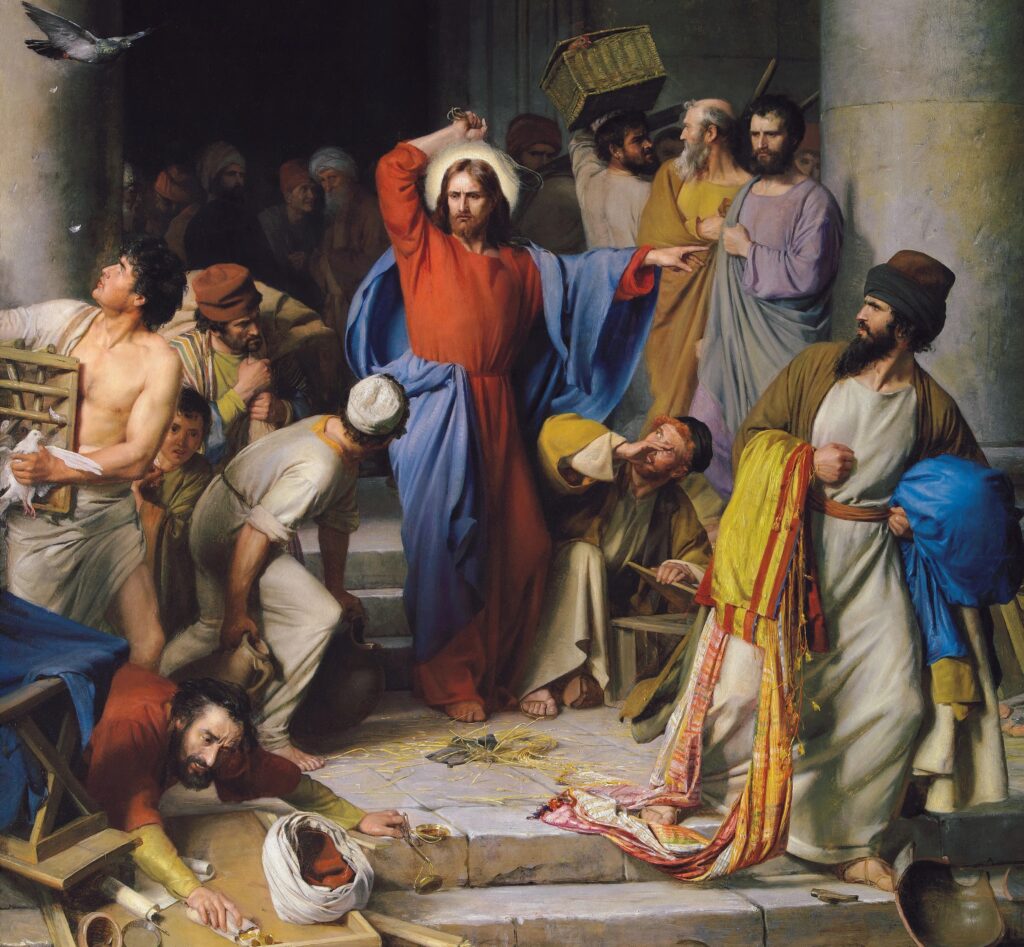
The Gospel from the Third Sunday of Lent (John 2:13-25) describing Jesus expelling the money changers and animals from the temple with a whip made of cords might puzzle us. How could Jesus, who is God and sinless, become angry and act such a way?
Anger itself is not a sin. Scripture says, “If you are angry, let it be without sin. The sun must not go down on your wrath; do not give the devil a chance to work on you.” (Ephesians 4:26-27). Thus, Scripture distinguishes between sinful anger and righteous anger. This distinction is important because society often looks at anger only from its sinful side; however, anger plays an important role in bringing about justice and leading people to conversion and virtue.
Furthermore, the wrath of God is a common theme in the Old Testament. God’s anger or wrath “is not angry retribution against those who have offended God. Rather, it is his righteous judgment against those who do evil. God is righteous.” (What is the Biblical Understanding of the Wrath of God?, in Christianity.com). In the Old Testament, God’s anger is brief and is always tempered by mercy.
In our moral and Christian life, sinful anger (one of the seven capital sins) leads to other sin. All seven of the capital sins lead to greater sin(s); for this reason, they are called capital sins. Righteous anger, however, is aroused in reaction to sin, or injustice, or in defense of the innocent, or for the protection of one’s rights or property. Righteous anger is necessary – think of the protests of Dr. Martin Luther King Jr. or Mahatma Gandhi. In the context of the cleansing of the temple, although we do not fully understand Jesus’ motive(s), it was a righteous anger that led to a prophetic action: Jesus, like the prophets before Him, performed an action to gain immediate attention and to teach a lesson. He was cleansing the temple of misuse and directing the Israelites to a deeper faith and worship, which leads to Jesus Himself.
Regardless of Jesus’ prophetic action, God’s predominant attribute is mercy. Even though God’s wrath is a common theme of the Old Testament, God’s wrath is always mitigated by and leads to His merciful and healing love. When God revealed Himself to Moses, the LORD proclaimed, “The LORD, the LORD, a merciful and gracious God, slow to anger and rich in abounding love and fidelity … forgiving wickedness, rebellion and sin; yet not declaring the guilty guiltless.” (Exodus 34:6-7)
The readings of the Fourth Sunday of Lent are a rich reflection on God’s abundant mercy that culminates in Jesus’ coming into the world. (2 Chronicles 36:14-16, 19-23; Ephesians 2:4-10; John 3:14-21). Reflection upon these readings now during the Lenten season and even beyond may bear good fruit for us in our spiritual lives and in our relationships with others. As we open ourselves to God’s corrections and mercy and accept them, we, in turn, may bring that mercy to others and, perhaps, we may even forgive ourselves as is necessary and in which it is very hard to do at times.
Although God is merciful, God, on the last day – either the last day of our own lives or on the last day of time – will come as the Just Judge. Matthew 25:31-46 is a classic example of this reality. God as Judge is a tenant of our faith; we profess this in the Nicene Creed as well as in the Apostles’ Creed at each Sunday Mass: “…[Jesus] will come again in glory to judge the living and the dead … .” The role of Jesus as Just Judge is based on justice – justice must be meted out either in this life or the next life. Therefore, to make a judgment is necessary in life and is good only if we judge with fairness, in the full truth, with respect, and in the search for justice, the good and the common good. To judge and to make decisions is a necessary part of the ethical/moral life.
To be judgmental, that is, to judge another person or situation based upon bias, prejudice, a lack of truth, lies, favoritism, etc., is wrong and is an aberration of justice. Right judgment or Christian judgment is based upon the gifts of the Holy Spirit: wisdom, understanding, counsel and knowledge that are bestowed upon us in the Sacrament of Confirmation. Many of us are confirmed at an older age because decision-making and making judgments are a big part of adult life.
Thankfully, God’s abounding mercy began the instant sin entered the world, and God’s mercy will continue until our dying breaths and until the end of time. The parable of the Merciful Father or the Prodigal Son emphasizes this. (Luke 15:11-32) It is God who searches for us daily when we have rejected God. It is the Merciful Father who runs to us, embraces us, welcomes us and prepares a feast for us even though we have turned away from the Lord. The Catholic devotions to the Sacred Heart of Jesus and to Divine Mercy richly promote this reality of God in the context of our tepid spiritual or sinful lives.
Finally, as we experience the Father’s mercy, let us also be merciful to others. (Luke 6:36) The very prayer that Jesus taught His disciples, the Lord’s Prayer, emphasizes this. God’s mercy (or judgment) will be meted out to us in this life or in the next in as much as we are merciful (or judgmental or merciless) to others, as in the parable of the Unforgiving Servant. (Matthew 18:21-35)
Father Matthew R. Weber is pastor of Holy Cross Parish, Bridgeton.





 at the bottom and then tap “Add to Home Screen”
