





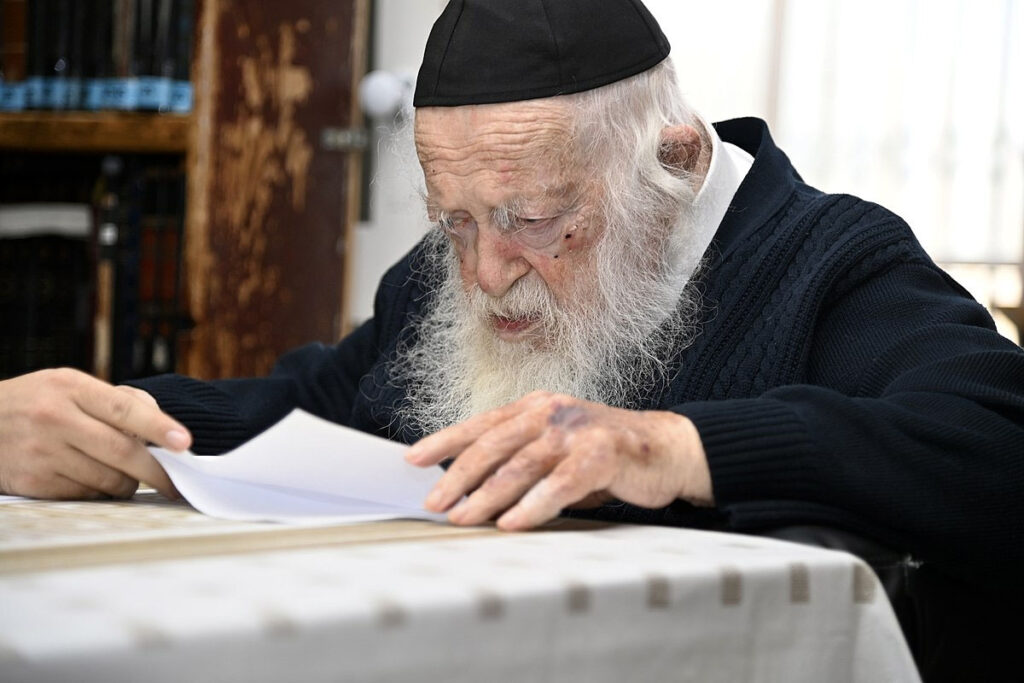
Rabbi Chaim Kanievsky, seen in this 2016 photo, was known to have an encyclopedic knowledge of Jewish law and holy Scripture, studying religious texts for more than 17 hours a day.
Hundreds of thousands of ultra-Orthodox Jews in Israel recently gathered for the funeral of one of the most prominent influential scholars of Torah studies, Rabbi Chaim Kanievsky. Estimates range from half a million to a million people to have attended, the largest gathering of people in the history of the State of Israel.
The funeral took place March 20, the crowds of men and boys dressed in black suits filled the streets of Bnei Brak, the ultra-Orthodox suburb of Tel Aviv. Police, paramilitary officers and volunteers formed a large phalanx around the funeral bier as it was carried through the streets to avoid a stampede like what happened last year, when 45 people were crushed to death during an ultra-Orthodox pilgrimage to Mount Meron.
Rabbi Kanievsky was 94 at the time of his death. He was the de facto head of what is commonly called the Lithuanian branch of ultra-Orthodox Judaism. He was revered by his community as the consummate scholar of Jewish law and tradition. His rulings on anything from the most banal to the most profound questions touching his followers’ lives were binding.
The rather insular ultra-Orthodox community makes up about 12 percent of Israel’s 9.4 million citizens. They live by a very stringent interpretation of Judaism, with a focus on Torah study and strict observance of Jewish traditions. Although he held no official title of leadership, Rabbi Kanievsky was considered a major luminary in the non-Hasidic ultra-Orthodox world, known as the Haredim. This non-Hasidic stream of ultra-Orthodox Jewry has its roots in Eastern Europe. Lithuanian Jews form about a third of the 1.1 million Haredim in Israel.
This quiet, unremarkable looking man with a wispy gray beard and wrinkled skin was revered by his community because of his encyclopedic knowledge of Jewish law and holy Scripture. His family said that every day of his life since the 1930s he studied religious texts for over 17 hours. His relentless and dedicated scholarship won him a reputation of being a modern-day sage. Every day, hundreds of people would line up to seek his guidance on matters like urgent medical and political issues; he was also questioned as to what appliances for home use were kosher. Because of his strict regimen of Torah study, he didn’t find time to read newspapers or watch television, and his knowledge of world events was virtually negligible.
Born in 1928 in what is now Belarus, Rabbi Kanievsky moved to what became Israel before World War II, making him one of the last bridges between the European Haredi communities that were decimated during the Holocaust and the new Haredi world that emerged after the establishment of the State of Israel. He was born into a revered family heritage; his father and uncle were considered venerable religious sages. His father, Yaakov Kanievsky, was known in the ultra-Orthodox circles as the “Steipler Gaon” (“genius”), and his uncle was Avraham Yeshayahu Karelitz, a Talmudic scholar known as the “Chazon Ish” (“vision of man”).
Rabbi Kanievsky did not head a yeshiva or even teach seminary students. He became a great Torah scholar by spending 70 years studying, first as a seminary student and later in his tiny three-room apartment, where he lived since he was married to his wife, Batsheva. He held no titles such as dayan (judge) or admor (Hasidic master), so his family and community began calling him the “Prince of Torah.” When asked to attend any events in the community, he would answer that he could not attend because “I am in debt,” meaning his need to study Torah. His Torah studies started at 4 a.m. and ended at midnight. He primarily studied the Babylonian Talmud, and he also mastered many other texts, some rather obscure, such as religious laws pertaining to farmers.
Israeli prime minister Naftali Bennett paid tribute to Rabbi Kanievsky in a statement before a cabinet meeting on the day of his funeral, saying, “The name of Rabbi Kanievsky will be remembered as an important part of the Torah history of the people of Israel.” He added, “The son of the Steipler and the nephew of the Chazon Ish, he continued in their path, after the Holocaust, in the Land of Israel, preserving the Torah world of the destroyed communities of Europe.”
He will be replaced by Rabbi Gershon Edelstein, 98, who was already considered to hold almost equal status in the Haredi world.
Father Joseph D. Wallace is diocesan director of Ecumenical and Inter-religious Affairs and pastor of Christ the Redeemer Parish, Atco.



 at the bottom and then tap “Add to Home Screen”
