






The Diocese of Camden’s unique regional history has blessed us with both the Cathedral of the Immaculate Conception, whose cornerstone was laid in 1864, and Saint Joseph’s Pro-Cathedral, the current building of which was constructed in 1952. The notion of the bishop’s chair, or cathedra, being tied to a specific church has very ancient Christian roots, as it developed out of a theology recognizing the unique ministry of a local church’s leader to be a successor to the apostles and to validate and authenticate the faith held in common by all worshippers within a given place.
Bishop Dennis Sullivan was given this unique charge to accompany our local Church in South Jersey by the pope directly, after the pope listened to the advice of various consultants with a deep familiarity about our particular region’s needs, history and traditions. Thus, the seat of his local authority and connection with the people of his diocese rests in a special way in the tradition of his cathedral.
Most people are aware that the Basilica of San Pietro in Rome was built (and then rebuilt) over the resting place of the chief apostle after his execution, which tradition holds, occurred on an upside-down cross under the emperor Nero. Fewer are familiar with the fact that this grandest and largest church in the Catholic world is not in fact the Cathedral of Rome. That honor belongs to the church of San Giovanni in Laterano. Though this title is usually translated into English as Saint John Lateran, there is no such person with that first and last name. Instead, this important “mother church” of the city where Peter and Paul were martyred and which became the hub of global Christianity is dedicated to both Saint John the Baptist and Saint John the Evangelist, on land that once belonged to the Plautii Laterani family.
The basilica is among the most beautiful and important sites in Rome, connected to the oldest baptistery in the world after Emperor Constantine’s Edict of Milan and the current Pontificia Universitá Lateranense, which includes both an Institute for Pastoral Ministry formation (Redemptor Hominis) and the John Paul II Theological Institute for Matrimonial and Family Science. The obelisk in its piazza, covered with easily recognizable Egyptian hieroglyphics, is believed to be among the largest still standing, after being shipped across the Mediterranean on barges to prove Rome’s dominance over the other ancient empires in competition with them. Today it is topped by a metallic cross, making clear the Christian mindset that the King of the Universe rules over all other earthly glories and principalities.
Students I take to the basilica always gasp when entering for the first time (Saint Paul Outside the Walls also seems to have this effect). More than any other feature, the rows of oversized sculptures of the 12 apostles capture one’s attention. Local lore says the heads of Saint Peter and Saint Paul have been separated from the corpses in their respective churches and placed here in the baldacchino above the central altar. The center of the church is also reported to contain a small wooden table on which Saint Peter presided over the Eucharistic memorial in the years immediately after the Last Supper and Resurrection. Each year on Nov. 9, the universal Church celebrates Pope Sylvester’s dedication of the basilica in 324 AD.
For about 1,000 years, the popes lived in the Lateran complex, which was recognized as the “mother and head of all the churches in the city and the world.” Pope Francis has said that were he ever to resign, he would consider taking up residence there instead of remaining in the Vatican, as his predecessor did. At least six popes are buried in the Lateran, the most recent being Pope Leo XIII (d. 1903), the author of the influential encyclical “Rerum Novarum.” The “Lateran Accords” between Italy and the Holy See signed there in 1929 established the modern Vatican as the world’s smallest independent country, completely surrounded by the city of Rome.
Whether in South Jersey or the eternal city, the cathedra, or “seat,” still represents the place where both learning and teaching took place in the ancient world. We can, then, see a bishop’s (or pope’s) connection as teacher, shepherd and co-traveler to what was traditionally called his ecclesia matrix, which has connotations of maternity, origin, source and nourishment, as it literally means his “womb church” in Latin.
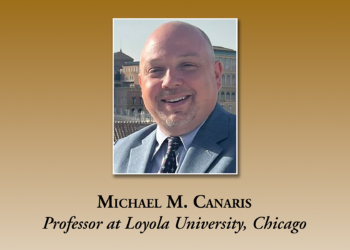
Originally from Collingswood, Michael M. Canaris, Ph.D., teaches at Loyola University, Chicago.




 at the bottom and then tap “Add to Home Screen”
