

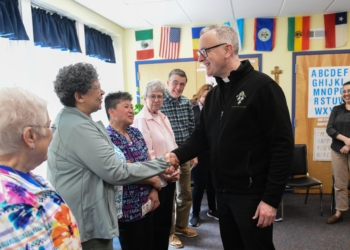





Carl Peters edits pages of the Catholic Star Herald before they go to print. (Dave Hernandez)
This sounds like a custom-made anecdote, but it’s true.
I spent the second morning of my retirement from this newspaper reading a book that is, like me, highly critical of certain powerful political figures.
Later that day, I was with people whose views are completely different than mine. Dismayed, I wondered how they formed their opinions. What do they read, listen to and watch? What sources do they trust and why? (No doubt, they have the same questions about me.)
A couple of hours later, a friend asked about my experience of working at a diocesan newspaper.
I first thought about how a single story could produce widely different reactions from readers – including from the staff and contributors of the paper itself. But I didn’t have to work at the Catholic Star Herald to learn that people of the same faith have different views on politics and culture. I learned that from my own family in the 1960s.
Catholic and secular media should provoke thoughtful debate, but over the years, I came to believe diocesan newspapers also provide a different kind of service. It has as much to do with how we see ourselves and each other as it does with how we see the issues of the day.
Although he wasn’t talking about diocesan newspapers, C.S. Lewis once made a comment that seems fitting. In addition to being a Christian apologist, Lewis was a scholar of medieval and Renaissance literature. An often-repeated story – that may or not be true – is that one day a student asked him why people read literature.
Lewis supposedly answered, “We read to know we are not alone.”
One of the purposes of a diocesan newspaper, I would argue, is to remind local Catholics that they are not alone. The paper reminds them that they are part of a community and part of an ongoing story that began long ago.
The Catholic Star Herald is evidence that the story of the Church is not only the Old and New Testaments, not only tales of saints and martyrs. It is also a story that concerns the current struggle for religious freedom in places like China and North Korea, the desperate hope of people at the U.S.-Mexico border, ecological issues and more.
For all readers, it is also the story of their fellow Catholics here in South Jersey.
Diocesan newspapers cover Church leaders and contemporary issues. Those stories are not unconnected to other kinds of stories: an article about a family in need being treated with dignity at Catholic Charities; a feature about a parish nurse or a school secretary; coverage of the generous work of fraternal organizations or the enthusiasm behind parish ministries; or even a photo of a clergyman blessing dogs, cats, goldfish and other pets on the feast of Saint Francis of Assisi. They are all reminders that the Catholic Church is built on Christ, who both challenges and comforts his followers in an ever-changing and often confusing world.
Disagreement is inevitable. That’s true for the hierarchy and theologians, as well for young people who are first trying to understand what the beatitudes and Jesus’ parables mean in their own lives. Every serious Christian is on a journey that can be challenging, frustrating, sometimes disheartening but often – and the proof is on the pages of this newspaper – inspiring.
There will always be public figures who abuse the Bible for political power or personal gain, and those who use religion to rationalize their own desires, or as a vehicle to vent their anger and bitterness.
But, all the time, here in South Jersey, there are also clergymen and religious who quietly shepherd families through crisis, musicians who use their talents to praise God, volunteers who visit the imprisoned, surgeons who pray before going into the operating room, shut-ins who say the Rosary for the intentions of others, and many other individuals, families and groups who strive, however imperfectly, to live as Catholics. To get a sense of that aspect of Catholicism, read a good diocesan paper – including the ads, which are also a testimony to the vitality of the local Church.
Abraham Joshua Heschel once observed that we have no proof of God’s existence, only witnesses. As a rabbi, he was referring to the prophets. Catholics, of course, add Jesus and the saints. I would argue that we also have each other.
Carl Peters is former managing editor of the Catholic Star Herald.
Want to read more columns from Carl Peters? Visit an archive of his writing at https://catholicstarherald.org/author/carl.



 at the bottom and then tap “Add to Home Screen”
