







When I heard the announcement that the New Strategic Arms Reduction Treaty between the United States and Russia would expire Feb. 5, I thought back to my college seminary days in the early 1980s. During that time, I participated in my first public protest; it was in downtown Scranton, Pa., and I was standing up against the production and proliferation of nuclear arms throughout the world.
It is concerning, then, that the only treaty limiting these hazardous weapons between the United States and Russia – which possess two of the largest nuclear arsenals globally – has now expired. The expiration of this agreement ends more than 50 years of bilateral strategic arms control – which is an existentially alarming development.
The New START, signed in 2010 by President Barack Obama and Russian President Dmitry Medvedev, set a limit of 1,550 nuclear warheads for each party. Numerous experts observe that in the absence of this treaty, there will be no remaining constraints on the nuclear arsenals of either the United States or Russia. With no negotiations scheduled, both sides must independently evaluate the other’s nuclear arsenal and production capacity. Naturally, this could lead to misunderstandings and contribute to an unfettered nuclear arms race not seen in decades – and on the precipice of AI capabilities for war.
At a recent general audience in Rome, Pope Leo XIV warned the world of the grave danger of a “new global arms race.” He said that “every constructive effort in favor of disarmament and mutual trust” should be sought. We must end “the logic of fear and distrust,” moving toward “a shared ethic capable of guiding decisions toward the common good and making peace a heritage safeguarded by all,” he said.
In addition, the president of the U.S. Conference of Catholic Bishops, Archbishop Paul S. Coakley, called upon government policymakers to “courageously pursue negotiations to maintain New START’s limits.”
“I call on people of faith and all men and women of good will to ardently pray that we, as an international community, may develop the courage to pursue an authentic, transformative and lasting peace,” he said.
The archbishop recalled the clarion call that Pope Leo gave in January during an address to the Diplomatic Corps. The pontiff warned that “there is a danger of returning to the race of producing ever more sophisticated new weapons, also by means of artificial intelligence.”
During a recent interview, U.N. Secretary-General António Guterres issued a similar warning. “Ultimately, global peace and stability cannot be achieved without respect for international, predictable behavior and collective cooperation. Strong, inclusive multilateral institutions, grounded in shared responsibility and values, are essential to managing conflicts, addressing inequalities, responding to humanitarian crisis, tackling climate change and upholding the principles of the U.N. Charter.”
I still hold the same views I had as a seminarian in Scranton; I passionately believe that nuclear weapons endanger humanity and should be controlled, or ideally, abolished altogether.
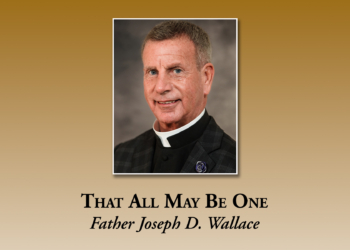
Father Joseph D. Wallace is diocesan director of Ecumenical and Inter-religious Affairs and pastor of Christ the Redeemer Parish, Atco.




 at the bottom and then tap “Add to Home Screen”
