



A few weeks ago, I received an email from a woman in Alaska taking me to task for a recent article I had written.
“I was reading your interview with Mark Wahlberg,” she wrote, referring to my interview with the Catholic actor for the biopic “Father Stu.” “I am disappointed that you only called Father Stu’s disease ‘an incurable muscle disease.’ I wish you would have added that it was Inclusion Body Myositis. My husband was diagnosed with IBM in 2010. At this time, he is bedridden.”
She followed this email up with a telephone call less than 24 hours later in which both she and her husband shared emotionally and honestly about his journey and the lack of public knowledge concerning the disease. “Referring to the muscle disease as Inclusion Body Myositis would probably prompt people to seek out more information about it, as it is rare,” she said, kindly.
She was right. I made the change to the online version of my article.
How did a woman in Alaska read something from the Diocese of Camden? It was distributed through Catholic News Service, the communications arm of the U.S. Conference of Catholic Bishops. On May 4, it was announced that CNS’ offices in Washington and New York would close, leaving the Rome office to distribute news from the Vatican.
To stress the importance of this news in another way, this would be the equivalent of your local newspaper or news website no longer including national and international news from the Associated Press or a similar news aggregate site. Without CNS to distribute articles, videos, photos, columns, etc., from diocesan publications across the nation, those like my Alaska callers would never have read my article. More importantly, they would never have had a voice to encourage me to change my words to better inform readers.
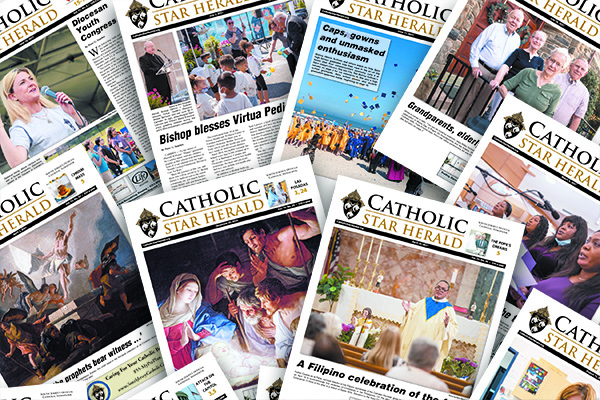
I say all of this to point to the ever-increasing need for Catholic journalism, especially local Catholic journalism. May 28-29 is the USCCB’s Catholic Communication Campaign. This campaign helps entities like the Catholic Star Herald spread the Gospel through numerous media platforms. Through this annual collection, you, the faithful of the Diocese of Camden, can support our ministry to evangelize as well as the Catholic Church’s national and international communications efforts.
Last year, the Diocese of Camden collected $19,934.12 for the Catholic Communication Campaign; 50% was sent to the USCCB, with $9,967.06 remaining with the Diocese. On behalf of the Communications Department, I thank you for your generosity and ask that you again think of your local diocesan communications ministry this year.
A perfect example of the important work that stems from diocesan communications is the priestly ordination that adorns the cover of this newspaper, the articles and photos spread throughout these pages, and the livestream video and hundreds of photos on the Catholic Star Herald website as well as diocesan social media. All of this Good News would not be possible without your support.
Recently, I was privileged to hear Bishop Paul Tighe, secretary of the Pontifical Council for Culture, speak about “An Ecclesial Perspective on the Digital Culture” at Saint Charles Borromeo Seminary, Wynnewood, Pa. As a monsignor, he was, as one publication put it, basically, “the Pope’s social media guy” handling Twitter as former secretary of the Pontifical Council for Social Communications.
Bishop Tighe reflected on a talk Pope Francis gave that pontifical communications council. “Insofar as the Church is present, I want it to do three things: I want it to listen to people. To engage in conversation. And I want your hallmark word to be a word of encouragement.”
A word of encouragement, Bishop Tighe said, because so many people in our world are having difficult times. “What the Church needs is to extend to them that sense of support and those images that Pope Francis is so strongly committed to – that of the field hospital. We don’t have all the answers necessarily for everyone, but that doesn’t mean we don’t do the best we can to support, encourage and strengthen people.”
He continued, “One of our primary interests is facilitation, dialogue and discussion between the Church and those who don’t identify with the Church or, at times, misunderstand the Church. … We live in a culture that shapes us. We can try to shape it.”
“How do we dialogue and think about the culture we live in, a culture we – people of faith and those of no faith – have constructed? One of the things we try to do,” he said, “is be attentive to affirm things that are good, and recognize that as a Church we have a lot to give to this world, but we can also learn.”
Catholic journalists are committed to affirming the good, and reporting on what can be done better. Thanks to the Alaskan husband and wife, I learned not only more about Inclusion Body Myositis and changed my words – I also learned that the wife was received into the Catholic Church at the Easter Vigil this April. She sent me the livestream video so I could share in her joy.
A livestream video, I may add, supported by the ministry of Catholic communications. Please remember your diocesan news outlets May 28-29, and be part of this evangelization mission.



 at the bottom and then tap “Add to Home Screen”
