





Prior to undertaking his seminary training, Msgr. Elmer, a priest from Texas, fought in the Second World War. He took part in the D-Day invasion and related the following story to a group of seminarians.
As the soldiers moved off the beaches and into the local town, they came to a fork in the road. In the middle of the fork was a statue of the Pieta (Mary holding the dead body of her son, Jesus). A wounded German soldier had climbed up into the arms of Mary and died.
Needless to say, it was an image that stayed with Msgr. Elmer for the rest of his life.
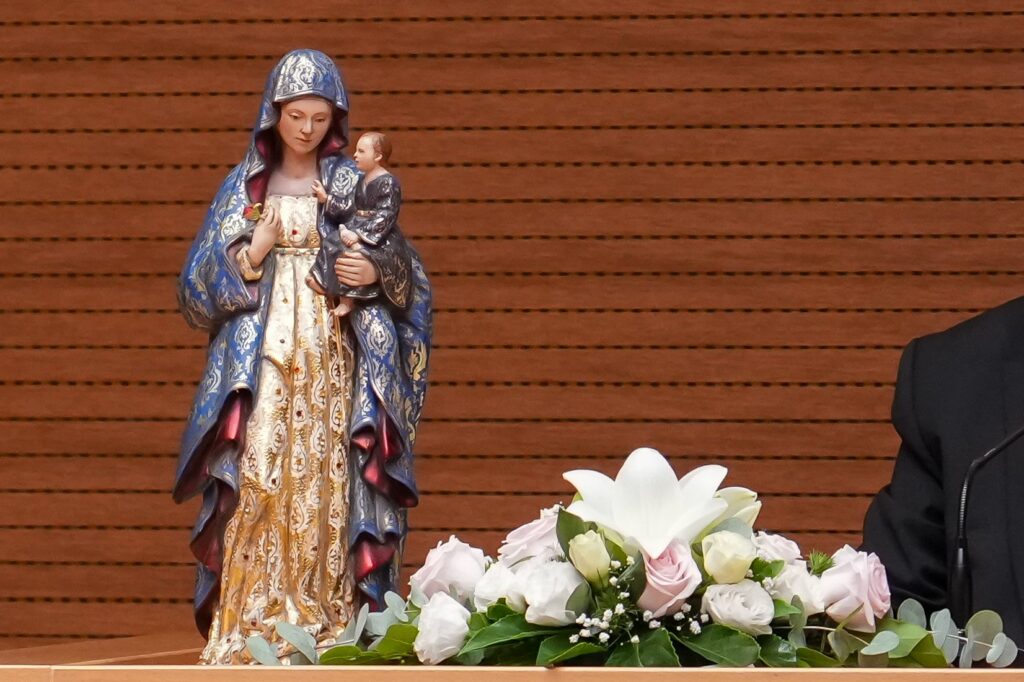
It is a powerful story that can help us understand the recent Doctrinal Note from the Dicastery for the Doctrine of Faith, “Mater Populi Fidelis,” regarding Mary’s cooperation in the work of salvation. The note serves to clarify and guide; it does not define Catholic teaching – rather, it seeks to enrich and complement Marian devotion.
It begins: “The Mother of the Faithful People of God is viewed with affection and admiration by Christians because, since grace makes us like Christ, Mary is the most perfect expression of Christ’s action that transforms our humanity.” (#1)
These two themes are central to the document: Mary’s motherhood of the faithful, and Mary’s cooperation with the grace of Christ.
Reading recent headlines, it appears that most media coverage of this document seems to center on the Church stating that Jesus is the sole mediator of salvation. This is not a new statement, for the Church has been proclaiming this for 2,000 years. The centrality of Jesus Christ in the salvation of the human race was also put forth in “Dominus Iesus,” the declaration from the Congregation for the Doctrine of Faith released in 2000.
“Mater Populi Fidelis,” then, strives to illuminate how Mary cooperated in the work of our salvation. It develops both Mary’s objective cooperation as well as her continued influence on the community of believers – the Church. It refers to the woman’s cooperation in the redemption of the descendants of Adam, as found in Genesis 3:15, and connects it to Jesus calling Mary “woman” two times: at the Wedding at Cana, where she instructs the waiters to do whatever her son tells them; and at the Crucifixion, where she is associated with Jesus’ hour upon the Cross, the sacrifice from which all grace flows. (cf. John 2:4, 19:26)
The document also gives guidance regarding Mary’s titles, illuminating their meaning and guiding the faithful away from any use that would obscure the centrality of Jesus. Terms such as mediation, cooperation, assistance and intercession can be applied to Mary, but not in a way that intends to “add any efficacy or power to the unique mediation of Jesus Christ, true God and true man.” (#25) Rather, all such cooperation, intercession and assistance must be united and subordinated to Jesus.
Saint John Paul II echoed this traditional teaching in “Redemptoris Missio”: Although mediation of different kinds and decrees are not excluded, they acquire meaning and value only from Christ’s own mediation; they cannot be understood as parallel or complementary to His. (RM #5)
“Mater Populi Fidelis” also explains that Mary’s participation in the mission of Jesus comes from the free, unmerited gift of grace given by God. (#67) Through her personal and unique relation with Jesus, Mary becomes the mother of the faithful, even in the order of grace. (cf. #72) The note reminds us that Mary contributes to “preparing us to receive God’s sanctifying grace; in that context, one can indeed think of her as acting to contribute something of her own insofar as she ‘can cause some disposition’ to others.” (#65)
Mary’s cooperation is in Christ and is participatory, the note states. “Her maternal role is indissolubly joined to Christ’s role and is directed toward him.” (#37) Her “motherhood is not only biological, nor is it passive in nature, but it is a ‘fully active’ motherhood that is joined to the salvific mystery of Christ as an instrument willed by the Father in His plan of salvation.” (#15)
The document uses the image of the living water (John 7:37-39) and Jesus’ teaching that believers would do greater works than these (cf. John 14:2) to illuminate how Mary, in cooperating with the grace of Christ, has an influence upon the faithful. This influence always leads one to Jesus and to follow His instruction.
This brings us back to the story told by Msgr. Elmer. The soldier, looking upon Mary holding her Son, Jesus, led him to seek the mercy of God. He did so through the intercession of Mary.
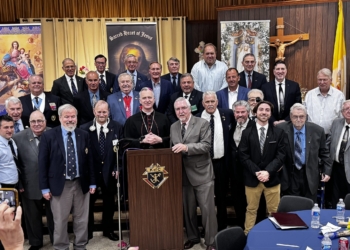
Father Jason Rocks is chancellor of the Diocese of Camden and pastor of Holy Eucharist Parish in Cherry Hill.




 at the bottom and then tap “Add to Home Screen”
