




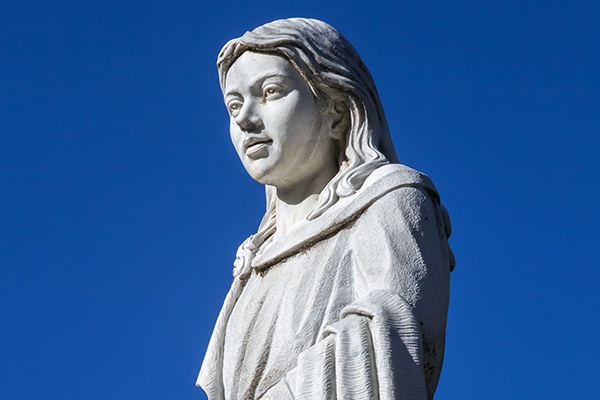
On March 24, 1980, while saying Mass, the archbishop of San Salvador, Oscar Romero, lost his life to an assassin’s bullet. He is considered by many to be a modern-day martyr and a patron for justice and peace efforts around the world. He was only one of over 75,000 victims to die or disappear in the civil war that ravaged that country during the decade.
Romero, born in the small Latin American country in 1917, became a parish priest and then archbishop in 1977. He sided with the poor and oppressed in their struggle for survival and economic justice. However, his commitment was multiplied exponentially when his friend Father Rutilio Grande was murdered for his radical decision to live in solidarity with the marginalized.
As Romero became more outspoken against the government’s atrocities, he became a polarizing figure. He penned a letter to President Carter begging the United States to cut funding to the political leaders of El Salvador, citing their abusive and repressive tactics. He also reported his opinions to Rome and personally to Pope John Paul II.
Romero’s death shook and galvanized the population of El Salvador. The mourning was intense and word of his courage and life’s message spread throughout the continent. At his funeral, bombs and snipers terrorized the 250,000 attendees, with many resulting casualties. His body was finally laid to rest in the Catedral Metropolitana de San Salvador. His dying words were reportedly a prayer for divine mercy on those that took his life.
Our current Pope Francis, with his unswerving commitment to the poor, was obviously deeply inspired by Romero’s life and death. He has once again put steam behind the movement to make Romero a saint eventually. Many Salvadoreans already refer to him as San Romero.
Because of his endorsement of universal human rights, he was nominated for the Nobel Peace Prize. He is thus recognized for his heroism even outside the parameters of the Catholic Church. From where I write this in England, he is honored as one of the 20th century martyrs memorialized in the famed Westminster Abbey, an Anglican edifice.
Romero became a central figure in the debates over liberation theology in the late 20th century. Regardless of one’s opinion on this complicated and thorny issue, Romero’s peaceful commitment to the forgotten cannot be called anything other than inspirational. His words and attitude are reminiscent of other heroes like Gandhi and Martin Luther King, Jr. Like the Christ he followed, Romero called for a conversion of heart for those who would put their own interests ahead of our duty to God and others.
Michael M. Canaris, Ph.D., of Collingswood, is a Research Associate at Durham University’s Centre for Catholic Studies in Northeast England.





 at the bottom and then tap “Add to Home Screen”