


As the country prepares for yet another presidential election, our national attention turns to debates that we hope will clarify the issues and the candidates’ stands. Unfortunately, too much attention is focused on the more sensational aspect of the candidates’ framing their stances on the issues by attacking one another with one-liners meant to embarrass or paint the opponent in the most unfavorable light. Political civility is often categorized as weakness in our modern context. Politicians are almost forced into negative categorizations to satisfy a media fed lust for the negative.
Abraham Lincoln gave sage advice to the nation in his second inaugural address: “With malice toward none, with charity for all, with firmness in the right as God gives us to see the right, let us strive on to finish the work we are in, to bind up the nation’s wounds, to care for him who shall have borne the battle and for his widow and his orphan, to do all which may achieve and cherish a just and lasting peace among ourselves and with all nations.”
In the midst of our national debate about the future we should never lose sight of the need to strive for civility in our conversations with one another. In a recent letter to Georgetown University, president John J. DeGioia, summed up the call for civility as follows: “In our vibrant and diverse society, there are always important differences that need to be debated, with strong and legitimate beliefs held on all sides of challenging issues. The greatest contribution of the American project is the recognition that together, we can rely on civil discourse to engage the tensions that characterize these difficult issues, and work towards resolutions that balance deeply held and different perspectives. We have learned through painful experience that we must respect one another and we acknowledge that the best way to confront our differences is through constructive public debate. At times, the exercise of one person’s freedom may conflict with another’s. As Americans, we accept that the only answer to our differences is further engagement.”
Our Catholic-Jewish Commission desires to add to this civil discourse by examining the role that faith plays in our stance on issues and our voting choices. On Wednesday, Oct.10, at 7:30 p.m. at the Katz Jewish Community Center, 1301 Springdale Road, Cherry Hill, we will be offering “Voting Your Faith: What does it mean?” Join us for an in-depth look at the ways in which religious beliefs and commitments play out in contemporary American culture and how this affects the way people vote. The keynote speaker will be Professor Perry Dane from Rutger’s Law School, and our guest panelists will be Father Robert Gregorio and Rabbi Avi Winokur. Cost is $10 advance and $15 at the door. For more information, contact Helene Klimberg: 856-751-9500 ext. 1117 or email hklimberg@jfedsnj.org.
Certainly our faith informs our vote as Catholics and Jews. Cardinal Donald Wuerl, archbishop of Washington D.C., in the article “Religious Faith in the Public Form,” said, “What the Catholic Church brings to the world, to our society and to each one of us is Jesus Christ, his Gospel, his vision, his way of life and his promise of a world of truth, justice, compassion, kindness, understanding, peace and love. We speak of a good and just society. With the eyes of faith, we see God’s kingdom coming to be among us… The voice of faith today is still the voice of conscience. It is the echo of God within us. As faithful citizens, we must speak out in defense of Gospel values, our faith heritage, we must proclaim the dignity of each person, and we must insist on the obligation of the state to foster such values. To do this is to give voice to our own identity.”
Let us hope that civility will mark the remainder of our national conversation and that mutual respect will dominate our electoral process. I do hope that you will come out for our symposium “Voting Your Faith: What does it mean?” on Wednesday evening at the Jewish Community Center in Cherry Hill.
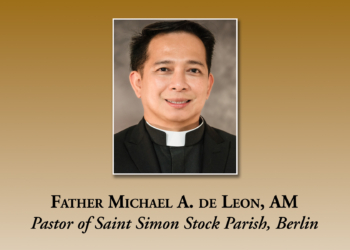
Father Joseph D. Wallace is coordinator, Ecumenical and Inter-religious Affairs, Diocese of Camden.




 at the bottom and then tap “Add to Home Screen”