





Father Robert C. Pasley, rector of Mater Ecclesiae, Berlin, celebrates the solemn High Mass of the Assumption Aug. 15, 2018, at the Cathedral Basilica of Saints Peter and Paul, Philadelphia. (Alan M. Dumoff)
On July 16, Pope Francis promulgated a “Motu Proprio,” that is to say an authoritative letter given at his own discretion, regarding what is commonly referred to as the “Traditional Latin Mass.”
It occasioned a wide variety of immediate responses, from Cardinals Raymond Burke and Blase Cupich to Archbishops Gus Di Noia and Carlo Maria Viganó, to Father Jim Martin, S.J., George Weigel, Austen Ivereigh and countless others. Thus, most commentators agree that “Traditionis Custodes” will one day be recognized as one of the defining moments of the Francis pontificate, along with things like his visit to the Italian island of Lampedusa, the publication of “Laudato Si’” and his Urbi et Orbi blessing in the empty Piazza San Pietro during the height (or nadir) of the pandemic.
The document was accompanied by an explanatory letter that gave Pope Francis’ reasoning behind what he felt was the need to augment an earlier liturgical “Motu Proprio” written by Pope Benedict XVI almost exactly 14 years ago, “Summorum Pontificum.” Effectively, the two new texts place a number of potential restrictions on the celebration of the Latin Mass, which is sometimes called the Extraordinary Form of the Roman Rite, or the Usus Antiquior.
In Francis’s analysis, the permissions extended by Saint John Paul II – which were in some ways guarded and closer to the new protocols – and especially the broader ones offered by Pope Benedict, did not bear the ecclesiological fruit that his predecessors had envisioned. Predictably, not everyone agrees with said analysis of the current state of affairs.
It is clear that there are few things that awaken passionate opinions in Catholics more than liturgy, since this is the prime public expression of our faith. It’s important to recognize this explicitly, and be honest and charitable in any discussions where our fellow Catholics may feel disoriented or disillusioned. But as a theologian specializing in ecclesiology, I am aware that I need to have answers at hand for questions about these issues when they are sure to arise.
First and most importantly, I am convinced that “Traditionis Custodes” is a document most fundamentally about the interpretation of the Second Vatican Council. It is perhaps the strongest and clearest statement of my lifetime that the legitimacy of Vatican II is not up for debate in the modern Catholic Church. I have read a copious amount of commentary on this document in the last 10 days, as well as the English, Italian and Spanish translations of the text (notably there was no Latin one published). I am personally convinced that the council’s ongoing role in the life of the Church was the primary factor in Pope Francis’ decision to take these steps.
Second, the document touches on the healthy tension in the Church between pluralism and unity. Pope Francis says without ambiguity that he is “constrained” to take these actions “in defense of the unity of the Body of Christ.” That unity, stemming from Christ’s prayer in John 17 that his followers may be one as he and the father are one was, in Pope Francis’ mind, being “distorted” by some of the undercurrents of conversation in communities where this was the preferred form of worship.
The faculty for wider use of the Tridentine Mass – which it is important to note itself arose as a reform in a particular historical moment with its own exigent demands – was leading to results the pope deemed “contrary to the intentions that led to granting the freedom to celebrate the Mass with the Missale Romanum of 1962 [by his predecessors].”
Lastly, this is yet another step away from the Mediterraneo-centrism that defined the Church for so much of its history, and another opening toward the dialogical world-Church that was inaugurated at the council. There is no doubt that Jesus lived, died, and rose again in the Mediterranean world. And so the origins of the faith can never be dissociated from the historical Person of Jesus and the specific context in which God entered history.
But most scholars also think that Jesus did not himself speak Latin, beyond perhaps a few words. It was rather simply the lingua franca of the expanse of Western empire, which did not overtake Greek and Aramaic in the East. And the overwhelming majority of contemporary Latin Masses have been taking place in America, France and England, not in Africa, Latin America, Asia or other areas of Christian growth. These wide permissions were not in Francis’ mind genuinely reflective of global Catholicism, though he importantly recognizes the role of the local bishop on the ground as the chief liturgist in his own local diocese.
As noted scholar Jaroslav Pelikan once put it, “Tradition is the living faith of the dead; traditionalism is the dead faith of the living. Tradition lives in conversation with the past, while remembering where we are and when we are and that it is we who have to decide. Traditionalism supposes that nothing should ever be done for the first time, so all that is needed to solve any problem is to arrive at the supposedly unanimous testimony of this homogenized tradition.”
Whether one necessarily agrees with him or not, it is clear that nothing could be further from Pope Francis’ vision of the Church.
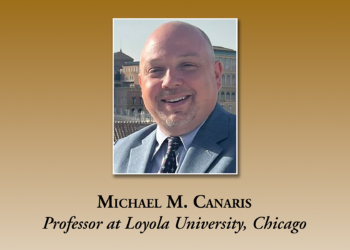
Originally from Collingswood, Michael M. Canaris, Ph.D., teaches at Loyola University, Chicago.



 at the bottom and then tap “Add to Home Screen”
