





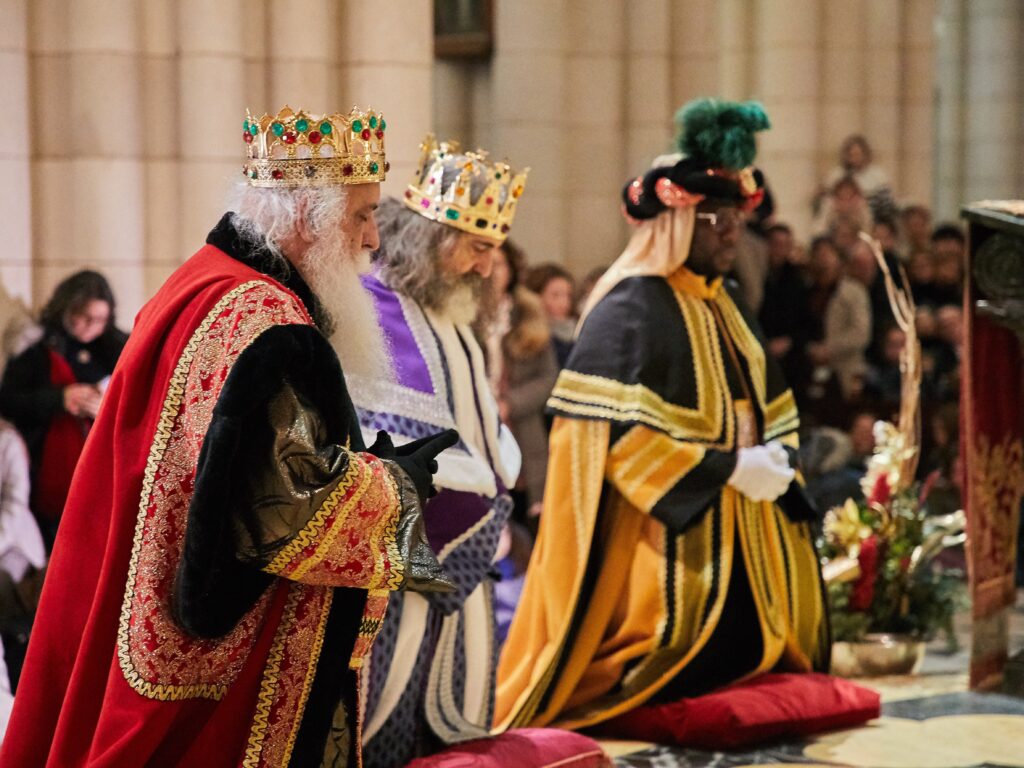
The story of the Magi visiting the Infant Jesus appears only in the Gospel of Matthew, although there are some non-biblical early Christian texts that also describe it. Even the accepted Matthean text names only the three gifts, not specifically three wisemen or kings. But from very early on in the history of the Church, this event took on a great deal of significance. The shepherds for example, which occur only in Luke’s account, receive comparatively less fanfare and liturgical markers than the Magi. Interestingly, no single story has both sets of callers coming to the crib.
Matthew’s primary intent is to present Jesus as the New Moses, with all kinds of Hebrew resonances – from Herod’s purge of infants (bringing to mind the days of the Pharaoh) to the Sermon on the Mount (bringing to mind the Ten Commandments given on Sinai). Thus, it is his visitors from the East who experience the “revelation” or “manifestation” (from which we get the word Epiphany), and through whom we celebrate the non-Jewish nations first recognizing the King of the Universe.
Most early Christians would recognize “the East” to refer to ancient Parthia, roughly modern-day Iran and Turkmenistan. By the time of Jesus, some of the influence of Arsacid Zoroastrianism had been streaming through currents of Judaism for a long time, especially since the Babylonian Exile. For this reason, the first depictions of the wisemen in the catacombs and on Christian sarcophagi present them wearing the Phrygian conical caps so identified with the Thracians, Scythians and Persians. The message is clear: In the same way that conquered leaders were made to prostrate themselves in their local garb before the secular Roman emperor, they now voluntarily do so in front of this mysterious child who has significantly more authority than the earthly power and glory of Rome, or any nation-state.
The Magi take on central roles in the Christmas season, which we lamentably lose (in large part) in American culture beyond some references to the “Kings of Orient Are.” Here, the consumerist distortion of the season confuses Advent (or even Halloween!) with Christmas: the preparatory shopping and cooking end, along with Christmas music on the radio and satellite apps, on the night of the 25th. For most people, everything that comes after is basically a seasonal footnote.
In the Church, however, this is rather the beginning of a longer season, stretching through the memorial of the (adult) Baptism of the Lord, and in some older traditions, to Candlemas in early February. The 12 days of Christmas for instance come after, not before, the Birth of the Lord, tracing the period between the Nativity and Epiphany. This shelving of the other characters in the narrative is not the case everywhere. I remember my wife’s despondency early in our relationship during her first days in America, when I had to respond gloomily to her question where we’d watch fireworks on January 5 for the vigil of the Epiphany, or what Spaniards call the feast of “Reyes Magos.” (A similar moment occurred when she asked bewilderedly why the post office here was open on the Feast of the Assumption).
Of course, there are exceptions. The famed O. Henry story about selfless giving is a classic Epiphany contribution that our nation has made to the world. And Latino culture has provided an explosion of bakeries preparing traditional Roscón cakes for January 6, which is also the progenitor of New Orleans’ King Cake, though now more associated there with Mardi Gras than its proper seasonal roots.
In 44 BC, a comet appeared over the Mediterranean, which many pagans interpreted to prove that Julius Caesar had been deified after his assassination. It is historically probable that some of the Roman coins minted by his nephew Augustus – which showed his uncle with this passing heavenly body overhead – had circulated throughout Judea in the time of Jesus. It’s clear then that the evangelists’ Birth narratives, which appeared roughly a century later, were intended to critique such a benediction on the excesses of the empire. The esoteric priests of the East, eventually given the names of Melchior, Balthasar and Caspar, brought symbols of Christ’s sovereignty (gold), priesthood (incense) and eventual death (the burial spice, myrrh).
The British Christmas carol “As with Gladness Men of Old” longs for the day when we will join the faithful of every generation to praise the only genuinely Wise one, but without need of any created celestial images or miraculous wonders to convince the dubious. “And when earthly things are past, Bring our ransomed souls at last, Where they need no star to guide, Where no clouds thy glory hide. … Thou its light, its joy, its crown; Thou its sun, which goes not down. There forever may we sing Alleluias to our King.”
May we in the caravan of life today continue to traverse afar, recognizing both the ultimate reason for our journeying and the sanctity of those on the road with us.
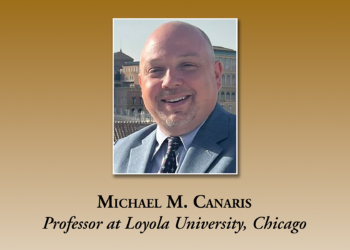
An alumnus of Camden Catholic High School, Cherry Hill, Michael M. Canaris, Ph.D., teaches at Loyola University, Chicago.




 at the bottom and then tap “Add to Home Screen”
