







Lamentably, very rarely do most parishes in the United States participate in the storied traditional singing of the Marian antiphons, a series of hymns to the Virgin that are recited at various times of the liturgical year. The most familiar is probably the Salve Regina, which is meant to be sung from Pentecost through the First Sunday of Advent. It’s the best known because it covers the longest swath of the year, the bulk of the Church’s Ordinary Time. But Eastertide and Advent-Christmas-Epiphany have their own, the Regina Caeli and the Alma Redemptoris Mater, respectively.
I particularly love the hymn most associated with Lent, the Ave Regina Caelorum, which I came to appreciate at countless “station” Masses in Rome over the penitential season. It is sung from Candlemas (Feb. 2) through Holy Saturday.
The Latin text reads as follows:
“Ave Regina Caelorum, Ave Domina Angelorum. Salve Radix, Salve Porta. Ex qua mundo lux est orta. Gaude Virgo, gloriosa; super omnes speciosa. Vale, o valde decora, et pro nobis Christum exora.”
Translation is never mathematics, where a one-to-one conversion is always perfect. But an approximation in English would read something like:
“Hail, Queen of Heaven; Hail, Lady of the Angels. Salutations, Root [of Jesus]; Salutations, Gate, through which a Light has arisen over the earth. Rejoice, O glorious Virgin, lovely beyond all others. Fare thee well, fairest maiden, and implore Christ to pity us.”
In English, we lose some of the growing intensity of the intimacy being expressed in the addresses to Mary: ave, salve, gaude, vale. It’s clear that the hymn is imbued with a profound sense of joy, especially compared to its Lenten counterpart that many of us will recognize from Stations of the Cross, the Stabat Mater Dolorosa, best translated as “there stood the sorrowful mother.” This latter emphasizes her anguish at the foot of the Cross, while the former extols her protagonist role in salvation history.
The Ave Regina Caelorum is usually attributed to Hermannus Contractus, or Hermann the Lame, a Benedictine monk at Reichenau, an island abbey on Lake Constance in Southern Germany. Hermannus was said to have been born with a cleft palate, and perhaps either cerebral palsy or spina bifida. He thus had extremely limited physical mobility and could barely speak. And most of the hymns he wrote, like the Salve Regina and the Veni Sanctae Spiritus, were composed after he went blind. But in addition to these beautiful musical compositions, he also made valuable contributions to history, astronomy and geometry, which of course meant developing a mastery of Greek, Latin and Arabic at the time. He died at the age of 41 in 1054 AD, and was beatified eight centuries later by Pope Pius IX.
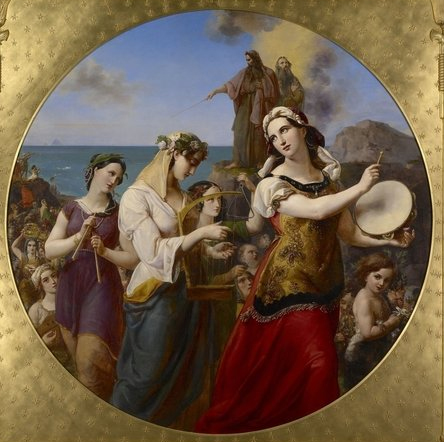
Scholars debate whether the name Mary (Miriam in Hebrew) originally refers to the word for “bitter” or the one for “rebellion.” We do know that Jesus’ grandparents probably chose it for their daughter as a reference to Moses and Aaron’s sister, best known for helping her brother after he was sent down the Nile in a basket. But the Old Testament Miriam also transcended her name’s negative overtones by leading the Israelites in exaltation after their escape from Egypt. “Then Miriam the prophetess, Aaron’s sister, took a tambourine in her hand and all the women followed her, with timbrels and dancing. She shouted ‘Sing ye to the Lord, for He has triumphed gloriously.’” (Ex 15:20-21)
Of course Lent is a time for self-renewal and the ongoing conversion of our lives, which is more process than light-switch. That undoubtedly involves sincere repentance for our wrongdoing. But Hermannus Contractus and both Miriams teach us not to remain mired in our bitter rebellion, but rather to allow our spirits to dance with joy along with all of them that, indeed, such “a Light has arisen over the earth.”
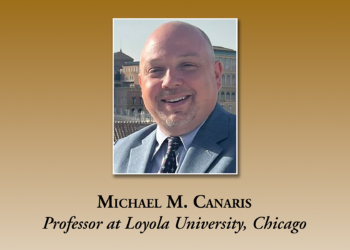
Originally from Collingswood, Michael M. Canaris, Ph.D., teaches at Loyola University, Chicago.






 at the bottom and then tap “Add to Home Screen”
