





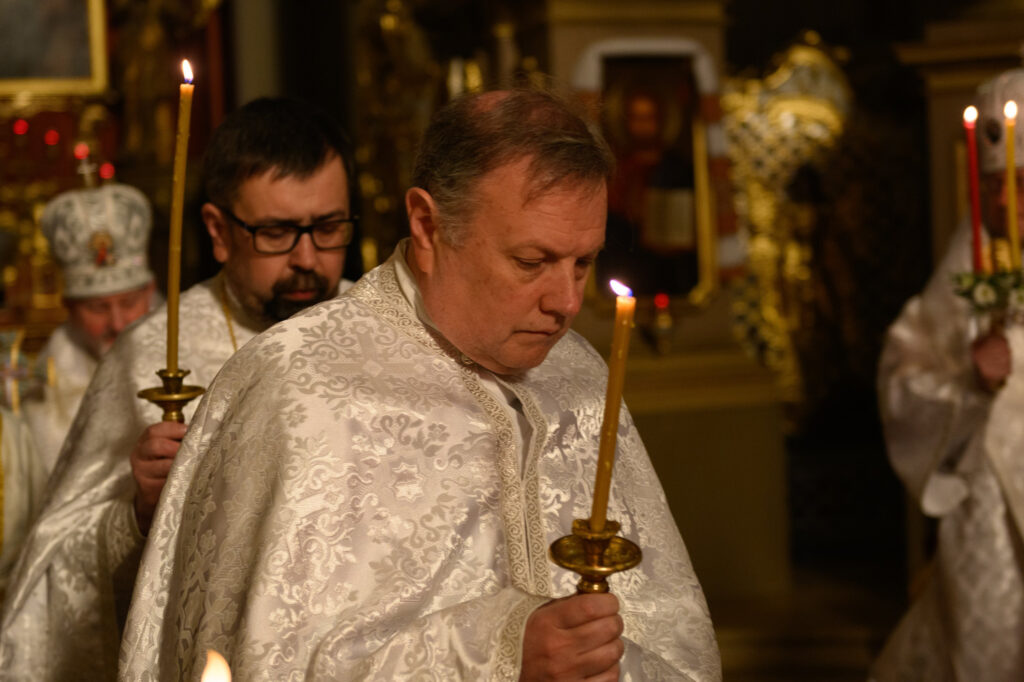
Images were broadcast around the world of Volodymyr Zelenskyy, who is Jewish, and Vladimir Putin, who is Russian Orthodox, marking the East’s celebration of Easter in their respective countries’ famed cathedrals.
As is the case in most years since the 16th century, in 2022 the Orthodox world celebrates the Resurrection of the Lord on a different date than the Western (Catholic and Protestant) Christian world. The two overlap less and less frequently, with only 31 such joint celebrations occurring in the 21st century. In fact, should nothing change, after the year 2700 AD, these celebrations of Easter will never coincide again.
The easiest way to understand the reason for this is the East’s liturgical use of the Julian calendar instead of the Gregorian one. Russia adopted civil usage of the West’s calendar in 1918, and Greece did the same in 1923. But in calculating Easter, these and other Orthodox countries still default to Julius Caesar’s calendar instead of employing the reforms proposed by Pope Gregory XIII in 1582.
The Emperor Constantine helped establish the calculations for settling on a common celebration to mark the Lord’s Resurrection at the Ecumenical Council of Nicaea in 325 AD. Until then, some communities had marked the Pascha on the 14th of the Jewish month of Nisan – the lunar feast that represents the beginning of Passover –no matter what day of the week it fell on, while others linked it specifically to the following Sunday, since the Bible mentions the women arriving on the first day of the week. The formula decided in the ancient world was rather simple: the first Sunday after the first full moon after the Spring equinox.
But between the fourth and 16th centuries, the vernal equinox had begun to “slip,” because the Julian calendar hadn’t measured the calendar year with enough precision, leaving a few decimal places off the 365.2422 days in each year. Over time, those extra missing hours accumulated, causing the calendar to fall out of synch with the actual astronomical phenomena.
Pope Gregory’s solution, at the advice of Jesuit mathematician Christopher Clavius, was to issue a papal bull titled “Inter Gravissimas,” which decreed that Oct. 15, 1582, would follow Oct. 4 of that year in Catholic nations, eliminating 10 days, and establishing calculations to avoid future slippage by adjusting the practice of leap years.
A friend at the Vatican Observatory at Castel Gandolfo outside of Rome once suggested to me that the best explanation of this is a creative children’s book written by philosopher and scientist Abner Shimony. The little volume, “Tibaldo and the Hole in the Calendar,” is worth seeking out for the curious children in your life, if you are looking for some intriguing summer reading.
In it, the fictitious young Tibaldo is faced with the disturbing reality that his 12th birthday will fall into the “hole” of the days being skipped in October 1582 when the calendar is being updated. It not only creatively tells the story of his attempts to buttonhole Pope Gregory to explain his pressing concerns about this most grave matter, but paints a nuanced and accessible picture of the astronomy, medicine, mathematics and technological developments of the day, and how they continue to have ripple effects into our collective modern world.
More detailed explanations in appendices are cleverly framed as Tibaldo’s teachers’ lectures and critical refutations of earlier positions and theories. Diagrams of the heavens and lighthearted discussions of the complexities of everything from Roman numerals to the difference between sidereal and solar time-keeping enable one to get a firm grasp on the growing storehouse of human knowledge that continued to expand as the foundations of the modern scientific method were being laid in this period. I’m excited to share the beautifully illustrated little text with my own infant daughter eventually, though at seven months old, I don’t think she has the bandwidth for Aristarchus, Copernicus and Tycho Brahe quite yet.
There have been many discussions about trying to negotiate a common celebration of Easter agreeable to all parties who share faith in the Risen Lord, most notably by the World Council of Churches and under both Popes John Paul II and Francis. Whether we will live up to Christ’s prayer that his followers remain one, as He and the Father are one (Jn 17:21) remains to be seen, even when the communities that follow Him mark something as central to their faith as the memorial of His ultimate victory over death.
Originally from Collingswood, Michael M. Canaris, Ph.D., teaches at Loyola University, Chicago.





 at the bottom and then tap “Add to Home Screen”
