



By Ines San Martin, OSV News
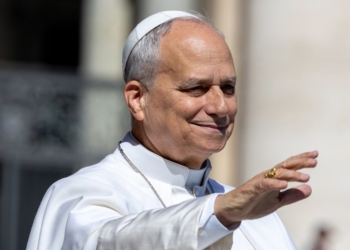
MADRID (OSV News) — Hours after celebrating Mass for an estimated 1.5 million people and leading a Corpus Christi procession through the streets of Madrid, Pope Leo XIV found himself in a very different setting.
He was in a packed arena where Spain’s leading figures from culture, education, business and sports challenged him with questions about truth, artificial intelligence, human dignity and the future of society.
The June 7 gathering at Madrid’s Movistar Arena, attended by some 12,000 people, was billed as “Building Networks with the World of Culture, Art, Economics and Sport.”
Addressing artists, educators, business leaders and athletes, Pope Leo argued that modern society struggles to preserve the soul of what it creates. “We run the risk of becoming experts in the media and effective producers, yet uncertain as to why, for what purpose, with whom and for whom we produce,” he said.
Arguing that “as an ‘expert in humanity,’ the Church does not turn a blind eye to anything truly human,” Pope Leo said, and he also challenged participants to consider those “being excluded despite their virtues and abilities?”
“We cannot ignore the fact that the condition of the poor is a cry that, in the history of humanity, constantly challenges our lives, our societies, our political and economic systems, and the Church,” he said.
Upon his arrival, Pope Leo walked through the arena, greeting attendees and shaking hands before making his way to the stage. The pope received a four-minute standing ovation even before he began speaking. Throughout the evening, speeches were interspersed with artistic performances, including a flamenco presentation by renowned dancer Sara Baras.
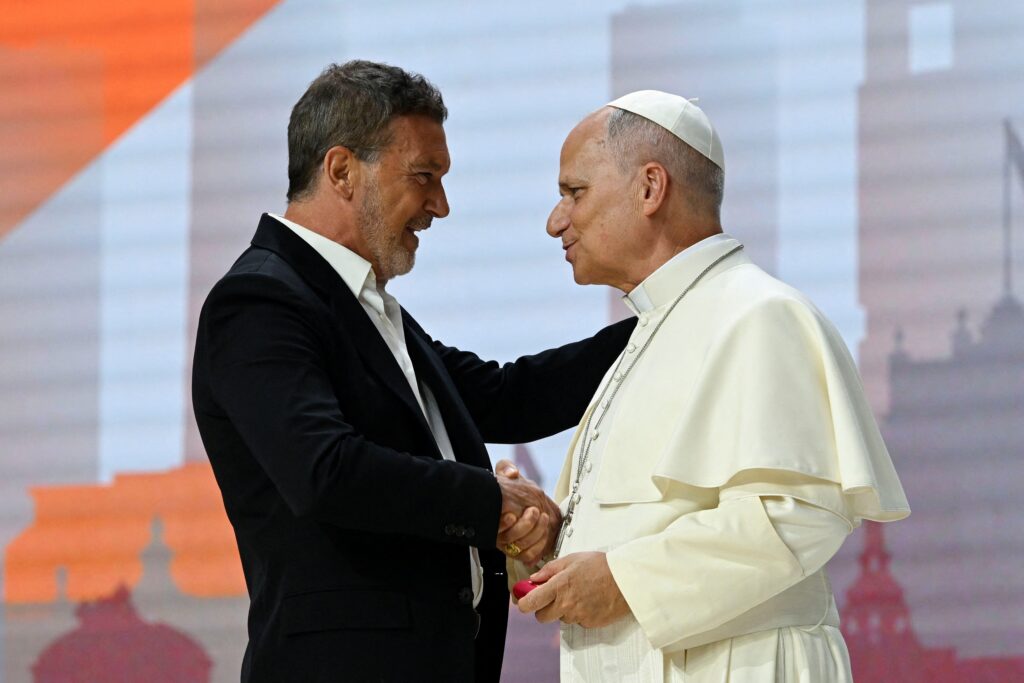
Among the participants was Spanish actor Antonio Banderas, who reflected on the historic relationship between Christianity and artistic creation.
“The Church has been the greatest producer of art in the history of humanity,” Banderas said, arguing that Jesus Christ is likely the most frequently depicted figure in the history of art.
Calling Christ “the great protagonist of the film of life,” Banderas said artists have long found in the Gospel an inexhaustible source of inspiration.
Drawing on memories of Holy Week processions in his native Malaga, the actor described how his earliest questions about God emerged from popular religious celebrations where art, beauty and faith merged in public life.
“Art is not only beauty,” he said. “Art is a question. It is a reflection. It is a contrast. It is a revolution. It is a tension between what we know and what we intuit.”
In a world increasingly shaped by artificial intelligence, Banderas argued that art helps human beings recover depth and soul, warning that technology must remain at the service of humanity and not the other way around.
Representing Madrid’s academic community, José María Coello de Portugal, rector of Complutense University, highlighted education’s role in promoting social mobility, peace and ethical scientific advancement.
He urged universities to remain committed both to diversity and truth, and asked how education can help heal increasingly polarized societies while guiding the profound technological transformations now underway.
The discussion then turned to economics and labor, with business and union leaders presenting a rare joint reflection on the challenges posed by artificial intelligence and globalization.
Olympic and Paralympic athletes Carolina Marín — who gifted the pope, an avid tennis player, a badminton racket — and Teresa Perales concluded the testimonies by presenting sport as a school of virtue and human development.
“The opponent is not an enemy,” Marín said. “Competing is growing with the other, never against the other.”
Perales added that true victory consists not in becoming invincible but in learning to rise again after failure with the help of others.
“Consider how many of us learned to respect our opponents on the field rather than by listening to a lecture,” Pope Leo said, when addressing the audience. “How many athletes teach us to lose without hatred, to win without humiliating others, or to get back up after falling.”
During his remarks, he repeatedly returned to the event’s central image of “building networks” to answer each of the testimonies that had been presented to him, proposing dialogue, shared creativity and selfless service as the threads needed to strengthen contemporary society.
Pope Leo argued that universities must remain committed to truth, businesses must place workers ahead of purely economic calculations, artists must not create only for elites, and technological development must take into account the poor, the elderly and those without a voice.
At the center of his reflection was the conviction that every sphere of society must be rooted in human dignity.
The pope also defended the role Christianity has played in shaping European civilization, asking whether Europe would be the same without the influence of faith and repeating the appeal made famous by St. John Paul II: “Do not be afraid. Open wide the doors to Christ.”
“Is it seriously possible to believe that Europe — which we deeply love — would be the same without the influence of faith?” Pope Leo asked rhetorically.
The event ended with music and a papal blessing. Yet perhaps its most memorable line had come earlier from Banderas, who closed his testimony by recalling the musical “Godspell,” whose title he translated as “the spell of God.”
“I am here today confessing that I have been a victim of the spell of God,” the actor said.
Ines San Martin writes for OSV News from Madrid. She is the editor of Mission Magazine, a publication of the Pontifical Mission Societies USA.



 at the bottom and then tap “Add to Home Screen”
