




Other than Independence Day, Thanksgiving is the most American of holidays. As American Catholics, we are doubly blessed because our perfect prayer and supreme act of worship is itself named “Thanksgiving,” the English word for Eucharist.
November also has a number of feasts on the liturgical calendar that enrich our lives and give us ample reason for giving thanks to God.
The month begins with the solemnity of All Saints on the first and the commemoration of All Souls on the second. Both of those celebrations flow from our belief in the communion of saints. Here “saints,” or “holy ones,” is understood in the broadest sense of the term, which is all those who are baptized. Simply stated, belief in the communion of saints means the ties we have with one another through Baptism into the Body of Christ do not unravel at death.
Saints in the narrower sense refers to all who are in heaven, canonized or not. We can pray to them and they can pray for us. Those who are in purgatory, “saints-in-the-making” if you will, rejoice that they are destined for paradise, but they are dependent on us for prayers to speed their entry there.
The dedication of three major ancient churches of Christendom is celebrated this month: the Archbasilica of Saint John Lateran, “the mother of all churches of Rome and the world,” on Nov. 9, and the Basilicas of Saints Peter and Paul on Nov. 18. While we admire the beauty and the antiquity of those structures, the celebration of their dedication is a reminder that it is we who are “God’s building, the temple of God,” and the Spirit of God dwells in us (1 Cor 3:9, 16).
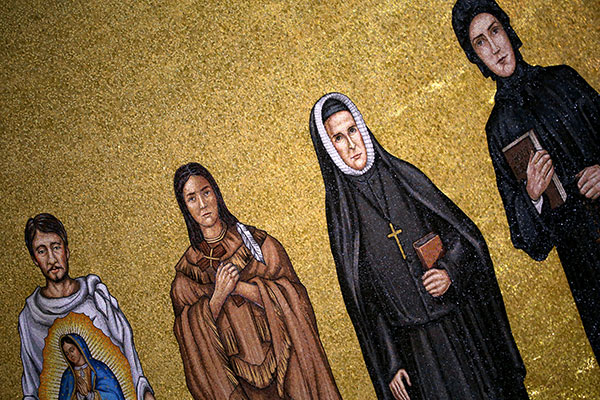
November also includes the feast days of two American saints: Saint Frances Xavier Cabrini on Nov. 13 and Saint Rose Philippine Duchesne on Nov. 18.
Saint Frances Cabrini was the first American citizen to be canonized in 1946. Born in Italy in 1850, she stood less than five feet tall and suffered from poor health all her life. Nevertheless, she resolved never to let her own inadequacies get in the way of the work of the Holy Spirit. Her motto was taken directly from Saint Paul’s Epistle to the Philippians: “I can do everything in Him who strengthens me.” (4:13)
Rejected by two religious orders of sisters for reasons of health, she founded her own community, the Missionary Sisters of the Sacred Heart. In 1889, when she and six other sisters arrived in New York to work among the immigrants, no provisions for living or ministry had been prepared for them. As a result, Archbishop Corrigan told her to go back to Italy! Of course, that was out of the question.
Eventually, she would make an astonishing number of establishments, 67 in all – in the United States, England, and Central and South America. Those include orphanages, schools and hospitals.
She died of malaria in the hospital she founded in Chicago in 1917, and her remains are venerated today in New York City.
Saint Frances Cabrini is known as the patron saint of immigrants.
Saint Rose Philippine Duchesne, another saint we claim as our own, was a French woman and member of the Religious Sisters of the Sacred Heart of Jesus. From the time she entered the convent, she had a burning desire to be a missionary to America. That was not realized until she was 50 years old.
With four other sisters, she sailed to New Orleans and then traveled up the Mississippi to St. Louis. She opened her first log-cabin school in Saint Charles, Missouri. She lived a life of poverty and great hardship among the frontiersmen.
Finally, aged 71, she traveled to Sugar Creek, Kansas, where her life-long dream to establish a school for Native-American children was realized. There she would remain for just two years. Because of the harshness of the living conditions, her inability to learn the native language and her failing health, she was forced to return to Missouri.
Surprisingly, she lived for another 10 years. She resided at the first mission she had founded in the United States at Saint Charles, and her ministry was one of constant prayer for the success of the American missions. At that time, she gained renown among the Native Americans as “the woman who prays always.”
Saint Rose Philippine Duchesne died in 1852 at the age of 83 and was canonized in 1988.
Father Edward Kolla is a retired priest of the Diocese.




 at the bottom and then tap “Add to Home Screen”
