





As Americans gather this week for our most uniquely religious of secular holidays, Catholics intrinsically recognize the profound connections between the annual celebration of gratitude each November and the regular liturgical life of the Church.
Schoolchildren are taught that the word Eucharist itself comes from the Greek term for “thanksgiving,” and it is obvious that in languages like Spanish and Italian, the acknowledgement of a service done or kindness received is related to the concept of grace (“gracias,” “grazie”). Saints for millennia have done their best to convince their fellow human beings that one cannot ultimately be grateful to God and unhappy, or ungrateful and authentically happy in life.
Yet, too many of us seem to forget how much more frequently the prayers at Mass call us to mercy and thanks, as compared to justice and prosperity. Anyone who has attended a liturgy celebrated by a bishop or cardinal hears his allusion to “me, your unworthy servant” (“et me indigno famulo tuo”), which of course echoes the prayer said by the faithful before receiving Communion.
This should draw our minds to the absolute gratuity of the divine invitation that always comes from God to sinful men and women, as opposed to imagining ourselves as some kind of privileged ambassadors dispensing our ideas of divine retribution on the world. Though we certainly profess that Christ will come again to judge the living and the dead – and so our decisions and actions have eternal consequences – it is clear Catholic doctrine that we can’t “earn” our way into heaven, as if we can show up after death with an adult version of Santa’s list and litigate our way into paradise. In that way, thanksgiving for God’s unmerited offer of self-gift is much more primordial and essential to our faith lives than our own always mottled response to such a loving transcendent overture.
In Dante’s “Purgatorio,” the particularly gruesome punishment inflicted on the envious is believed to be borrowed from medieval falconry. Since their gaze in life was focused not on the end for which they were created, but rather on the creaturely goods amassed by their neighbors, the covetous have their eyes shown shut with wire. No longer can they pine for the material belongings or good fortune that they feel aggrieved to have been denied at the expense of others.
As difficult as it is to admit, for too many Americans, this antithesis of genuine thanksgiving is frighteningly familiar, colored by an economic and consumerist advertising culture predicated on making us feel that we need to stockpile new, better or more luxurious things, and a social media environment – even in its most benign form (“the camera eats first when a delicious dessert arrives”) – entirely centered on trying to make others jealous of what they can’t or don’t or shouldn’t have. As in so many aspects of our life, we tend to add silent qualifiers to our everyday prayers: “It is right to give God thanks and praise” … [as long as I am entitled to have everything that I desire first].
November is my favorite month of the year, which is unfathomable to my wife, who spent much of her life on a Mediterranean island and is in the early stages of her battle with the Midwestern elements that occur from October through May. But a through-line exists that makes it, for me, the liminal passage to the “most wonderful time of the year.” It calls to mind: saints and family members who have gone before us in this pilgrim journey; the eschatological focus on last things culminating in recognition that Jesus Christ is the humble and longsuffering king of the universe; the movement toward Advent when we all innately know that anticipated joy is the best kind of joy; and now this festive reminder to thank God unceasingly in prayer for all the cornucopia of blessings of life. For me, that also even includes the season’s first snow.
Saint Paul’s words should then ring in our ears and define our approach to this, and every, season: “Rejoice always, pray continually, give thanks in all circumstances, for this is the will of God for you in Christ Jesus.” (1 Thess 5:16-18)
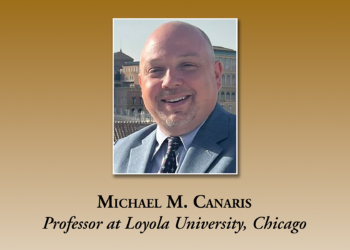
An alumnus of Camden Catholic High School, Cherry Hill, Michael M. Canaris, Ph.D., teaches at Loyola University, Chicago.




 at the bottom and then tap “Add to Home Screen”
