




This is the first in a series of articles for this paper on the theology of Salvador Dalí. Inspired by a recent visit to one of the world’s finest collections of his work in Saint Petersburg, Florida, I will in the coming weeks hope to delve into the complexity and religious significance of his incomparable genius, exploring how his art and contributions can still prove relevant to our contemporary world, in this 30th anniversary of his death.
It is important to say at the outset that I am an ecclesiologist and theologian, not an art historian. So while I am immensely taken by reading about and enjoying Dalí’s work and the symbolism and surrealism contained therein, I claim no expertise in the technicalities of the discipline, and write in this field merely as an amateur enthusiast and seeker, as we all are in various ways. These columns, of course, are not to be read as an endorsement or approbation of everything he produced or said, some of which was intentionally provocative or even downright mean-spirited. (His 1929 work alluding to his mother comes to mind, as do many of the intentionally sexual allusions contained in his corpus).
But those in the Catholic community, especially in the United States, cannot with authenticity claim that “trolling” is not still (too much) a part of our own internal and external discourse, and so any shock at the images or discussions ought not to be feigned as alien to the simultaneous and comingled experience of faith and doubt that marks all of us on the human journey.
It may prove helpful at the outset to discuss some biographical and contextual information about the man himself.
Dalí was born in 1904 in a Catalan speaking region of northeast Spain near the French border. His parents named him after their recently deceased son Salvador. Growing up among the family remembrances of his departed older biological brother, whom the artist obviously never knew, left emotional and psychological ambiguities that haunted him throughout his life. Who was the real — and the really beloved — Salvador? The deceased toddler or the eventual artist? He once commented that he mentally assassinated his departed sibling daily, trying to exorcise the phantasms of his spectral existence, which played such a formative role in the second Salvador’s earthly one.
Dalí’s work throughout his life, even when he lived here in America or elsewhere, continued to be formed and influenced by a profoundly Spanish, and in particular Catalan, approach to aesthetics. This may be one of the reasons I find myself so enamored with his work. I have visited Mallorca and Catalunya almost annually for two decades. I even met my wife there, as she lived the bulk of her adult life in the Balearics after emigrating there from Argentina. The undulating shapes of the rocks and cliffs being eroded and sculpted over millennia by the Mediterranean seas and salt air find resonance in much of his work, as do both the colors and costumes of the region which appear in so many of his pieces. When my wife found out that Dalí played soccer as a child with some of the famous early stars of FC Barcelona, it became clear that I could not walk away from the invitation to do this series and still be welcomed in our home. Next time I suppose I will have to find a local artist who once practiced with the Eagles.
Like me, Dalí found his muse and life partner abroad. He met and eventually married the Russian immigrant Elena Ivanovna Diakonova, who is best known simply as Gala. Her image will appear in many of his masterworks, often in poses or regalia reflective of the saints.
While the turn toward mystical Catholic themes that Dali’s work increasingly took over the course of his life has been critiqued as itself shallow, arrogant and self-promoting, (as if he awoke one day and said: “Today I will decide to be a mystic, the spiritual discipline and liturgical connection it implies is a nuisance”) it is important to distinguish the personal foibles, sins and shortcomings of the man from the spiritual contemplation it can and does elicit from his audience. Like Caravaggio or Michelangelo, deeply flawed human characters whose art has inspired generations, appreciating Dalí has some similarities to Augustine’s theological response to the Donatists of his day, who argued that the failings of ministers or bishops could invalidate the efficacy of the sacraments they performed. The artistic expression of Dalí, in an obviously imperfect analogical sense, can like the sacramental life of the church be seen as transformative and life-giving, as being rooted in the “work worked” (ex opera operato), whether or not we agree with every personal decision he made. I hope to make all this a bit clearer in the coming weeks, or at the least to provide some food for thought.
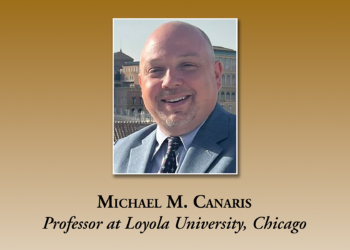
Originally from Collingswood, Michael M. Canaris, Ph.D., teaches at Loyola University, Chicago.




 at the bottom and then tap “Add to Home Screen”
