




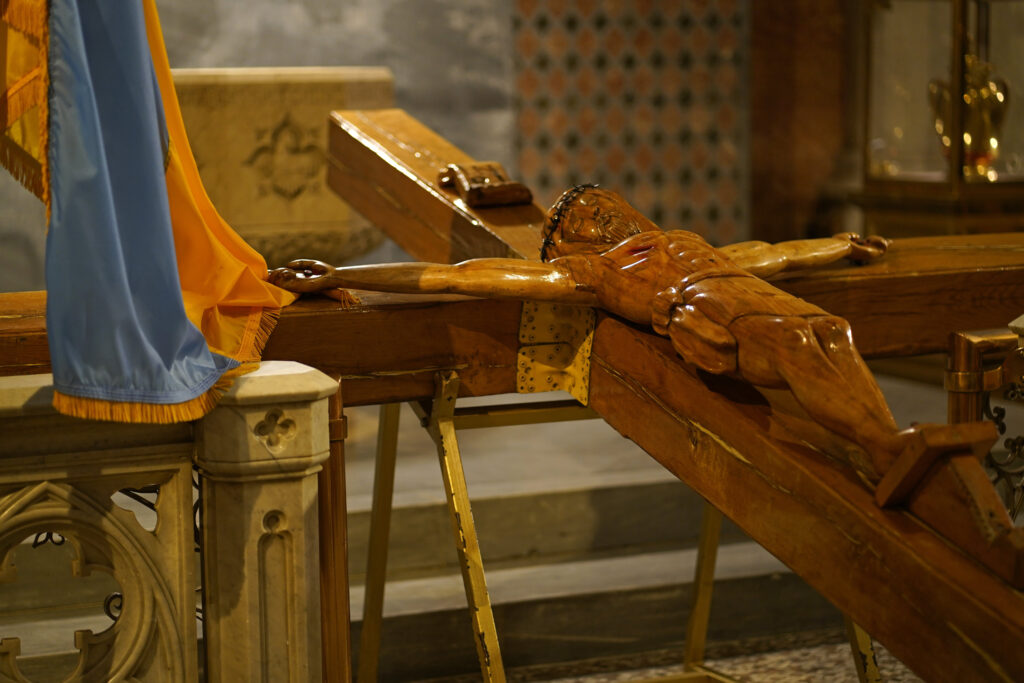
After immersing oneself in the movements of Holy Week, every faithful person has an important opportunity, says Father Jason Rocks, chancellor of the Diocese of Camden.
“See the 50 days from Easter to Pentecost as one long Sunday – of rejoicing in the Lord and in the newness of life that he has given us,” he says. “Really develop an Easter spirituality – I have died and risen with Christ, and my heart is now with him and in him, and I’m filled with joy from being one with the Lord.”
In the days leading up to Easter, Father Rocks, a canon lawyer, sat down with hosts of the Diocese’s Talking Catholic podcast, not only to discuss the movements of Holy Week, but to encourage the faithful to grow in the Lord every day.
Holy Week, he says, reminds the faithful that Jesus became incarnate. “That’s what we try to get through with our liturgies, that Jesus became flesh, the Word became flesh and dwelt among us and continues to dwell among us through his Church,” he says.
“Jesus became incarnate so that we could encounter God in an even more human way. Through our senses, we can look at him, we can touch him, we can hear him, if we’re close enough, we can even smell him. We allow these liturgies to help us raise our hearts and minds to what transcends. To the immortal God who became incarnate for our salvation.”
Beginning with Palm Sunday of the Lord’s Passion, Holy Week is a walking with Jesus, he says. “We have to remind ourselves that we’re that crowd on Palm Sunday that’s fickle. We love Jesus until it gets demanding, and then we’re like, ‘Crucify him.’”
In the Diocese of Camden, the Tuesday of Holy Week is the celebration of the Chrism Mass – a time when priests renew their promises and the bishop gathers with his priests to consecrate the Sacred Chrism and bless the Oil of the Catechumens and Oil of the Sick. Those oils are taken back to parishes to be used in the sacraments throughout the year.
“Oil burns – it gives off light and heat, which is what the Holy Spirit does. It enlightens us, and it fills us with the warmth of God’s love,” Father Rocks explains. “The perfumed oil reminds us there is a holy scent to God. And that our lives should give off a holy scent.”
When the bishop leans over and breathes on the Sacred Chrism during the Mass, it is reminiscent of Jesus breathing on the Apostles, saying “Receive the Holy Spirit.”
Christians, too, need to bring that breath of God into the word, Father Rocks says. “They need to be reminded that they’ve been anointed, that they’ve been made holy by their baptism, strengthened by confirmation and are constantly strengthened when they go back to the sacraments, especially Confession and the Eucharist.”
Moving into the Paschal Triduum, on Holy Thursday, the faithful are called to focus on the establishment of the Eucharist and priesthood. “The priest is asked to stand in the person of Christ. He is asked to identify with the host that is on the altar that he offers … to give his life for the people,” Father Rocks says.
At the Mass of the Lord’s Supper, Jesus washes his disciples’ feet, which, the chancellor points out, would have been quite dirty during those times of dusty roads and sandals. “He really got into the filth, so to speak. And all Christians are called to help their brothers and sisters in that way.”
After Mass, the faithful are invited to be with the Blessed Sacrament at an altar of repose, reminiscent of going into the Garden of Gethsemane with Jesus. It’s an opportunity, Father Rocks says, of “realizing just how human Jesus was.
“‘If it’s possible, let this cup pass from me,’ Jesus is saying. Nobody wants to do difficult things that are going to hurt. We all feel that way – God is too demanding, I can’t do it,” Father Rocks says. “But then knowing that God has given us grace in Christ to say the same prayer. ‘Not my will, your will be done.’ That is a prayer that is always answered.”
Continuing into Good Friday, all are reminded that death is a great mystery.
“What happens when you die? And then you add to that, what does it mean for a divine person to die in his humanity? And to know that he did that for me? Ponder that,” Father Rocks says.
Then, at the Easter Vigil, the faithful know that Jesus’ sacrifice on the Cross has been accepted. The sights, smells, and sounds – fire, candles, baptismal water and oils, litanies sung – are again a reminder of the Incarnation and that all are loved by God. “How great our dignity is that we are given a share in the life of Christ,” he says.
All of Salvation History has been leading up to this moment – Jesus’ Death and Resurrection. And the faithful share that life of Christ through the sacraments – whether it’s the catechumens brought into the Church or the congregation renewing their baptismal promises.
So after walking with Jesus through Holy Week – from his entry into Jerusalem and his agony in the garden to his Death on the Cross and Resurrection – unite with him, Father Rocks says. “Allow his life to fill yours so you can begin to live that new life in Christ.
“We will run into all sorts of difficulties; we all have our crosses,” he says. “But it is the Easter joy that gives us that strength we need to preserve and bear it well.”
To listen to the full podcast, visit talking.catholicstarherald.org.




 at the bottom and then tap “Add to Home Screen”
