




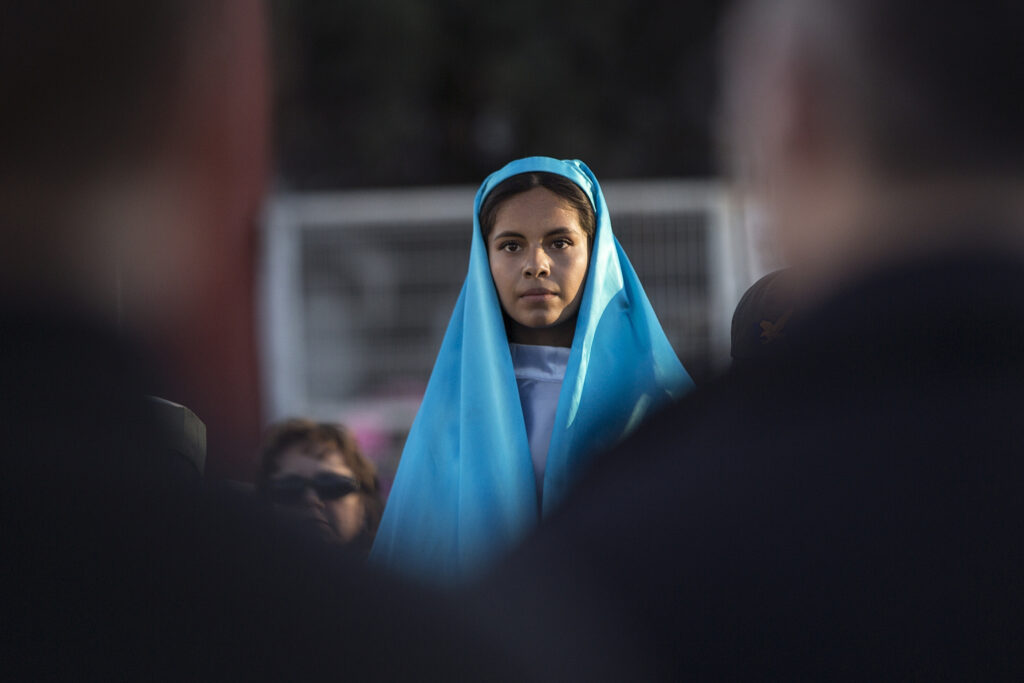
Faithful across the Diocese are being encouraged to walk with the Holy Family and welcome them into their hearts and homes this Advent and Christmas by participating in the Diocesan Posada.
“The Posada is so full of life. It puts you right into the Christmas story. You’re not reading history. You’re not reading about Mary and Joseph. You’re with Mary and Joseph. And really, you are like Mary and Joseph,” explains Bishop Dennis Sullivan. “That’s one of the big things that I think the Posada teaches – that we are pilgrims also in search. We’re on a journey, as much as Mary and Joseph were on a journey. And because we are Christians, we’re not going to reject them.”
Rooted in the Mexican culture, the Posada commemorates Mary and Joseph’s journey from Nazareth to Bethlehem and their search for lodging ahead of the Birth of Jesus. Celebrated for nine evenings before Christmas, Posadas traditionally include members of the faith community dressed as Mary and Joseph – accompanied by a procession – going door to door in search of refuge. On the last night, they are welcomed with festivities, food and piñatas for the children.
In the Diocese of Camden, the Posada (which means inn or hostel) will take place at 5 p.m. Dec. 18 at Saint Anthony of Padua Church, 285 Route 206, Hammonton. On this evening, all are invited to process around the church property with Mary and Joseph as they look for a place to stay. There will be music, singing and prayers – in Spanish and English – relating their story, and at the end, all will be welcomed with a Mexican meal and fun for children. The Posada will also tie in with the National Eucharistic Revival and its theme, “My flesh for the life of the world.”
“This evening will be a combination of pilgrimage, prayer and fellowship,” says Andrés Arango, Bishop’s Delegate for Hispanic Ministry and Director of Evangelization in the Diocese of Camden. “It is a good opportunity to live Advent, to prepare our hearts to receive Jesus.”
For Bishop Sullivan, the Posada is not only a way to pray, but a way to unite communities, something he saw firsthand when he was pastor of the Church of Saint Teresa in Manhattan. Tasked with bringing the Word of God to a congregation that included English, Latino, Asian populations and more, he utilized the Posada as a way to “bring the church to them, and then bring them to the church.”
At the time, the parish had a number of evangelization programs and small group studies taking place in people’s homes and apartments. The Posada became part of that pastoral outreach, with members of the faith community portraying Mary and Jesus going door to door.
“We had a whole dialogue that was used when Mary and Joseph would go to the door,” he explains. “Something along the lines of, ‘Who’s there?’ with the response of, ‘I am Joseph the Carpenter, but I am here with my wife, who is expecting a child.’ And then they would be let in to the home.”
“This gave people a real-life look at what it could be like to have Mary and Joseph in their home. They are pilgrims searching for a place to live,” Bishop Sullivan continues. “They could say to themselves, ‘I will give them welcome; I will give them a home. I will give them love. I will give them faith.’
“It was very beautiful.”
Eventually the Posada grew, culminating with Midnight Mass in Saint Teresa Church celebrated in multiple languages – English, Spanish and Mandarin with some Cantonese translations. Teenagers would vie to portray the holy couple, and upward of 50 angels would accompany their journey into the church.
“I was very pleased with how I felt people were learning and growing in their faith from participating in the Posada,” Bishop Sullivan says. “It was a way for the church to also say, ‘Come in, we want you here. This is where you can live, this is where you will be loved. This is where we will receive you.”
Just as his parish on Manhattan’s Lower East Side was diverse, so, too, are the six counties of the Camden Diocese he currently shepherds.
“Though Mexican in origin, the Posada has been adapted into many other Latino countries,” Bishop Sullivan says. “For those here in the Diocese who are not of these cultures, come experience the richness of this religious tradition. It’s not fancy theology. It’s very down to earth. It’s Mary and Joseph knocking at your door, and you’re invited to say, ‘Welcome, welcome, welcome.’”




 at the bottom and then tap “Add to Home Screen”
