







An anecdote about Saint Thomas More’s facial hair:
Because he would not support King Henry VIII’s separation from the Catholic Church, Saint Thomas More was about to be beheaded. As the executioner raised his axe, the saint shouted, “Stop!”
More used the brief pause to move his beard from under his chin to over the block.
“My poor beard” is not accused of treason, he explained, so it would be a shame for the axe to fall on it.
True or not, the story illustrates both Thomas More’s wit and his bravery. Famous for his death, the learned and accomplished saint was more than a martyr. Even in his own lifetime, he was known as a “man for all seasons.” He even influenced Shakespeare, whose play “King Richard III” famously used the change of seasons to describe England’s shifting politics:
Now is the winter of our discontent
Made glorious summer by this son of York.
In crafting his own portrayal of the king, the playwright used Thomas More’s “The History of King Richard III.”
The scholar Stephen Greenblatt devotes a substantial part of his book “Tyrant: Shakespeare on Politics” to “Richard III.” With an observation even more relevant in our current celebrity-centered culture than Renaissance England, he notes one of Richard’s “uncanny skills … is the ability to force his way into the minds of those around him, whether they wish him there or not.”
Cruel and devious, but also persuasive and charming, Richard is driven, Greenblatt writes, by “the joy of domination.”
Richard’s blatant lies are accepted by opportunists, enablers and those frightened into submission. While demanding unquestioning loyalty, he is loyal to no one. (Of his future wife, he says, “I’ll have her, but I will not keep her long.”) In Act 4, Richard’s closest ally – who urged him to adopt a false piety and pose with a prayerbook – hesitates to carry out a particularly immoral request. Act 5 begins with him being led to his execution.
English kings no longer behead opponents, but the world has not seen the last of actual and would-be authoritarians, or the end of debate over political power. In one unsettling exchange, Richard’s proxy argues against church sanctuary for a woman and child. He claims the times are too dangerous for church protection. In addition, he asserts, the child (being a child) hasn’t claimed sanctuary – and just doesn’t deserve it.
In 2000, Saint John Paul II proclaimed Thomas More the patron of statesmen and politicians. “His life teaches us that government is above all an exercise of virtue,” the pope wrote. “Unwavering in this rigorous moral stance, this English statesman placed his own public activity at the service of the person, especially if that person was weak or poor.”
The saint was brought to life for modern audiences with the Academy Award-winning film “A Man for All Seasons,” based on the play by Robert Bolt.
The on-screen Henry VIII, like Shakespeare’s Richard III, relishes his power over others. Many of his courtiers, in their efforts to win his approval, are unconstrained by moral qualms. More is an exception. Certain of his faith but free of self-righteousness, he does not divide the world into allies and enemies. He becomes the victim of those who do.
The ending of “A Man for All Seasons” includes a scene that alludes to Jesus’ encounter with the Daughters of Jerusalem on the way to his Crucifixion. More, walking to the executioner’s block, sees his own distraught daughter and tries to comfort her. “Death comes for us all,” he tells her.
Shakespeare’s “Richard III” also ends with the violent death of the title character and his last meaningful encounters. Before the fateful battle – “A horse, a horse, my kingdom for a horse!” – Richard is visited by the ghosts of those he has wronged. Each commands him to “despair, and die.” Richard, who had only utilitarian relationships, acknowledges, “If I die, no soul shall pity me.”
Thomas More composed many prayers, including one for a happy death. In another, written just before his execution, he asked for the grace to die without fear.
He also composed the Prayer for Good Humor. It ends: “Allow me the grace to be able to take a joke to discover in life a bit of joy, and to be able to share it with others.”
Martyrs are not generally remembered for jollity, but seemingly Thomas More was capable of sharing some humor – perhaps even with the man about to lop off his head.
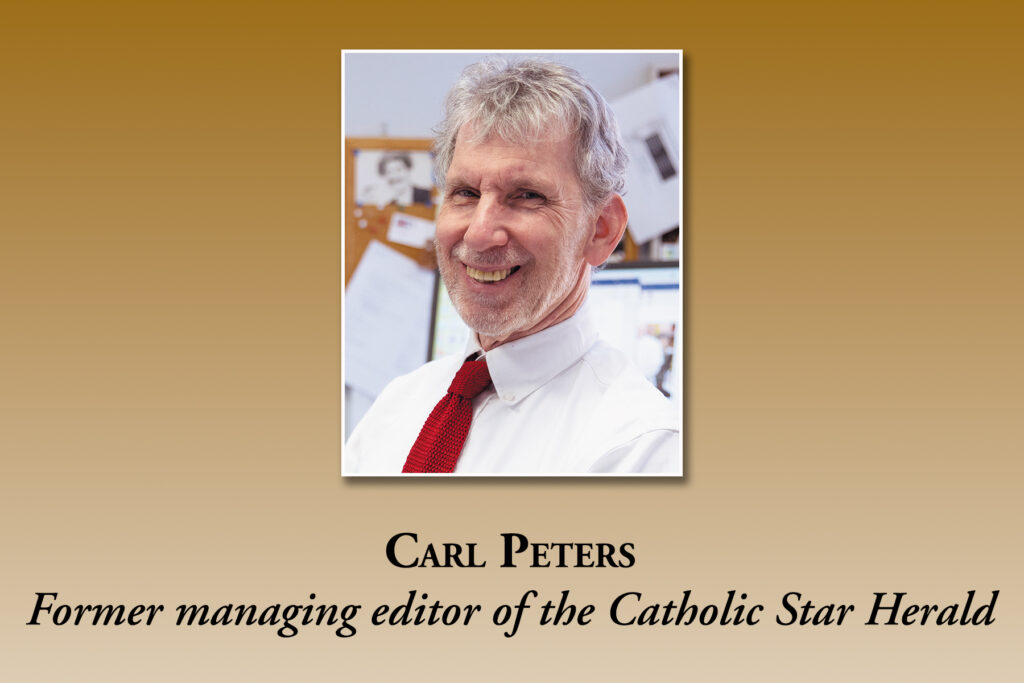
Carl Peters is former managing editor of the Catholic Star Herald.





 at the bottom and then tap “Add to Home Screen”
