




Moustafa Aldouri has told his story many times.
Torture. Displacement. Fear. Hope.
It hurts, he says, to relive those memories. “But if telling my story, over and over again, will help other people like me, then I don’t mind.”
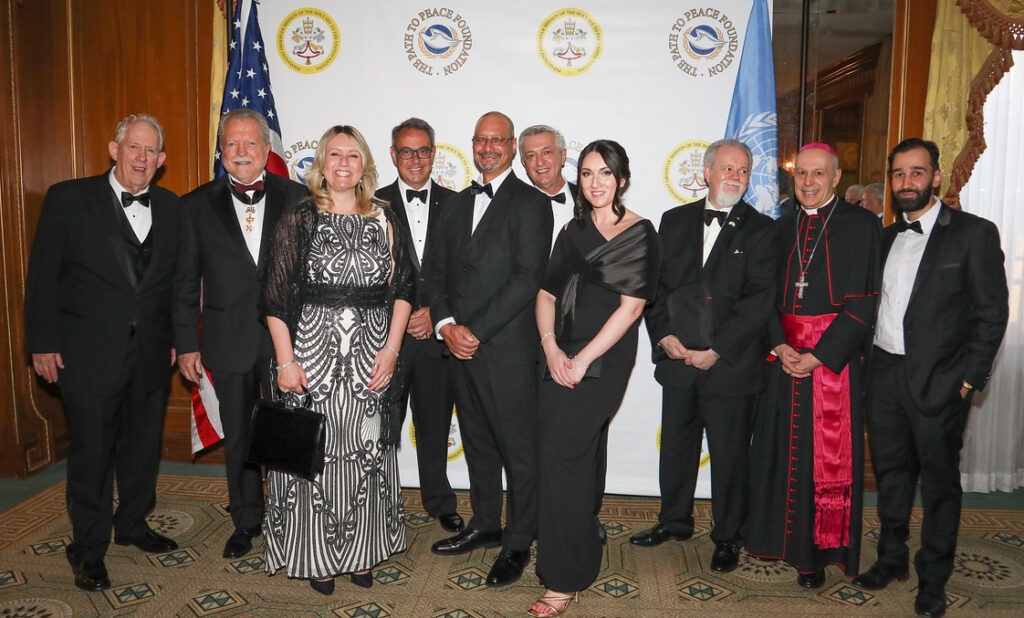
Aldouri, a case manager for Catholic Charities of South Jersey, was invited to share his Iraqi refugee story during the Path to Peace Gala on May 17 in New York City. The Path to Peace Foundation’s Gala supports the work of the Permanent Observer Mission of the Holy See to the United Nations in New York and urgent global humanitarian issues with expanding staffing and expertise. The foundation, though independent, collaborates with the Holy See Mission to make aware the Holy Father’s messages on Catholic Social Teaching with shared responsibility to challenge global indifference toward others.

Aldouri was 15 when he was snatched off the street, held for ransom and tortured for nine days. His kidnappers repeatedly called his parents, torturing him over the phone while issuing demands. “I was gone nine days, but when I returned, my parents had aged 10 years,” he recalled.
It was 2003, and with his once-peaceful home in Baghdad unsecure after the Iraqi government was overthrown, his family fled to Syria. After three years and with help from the United Nations, his family was relocated to South Jersey. Catholic Charities of South Jersey helped the family find resettlement and work.
“I want people to know that being a refugee is not an easy thing,” Aldouri said. “We go through a lot, but we survive.”
That was the message he shared with the more than 300 bishops and priests, celebrities and diplomats, relief workers, social justice advocates and everyday men and women who gathered for the Path to Peace Gala held at the Pierre Hotel on Manhattan’s Upper East Side. The evening’s honoree, Filippo Grandi, U.N. High Commissioner for Refugees, received the 2023 Path to Peace Award.
“Nobody makes as difficult a choice as refugees. The choice to leave behind everything that you have, that you know and that you love – that is the most difficult choice that any human being can make. Family, friends, home, work – to plunge into the unknown. And they have to do it to save their lives, the lives of their families. They have to do it to have freedom. To have hope in the future,” Grandi said.
Grandi, whose 40-year legacy of working for refugees and displaced people began as a volunteer with Catholic Relief Services, said Europe is facing the fastest-growing refugee crisis since World War II. There are more than 100 million refugees and displaced people in the world today.
“We often think of refugees as people coming to the rich countries,” he said. “But most refugees go to the countries located next to their country, and very often, those countries have big challenges and few resources.”
Aldouri knows he is fortunate to have arrived in the United States in 2008; he is grateful for Catholic Charities’ help in resettling his family in South Jersey.
“I know how painful it is to come from a place where you know everybody, you have your life put together. Then you lose all that, and you come here and you know nobody, you have nobody. That’s tough.”
His experience is one reason why he wanted to work with Catholic Charities in the Diocese of Camden. Like his clients, “I know what it feels like to lose everything.” He continued, “Refugees give back a lot to their community. Yes, they struggle, but as soon as they are self-sufficient and comfortable in their position, they start giving back.”
That sentiment was exemplified during the gala, which is also a main fundraiser for the Path to Peace Foundation. An Iraqi couple who fled Baghdad in the 1980s shared their refugee story with Aldouri after dinner. They also thanked him for publicly sharing his story.
“That was nice to hear from someone who has shared a similar experience. They said they were proud of me and that I did justice in describing what we went through,” he said.
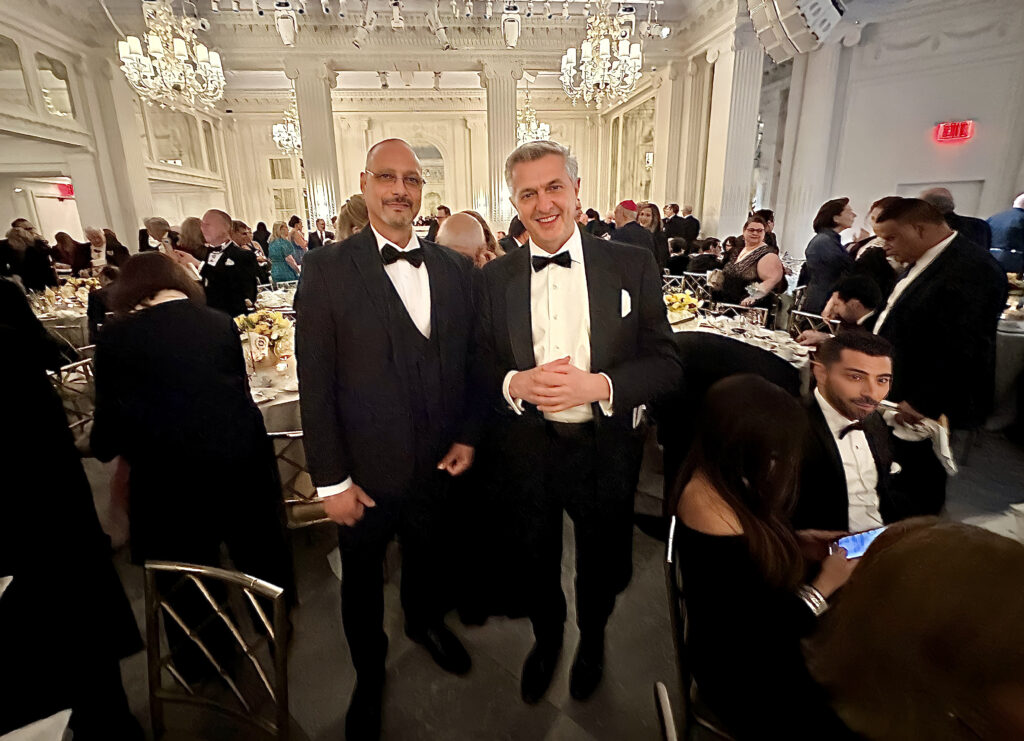
Jose Sanchez, director of Immigration, Refugees and Migrant Services, was among the four employees from Catholic Charities South Jersey invited to the gala. He said he witnessed many people approach Aldouri and thank him for sharing his story. He urged all to heed the Catholic Church’s call to welcome the stranger.
“The person who is coming from another country – who is moving into our Diocese – is our neighbor, a person of God, a human being in need of help,” he said. “Refugees are resilient people who have managed to do this trek on their own or for their children. They aren’t needy people who can’t accomplish anything. They just need help to navigate the system once they arrive.”
Archbishop Gabriele Caccia, Permanent Observer of the Holy See to the United Nations and president of the Path to Peace Foundation, echoed those sentiments in his opening address. He noted that this year marks the 60th anniversary of Pope Saint John XXIII’s encyclical “Pacem in Terris.”
He quoted from the encyclical’s teaching on refugees, which states, “It [is] impossible for us to view without bitter anguish of spirit the plight of those who […] have been exiled from their own homelands. There are great numbers of such refugees at the present time, and many are the sufferings – the incredible sufferings – to which they are constantly exposed.”
Said Archbishop Caccia, “It is amazing how these words are still as true today as they were 60 years ago, and in a context which is maybe worse and doubtless more globalized than at that time.”
Aldouri said he still considers himself a refugee “because I can never forget where I come from. … I would love to see more people interact with refugees – just to talk to them, to ask them how they are doing, how their day has been. Just the basics. A lot of people are scared of refugees – but we are just regular people.”
Aldouri said he is grateful for the opportunity to have shared his life experience with dignitaries from the Holy See and United Nations and is hopeful it will make an impact. He continues to be proud of the work being done by the staff of Catholic Charities of South Jersey.
“I wish the whole world was like our environment,” he said. “We don’t care where you are from or what religion you practice. If you need the help, we’ll help you. And if we need the help, you’ll help us. I’m sure whatever religion you practice directs you to help others. We all have the same goal.”



 at the bottom and then tap “Add to Home Screen”
