





As American Catholics, we give thanks to God for bringing us safely through a hotly contested but peaceful election. Some are happy with the outcome; some are not. But all of us can breathe a sigh of relief that it is finally over.
This period of transition leading up to the inauguration of a new administration is a good time for us to consider what our response should be to the new political situation and how our faith as Christians might help us in the process. Sacred Scripture certainly provides ample opportunities for us to do so.
It is noteworthy that, in the Book of the Prophet Isaiah, God uses a secular ruler – a pagan one at that – to accomplish his purposes. Jerusalem had fallen to the Babylonians in 587 BC, and the Jews who did not perish were driven into exile. Eventually, the Persians replaced the Babylonians as the dominant force in the Middle East, and their ruler, Cyrus the Great, issued a decree permitting the Jews to return to their homeland. Cyrus was even given the title God’s “anointed” one, that is, “messiah.” And he didn’t even know God!
The prophet proclaimed: “Thus says the Lord to his anointed, Cyrus, whose right hand I grasp. For the sake of my servant Israel, my chosen one, I have called you by your name, giving you a title, though you knew me not. It is I who arm you, though you know me not.” (45:1, 4-5) Furthermore, God said, “He shall rebuild my city and let my exiles go free without price or ransom.” (45:13)
However, according to another Old Testament tradition, Cyrus was indeed aware that his power came from God, and that God had charged him to rebuild the Temple in Jerusalem. By decree, he returned to the Jews all the gold and silver vessels that had been plundered from the Temple of Solomon before it was destroyed. Then he ordered his subjects who were their neighbors in exile to provide gold, silver and all kinds of goods and livestock to them as they began their journey back home. (Ezra 1)
The repercussions of those events are clear. God is sovereign. God is in control. God remains on his throne in spite of any shift in earthly power. Furthermore, God can and sometimes does use leaders of nations to fulfill his will whether they are aware of it or not, and even if they don’t know Him at all.
In the New Testament, reference to obedience to government leaders is made in a number of places. Jesus taught that we should render to Caesar what is Caesar’s. (Mk. 12:17) Saint Paul said that everyone should be subject to the governing authorities. (Rom. 13:1) However, it is understood that their governing authority comes from God. “There is no authority except from God, and those that exist have been instituted by God. Therefore, whoever resists the authorities resists what God has appointed.” (Rom. 13:1-2) Thus, the presumption is that civil officials will govern in a godly manner with honesty and integrity.
With those things in mind, we must honor and respect the office of president and the president himself. In doing so, we honor the will of God and respect our democratic institutions. At the same time, we should never cease to encourage the president to do what is right and good in whatever ways are available to us. As both Catholics and Americans, we should feel free to criticize, but never demonize, the president if and when he should fall short in governing as God would have it. We should pray for our president every day, realizing that, whenever we pray for him, we are really praying for ourselves.
May the Holy Spirit inspire the president-elect and all newly elected officials to govern wisely and virtuously.
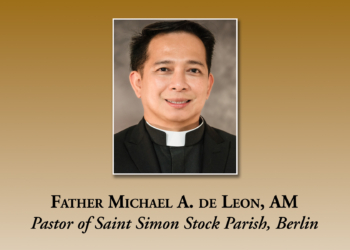
Father Edward Kolla is a retired priest of the Diocese.



 at the bottom and then tap “Add to Home Screen”
