




Because my paternal grandparents’ names were Constantine and Helen, I have long been fascinated by those two Christian icons, undoubtedly linchpin figures upon whom all of history turns. The first Emperor to endorse the faith is a monumentally important character, even if his supposed “Donation” to Pope Sylvester is, as one scholar calls it, “the most infamous forgery in the history of the world.”
It is largely due to the changes this soldier-turned-emperor who was baptized on his deathbed wrought in the Church regarding wealth, power and status that Dante laments in the Inferno, “Ah Constantine, how much foul harm was fostered, not by your conversion, but by the dowry which the first wealthy father took from you?” (XIX;115-117).
But for all his faults, which I am learning more about by currently reading the excellent new book “Constantine At the Bridge” by Stephen Dando-Collins, it’s his nephew Flavio Claudio Giuliano, who we know in English as Julian the Apostate, that unleashed even more tangible and terrible harm upon the nascent Christian community.
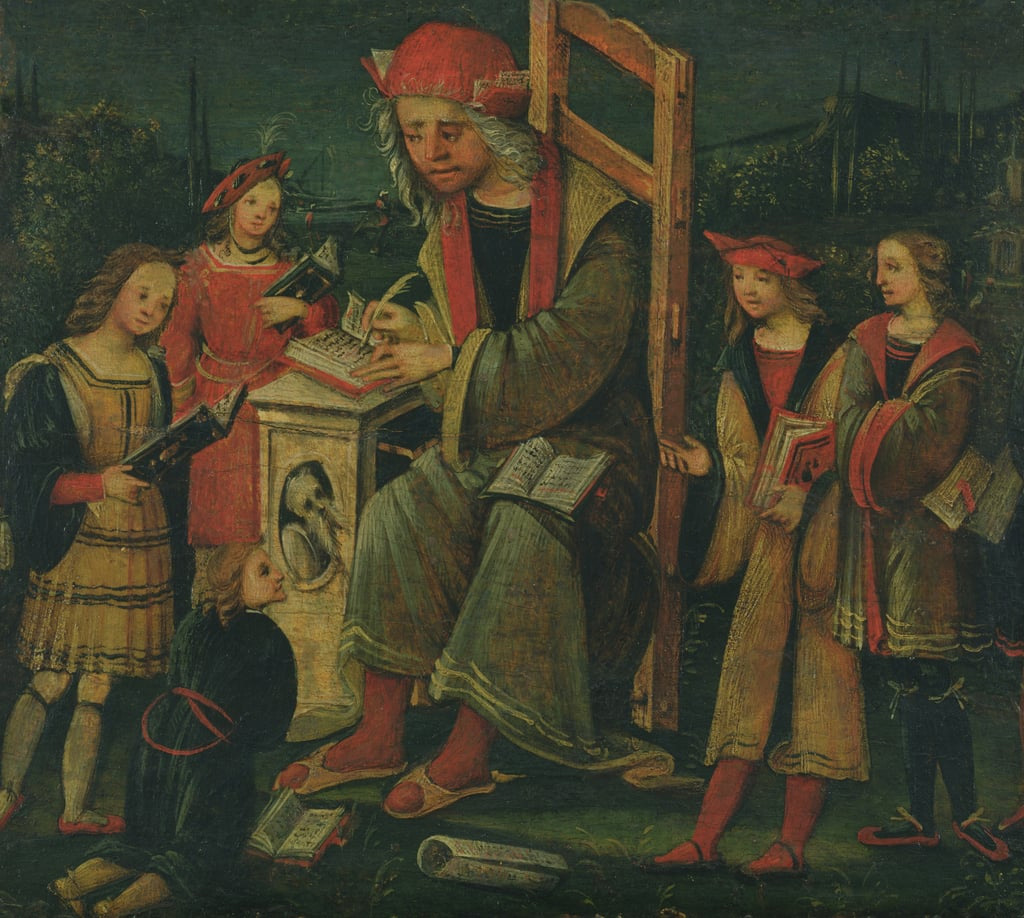
A local school teacher of the day, Cassian of Imola, refused to submit to Julian’s efforts to reinstate worship of the pagan gods across the Empire after Constantine’s death and incremental movement toward toleration. Julian’s response was to incite violence among Cassian’s largely pagan students and encourage them to exact punishment on their former teacher without restraint. Cassian was bound to a stake and his students attacked him with metal styli, the instruments they used to inscribe their lesson notes on wax writing tablets. Some allegedly went so far as to carve their initials into his flesh. He eventually bled to death from these “thousand cuts.”
The traditional date of this martyrdom is Aug. 13, 363, and so he is annually remembered each summer in various places where he is venerated – Italy, the Canary Islands and Mexico City, to name but a few. There is a basilica dedicated to him in the Italian region of Emilia-Romagna, not far from Ferrara and Ravenna. The amazing artwork across the centuries depicting Cassian’s pupils in revelry torturing their former instructor ought to strike fear into the heart of anyone who has spent time in front of a classroom or grading papers.
But on a more serious note, Cassian can serve as an inspiration to those of us who find our vocation in educating future leaders, whether in Catholic settings or beyond. The word education itself comes from the Latin “ex + ducare,” meaning “to lead or draw out of.” Whether it is in reference to Plato’s Allegory of the Cave, or the Matthean Gospel’s instruction to draw out of the vast storehouses of potential, treasures both old and new (Mt 13:51-53), those of us who feel called to such a vocation co-travel each day with our students on the path to wisdom.
Every good teacher is first a good learner, and so the daily undertaking is less about handing on pristine coins of knowledge that we have accumulated in our own course of studies, as it is about learning with, from, through and alongside our students. In the process, we ultimately hope to instill capacities for compassionate and critical service to society, and to cultivate potential agency and protagonism (not to be misinterpreted as antagonism) in their own future callings.
As Paulo Freire puts it, “The more students work at storing the ‘deposits’ entrusted to them, the less they develop the critical consciousness which would result from their intervention in the world as transformers of that world. The more completely they accept the passive role imposed upon them, the more they tend simply to adapt to the world as it is and to the fragmented view of reality deposited in them.”
I can attest that my students’ minds are much more than Cassian’s pupils’ waxen tabulae rasae, waiting for us to inscribe our worldviews and prejudices onto them with bloodstained implements.
Whether embodied by Constantine at the Milvian Bridge, or Cassian at the literal point of the pen, or the Great Commission at the Ascension, Christianity has always sought to transform the world. But as Paul asks, “How shall they believe in him of whom they have not heard? And how shall they hear without someone to proclaim it to them?” Educators serve this role as fearless heralds of a new and transformed tomorrow each and every day, no matter their disciplines or specializations.
Paul answers then his own rhetorical question, which can apply also to teachers of every kind: “How blessed and beautiful are the feet of them that bring glad tidings of good things.”
Originally from Collingswood, Michael M. Canaris, Ph.D., teaches at Loyola University, Chicago.




 at the bottom and then tap “Add to Home Screen”
