





In this liturgical season of transitioning into Lent, the Church celebrates the memorials of three heroes to the faith from the United Kingdom: Blessed Roger Filcock (Feb. 27), Saint Nicholas Owen (March 2) and Saint John Ogilvie (March 10). These figures were all Jesuits martyred for the faith in the Elizabethan and Jacobean Age, the period that ran from Queen Elizabeth’s accession to the throne in 1558 to the death of King James I in 1625.
The English College at Rheims (responsible for a famous translation of the Scriptures called the Douay-Rheims Bible) was a seminary that for a time prepared priests to re-enter England to minister to believers there during waves of persecution when it was illegal to practice Catholicism on the British Isles. Roughly one-third of the missionaries sent across the English Channel in this era were executed.
Filcock had been ordained a priest in Valladolid, Spain, and subsequently officially entered the Jesuits in 1600, but was still early in his formation in the novitiate when he was apprehended for celebrating Mass, sent to Newgate Prison in London, and eventually hanged, drawn and quartered.
His fellow member of the Society of Jesus, Nicholas Owen, was a lay brother and a famous constructor of “priest holes,” secret chambers in concealed areas beneath floors or behind false walls where occupants could hide clergy during raids in Catholic castles or country homes of the time. Not only could the celebrant conceal himself there if necessary, but most of the vestments and altar supplies could be stored away in the spaces for secret Masses.
In a book on these hiding spots, Allan Fea claims, “With incomparable skill, Owen knew how to conduct priests to a place of safety along subterranean passages, to hide them between walls and bury them in impenetrable recesses, and to entangle them in labyrinths and a thousand windings. But what was much more difficult of accomplishment, he so disguised the entrances to these as to make them most unlike what they really were. Moreover, he kept these places so close a secret that he would never disclose to another the place of concealment of any Catholic. He alone was both their architect and their builder.”
The exhaustive list of these secret places behind trap doors and underneath excavated rock piles is incredibly extensive. Some theorize others remain undiscovered even today.
Owen was eventually arrested, tortured and died on the rack at the hands of his captors. Both Filcock and Owen had known Saint Anne Line, one of the women of the era who helped manage the movement of clandestine priests who visited the recusant Catholics struggling to maintain their faith, and who was herself also executed.
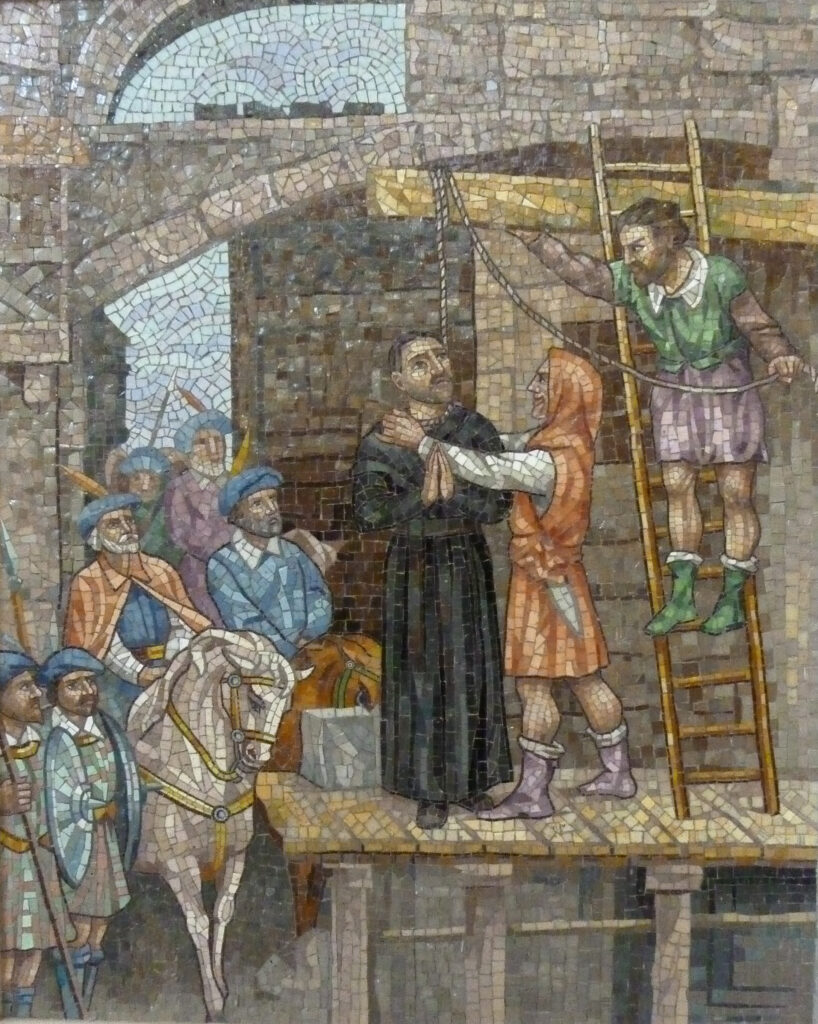
John Ogilvie is probably the best known of the figures mentioned here, a Scottish Jesuit who had studied in Germany and Paris. He re-entered Scotland posing as a horse trader, and then spent about a year traveling to celebrate Mass and hear confessions in secret near Glasgow. Like the others, he was eventually discovered, imprisoned and condemned to die. While hanging from the noose, he supposedly threw a concealed rosary into the crowd, and when an onlooker caught it, the experience thawed his heart and converted him. Ogilvie is still revered as the only post-Reformation Scottish saint.
In venerating these admirable figures, it is, of course, also imperative to note that Catholics in many places also persecuted Protestants during this extended period of religious wars that helped construct the “modern” world. Jan Hus being burned alive comes to mind. And so the terrible violence of the era was in no way one-sided. The notion that each side was shouting “Christ is Lord” as the bodies swung from gallows or smoldered on pyres around them still staggers the mind, and powerfully manifests the scandalous state of disunity that scars the Church of Christ into our day.
As one timely and profound example, most would identify both Russia and Ukraine as overwhelmingly “Christian countries.” And yet, as so often in history, their shared faith recedes in the face of other geo-political, economic, or territorial concerns, which leads to animosity, distrust, and, ultimately, sheer terror. These are undoubtedly all marks not of the Church, but of “the enemy of human nature,” as Saint Ignatius names it. No reality could be more antithetical to the community of Jesus’ disciples and their ongoing mission to bring Light to the world.
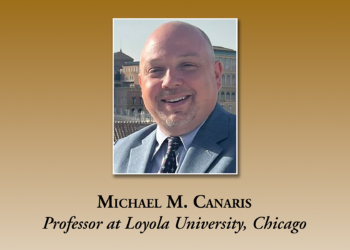
Originally from Collingswood, Michael M. Canaris, Ph.D., teaches at Loyola University, Chicago.



 at the bottom and then tap “Add to Home Screen”
