






About 400 delegates gathered from around the world last week at Boston College for the 2022 Assembly of the International Association of Jesuit Universities. Following up on earlier iterations in Mexico, Australia and Spain, those of us in attendance were able to devote four days to sharing and discerning collaborative paths forward concerning the future of higher education across borders and oceans.
When Saint Ignatius of Loyola originally gathered a group of like-minded enthusiasts around him (including eventual Saints Francis Xavier and Peter Faber) in the attempt to develop something new in the Church, the last thing on all of their minds was the institutional immobility that comes along with founding schools. They had their eyes set on Jerusalem and the hope to be missionaries, or even potential martyrs, in foreign lands. But their primary aim was the “care of souls,” and so they realized early on that this demanded an attentive ear so as to be able to respond concretely to the actual needs of the people they encountered. Within decades, they had founded dozens of schools to educate the rich and poor alike, and eventually the Roman College, which became the first real Jesuit university, now called the Universitá Gregoriana. There are more than 800 educational apostolates of various kinds in the network today.
The goal of our gathering was to discern collectively the future of higher education across our continental and regional networks in a manner authentic to this patrimony. A number of administrators, faculty, staff and students from around the world met to strategize about how best to facilitate cooperation and learn from one another’s strengths, and contemplate where we ought to be moving ahead together.
After 25 years on campuses entrusted to the Society of Jesus, I was able to reconnect with many friends and colleagues from various places, and make countless new ones. One of these close friends and cherished colleagues is Dr. Emilce Cuda, the Secretary of the Pontifical Commission for Latin America, and one of the highest-ranking women to ever work in the unique sociological world of the Vatican. She and I are designing a series of courses to be taught across North and South America, based on the “four dreams” Pope Francis describes in “Querida Amazonia.” We were able to build “puentes” (bridges) in person with many of the 30 schools in the AUSJAL network of Jesuit universities across Central and South America. We plan to begin offering bilingual courses through this new project in January, and will be meeting in Rome next month to firm up many of the logistics.
It is clear that issues like migration, ecological devastation, inter-religious dialogue, rising secularism, global economics, racial reckoning, political division and the shifting role of theology in the public square will loom large n the coming years as the 27 universities in the United States and hundreds around the world seek to implement and integrate Ignatian and Catholic values – which are never antithetical to one another – within their commitment to educating more than a million part- and full-time college students around the globe. This can only be done effectively if we model Ignatius’ willingness to seek God in all things, and to set the world on fire with our dedication to respond to individual and societal needs as the defining characteristic in our “way of proceeding.”
A theological approach that remains locked in the ivory tower of privilege, elitism and pretension can have no knowledge of or relevancy to an academy and world both already somewhat skeptical of its competence or suitability to offer opinions in the various public arenas of contemporary life. The contextual theology that defines much of our existence at Jesuit universities must be intellectually rigorous in its study of the historical discourses that contribute to the “handing on” and active reception of the broad inclusive Christian tradition (and thus fully and really theological), but also wholly immersed in and engaged with other streams of knowledge (and thus fully and really contextual). It must reach out unceasingly to other disciplines, to learn from them, in every conceivable field from hermeneutics to public health, from psychology to church management, from astrobiology to zoology; and relentlessly turn what it learns into a contemplative and critical pedagogical enterprise, one tireless in its commitment to oppose institutional violence, whether social, economic, ecological or ecclesial, and overturn systems that wreak havoc upon God’s children, spread across every continent, social class, religious profession and ideology.
This is an essentially ecclesiological endeavor, for it is in reality a vision of the Church and of our professional lives in relation to our spiritual ones that lies at the heart of the project. We must choose the standard with which we will associate ourselves, to use Ignatian imagery: those broodingly poring over volumes in the library of the Prodigal Son’s parable’s elder sibling, condemning the malevolence and seduction of his brother’s wanderlust and lamenting the catechetical and moral shortcomings of this current wicked generation, or those rushing out with the (Holy) Father into the (Buenos) Aires of the streets to enrobe with sanctity that which others deem profane, and to celebrate with authenticity their embrace, even if there are, to be sure, still remnants of the swine’s pods to be found there.
Pope Francis has said repeatedly that he seeks a “poor Church for the poor” and one that is “bruised, hurting and dirty.” Contributing to the growth and continual purification of such a Church from our unique and institutional positions of influence is a gauntlet that today lays at our feet as leaders in this truly unique and unrivaled network, and should be one that informs our future initiatives, aspirations and methods at every step along our shared “camino.”
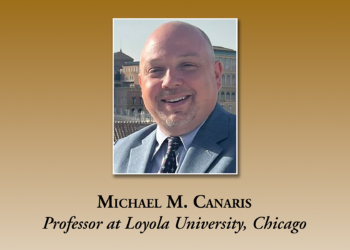
Originally from Collingswood, Michael M. Canaris, Ph.D., teaches at Loyola University, Chicago.



 at the bottom and then tap “Add to Home Screen”
