




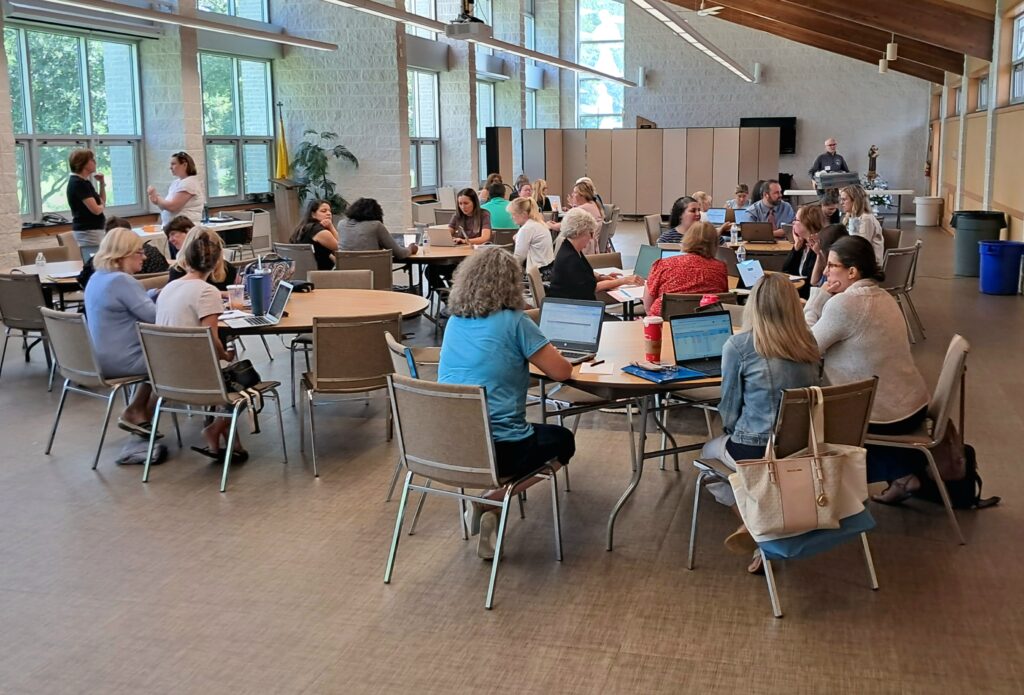
A collaborative, years-long effort led by the diocesan Office of Catholic Schools – which involved each of the 29 elementary and high schools across the Diocese of Camden – has achieved a significant milestone.
Following an intensive site visit over a three-week period in October, a team of 13 volunteer educators representing the Middle States Association of Elementary and Secondary Schools (MSA) has recommended full accreditation of all diocesan institutions as a network of schools for the next seven years – a designation expected to be made formally in April.
Network accreditation for all diocesan Catholic institutions replaces the former approach, through which each school would work towards Middle States accreditation individually. Dr. Bobby Lockwood, diocesan director of curriculum and assessment for Catholic schools, recalls a meeting in October 2023 with school principals, during which they explored this very approach and discussed some of its challenges.
“The meeting revealed that individual school accreditation has been fraught with challenges, including schools being limited to attain goals with limited resources, inconsistency with developing and adhering to goals based on principal and teacher turnover, and the ability of the Diocese to provide adequate support to schools with over 150 combined goals,” said Lockwood. “MSA recognizes these challenges and offers an option whereby all of the schools in a diocese work together with their Office of Catholic Schools to pursue MSA accreditation at the same time.”
This collaborative approach – referred to as a “network accreditation” – establishes common goals for all schools, while allowing individual institutions to add objectives unique to their communities. It also reduces the administrative burden on individual schools and promises a combined $75,000 in accreditation-related cost savings.
“Shared accreditation would also allow for more manageable distribution of the workload associated with establishing that each school meets accreditation standards and with developing goals and objectives,” said Lockwood. “The investment in network accreditation would yield efficiencies in supporting schools with professional development and shared programming and accountability over the duration of the accreditation.”
With all schools endorsing the network accreditation approach, the process kicked off in May 2024 and was led by Lockwood and assistant superintendent Dr. Sarah Kerins.
A key part of the process was identifying three Diocesan-wide accreditation goals: increasing language literacy skills for all students; enhancing Catholic identity more fully; and having adequate resources for effective school operations.
“The goals were developed by the Diocesan planning team of approximately 40 people,” said Lockwood. “We used survey feedback from parents, students, teachers, and school administrators and other data, such as standardized test scores, to help shape the goals.”
Each school developed strategies and action steps to work towards those three overarching goals, and had the option to add two additional goals as well.
Dr. Rachel Sole serves as the school counselor for St. Margaret Regional School, Woodbury Heights. She was also one of the internal accreditation coordinators for her school, and found the self-study phase of the process to be valuable for her institution.
“Our school community was very reflective in terms of our current instructional practices versus where we would like our students to be with regard to achievement,” she said, “as well as how our foundational documents highlight our school’s values.”
The process encouraged the team to update their school’s mission statement to ensure it provides a clear summary of their institutional values. Now, the mission references their goal of “developing world citizens who are rooted in faith, academics, and service in the Franciscan tradition.”
Sole sees Middle States accreditation as reinforcement for students and parents that the Woodbury Heights school holds itself to the highest standards.
“It demonstrates to both current and future SMRS Saints that we consistently evaluate not only the quality of education that is provided to students,” she said, “but also the environment that we shape to support a student’s spiritual, academic and social-emotional development.”
She described the accreditation process as a true team effort, expressing appreciation for their faculty, staff and administrators as well as the Diocesan Office of Catholic Schools.
“Each person involved was willing to offer ideas, resources, or just a general ‘you’ve got this’ reminder throughout each step of the journey to accreditation,” she shared. “Having the support from both within and outside of our school was a blessing and something for which I am so grateful.”
Resource director and teacher Crissy Bruce served as an internal accreditation coordinator for Resurrection School, Cherry Hill – another school that has already made improvements thanks to the network accreditation process.
Since the Middle States site visit in October, they have mobilized a teacher to provide additional support to students in kindergarten through the third grade, working in small groups on skills related to math and reading. Several teachers are also piloting a program that is grounded in the science of reading and that uses phonological awareness, decoding, text fluency and comprehension to support learning and growth.
“Our teachers have continued to work collaboratively to expand their classroom libraries and are working diligently to strengthen students’ reading skills and strategies,” said Bruce.
She sees the clear value of accreditation for her school, and others across South Jersey.
“It demonstrates that we meet high, nationally recognized standards and are committed to continuous improvement,” she said. “The process requires ongoing reflection on curriculum, teaching practices, and student outcomes to ensure we are meeting students’ needs.”
She added, “for current and prospective families, accreditation provides reassurance that our programs, leadership, and support services have been thoroughly reviewed by an independent organization and found to be effective. It also reflects our commitment to accountability, stability, and long-term planning in a supportive, faith-based environment.”
Trish Mancuso, principal of St. Mary School, Williamstown, shared a similar perspective on the benefits of accreditation. She noted that past Middle States goals – including assigning each grade level a saint that they learn about throughout the year, and incentivizing good deeds among students – continue to be part of the school’s traditions.
“Middle States accreditation affirms that we are committed to excellence and accountability,” said Mancuso. “It promotes continuous school improvement as it requires schools to engage in self-study, reflection and goal setting.”




 at the bottom and then tap “Add to Home Screen”
