




Virtue, noun: morally good behavior or character; a good and moral quality; the good result that comes from something
Throughout Catholic schools in the Diocese of Camden, students are modeling the virtuous life, guided by programs that recognize and encourage them in their good deeds.
From shoveling snow for their pastor, to acting as role models for their younger peers, these students are stepping up.
Close to the Faith
“I feel good, and I always want to do more,” said Abby Rosado, eighth-grader at Saint Peter School in Merchantville.
On a recent Monday during her school’s weekly morning assembly, she was commended for practicing charity in the classroom by assisting a teacher with classroom cleanup and being a valued member of the yearbook club.
“Doing good always gets you in a good place,” said Rosado, who takes pride in being someone the younger students can look to.
“I’m stepping up to be a leader,” she added.
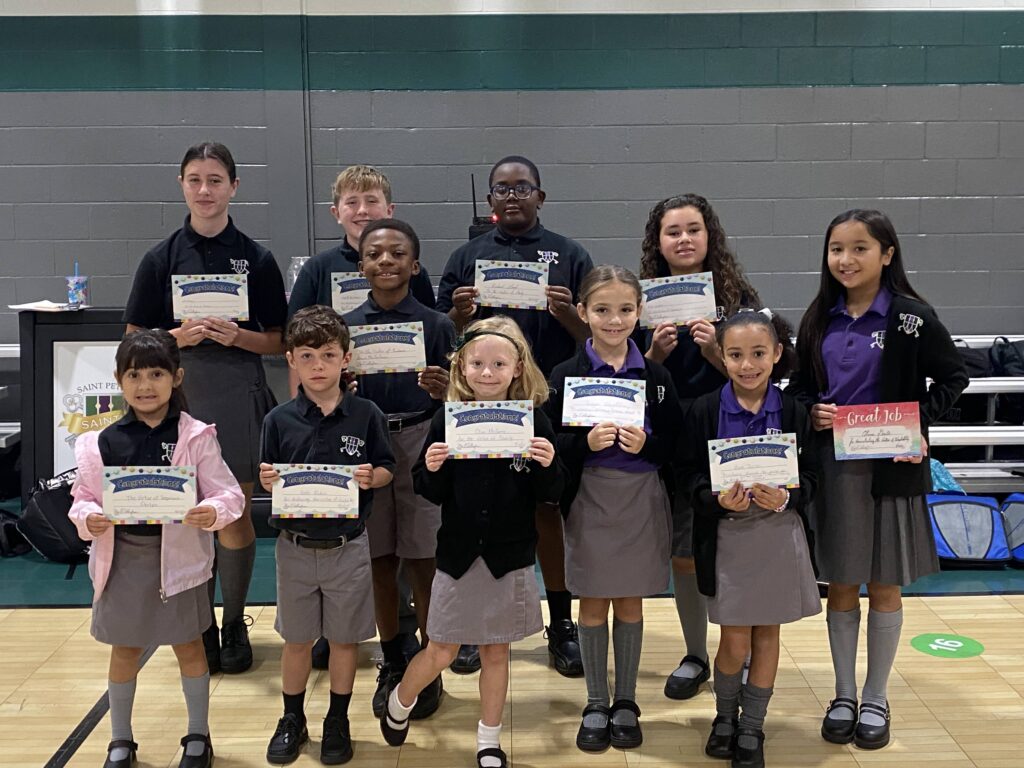
Every Monday morning, school students from K-8 are recognized as standard-bearers for such virtues as faith, hope and charity (the theological virtues), and justice, temperance, prudence and fortitude (the cardinal virtues).
Rosado’s classmate, Daribel Rosario, also recently received the virtues of fortitude and charity for taking photos at the school’s JV basketball game.
Initially unsure of her abilities, Rosario now takes pride in stepping out of her comfort zone and capturing photos on the court. Gaining confidence as a budding photojournalist, she hoped others would be inspired by her path.
“One small little task can encourage students to do something that they might be scared to do,” Rosario said.
The virtue certificate program at the school was started three years ago by Nancy Knipp, Saint Peter School seventh-grade homeroom and middle school math teacher, as a way “to keep students close to their faith,” Knipp noted.
The program “helps students realize that everything can be tied to our faith. We’re taking the teachings of the Lord and making them real.”
In another example of charity, she explained, two students recently helped Father Tim Byerley, school pastor, in shoveling snow in the school’s parking lot and clearing a safe path for the community.
Kathy O’Callaghan, Saint Peter principal, said that every Monday “the school is celebrating our faith and each other. We’re highlighting the amazing things our students are doing and reinforcing positive behavior.”
There is intention in recognizing each student in front of the entire student body, she emphasized.
“What better way for students to learn than from each other?”
“We’re infusing the Catholic culture here. Our mission is to bring people closer to Jesus, and we’re doing that.”
Many houses, one family
At Holy Angels School in Woodbury and Our Lady of Hope Regional School in Blackwood, the schools are taking similar tactics to steep the culture in good habits, with their respective student bodies’ separated into different “houses” of virtue, to build community, leadership and school spirit.
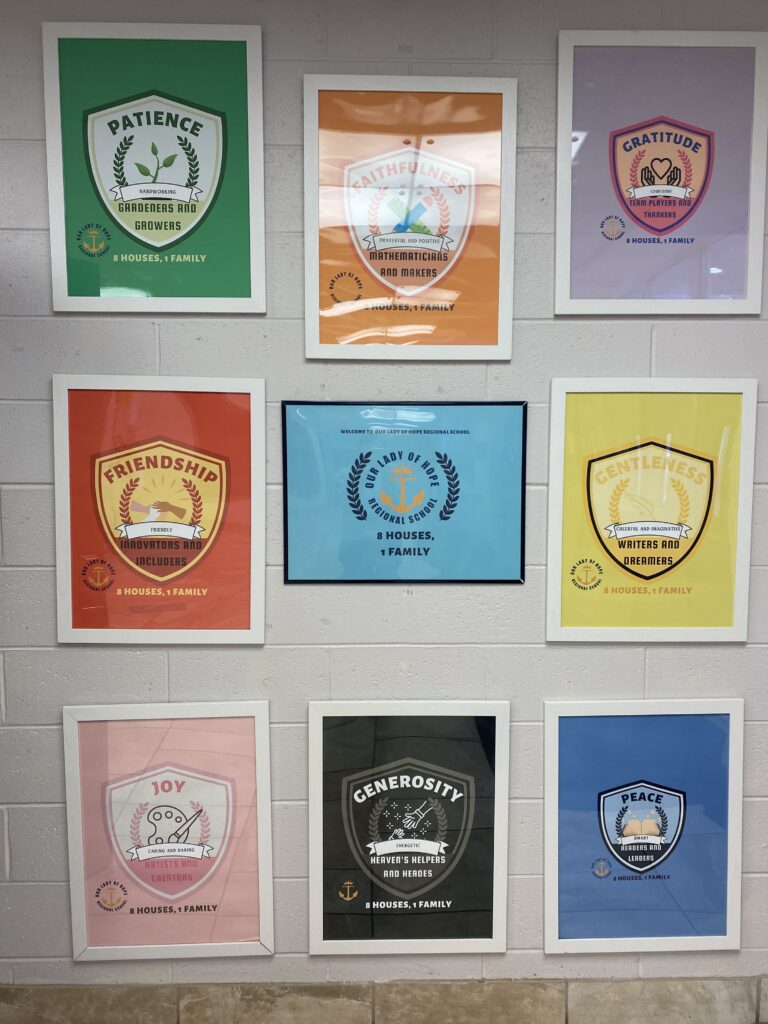
At Our Lady of Hope, K-8 students are placed into one of eight houses of virtue, complete with a special signifying color: Patience (green), Friendship (red), Joy (pink), Faithfulness (orange), Generosity (black), Gratitude (purple), Gentleness (yellow), and Peace (blue).
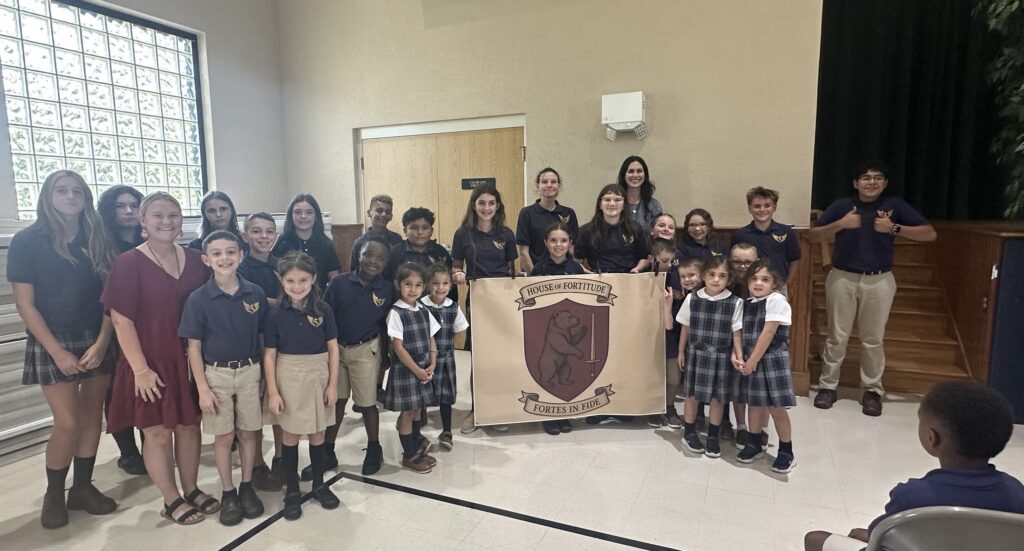
At Holy Angels, the students are placed into four houses: Justice (blue); Fortitude (red); Prudence (yellow); and Temperance (green).
With these fun, motivating, and fruitful initiatives, students are being formed in faith and camaraderie.
As the youth proudly wear their colors and engage in regular meetings at Our Lady of Hope, school staff are happy witnesses to “our students helping each other and working together to think of ways to foster holy friendships at school,” said Principal Elizabeth Martino, who is a part of the House of Friendship.
Holy Angels eighth-grader Leah Bosco, who serves as captain for the school’s Justice House, added that through their own prayer gatherings, meetings, games and activities, not a day goes by when students aren’t reflecting on their virtues.
“We’re connecting with God’s word here, in a fun and unified environment,” she said.
Through spirited competitions such as capture-the-flag and other physical and academic contests amongst the houses, students are sharpening each other’s mind, body, and faith, too.
Megan Lafferty, Our Lady of Hope’s Advancement Director, remarked that the first house meeting in September, when new students are officially welcomed into their houses, “is an especially exciting moment. The energy and enthusiasm [here] set the tone for the year.”
The multi-age structure “encourages mentorship, friendship and a strong sense of belonging,” she continued, while strengthening shared values, connections across grade levels, and acting as a reminder that “while we may be in different houses, we are always one family.”
At Holy Angels, eighth-grader Olivia Butler, captain of Fortitude House, said that she not only is “proud to bring the older and younger students together,” but thankful for the personal growth that has occurred this year.
“Before this year, I couldn’t speak in front of large crowds. Now, I’m leading the house in crafts, and assisting my peers,” she said.
“I’ve grown so much.”
Culture and community
The Woodbury school began the program this year after investigating ways to strengthen the community’s Catholic identity, noted principal William Hennessy.
“We’re building community and culture here,” he explained, crediting the program to Kristin Leftridge, middle school language arts teacher, and Academic Dean Matt Soldano.
For students, they will remain in the same house for the entirety of their time at Holy Angels, and keep growing in their understanding of their respective virtue.
Also of note is the fact that each house has their own patron saint students can get to know and pray to: Saints Josephine Bakhita (Justice), Joan of Arc (Fortitude), Thomas Aquinas (Prudence), and Francis of Assisi (Temperance).
“In a tangible way, they are connected to these holy women and men, and the virtue traditions of the Church,” Soldano said.
At the school, students also have the possibility to earn “points” for their respective houses, through academic excellence, good deeds, and other opportunities. Every chance to better their house’s standing is another step towards an understanding of what Church is about, Soldano continued.
“Students have a reason to care [for others], as opposed to just wanting to do good for themselves,” he explained.
“When a second-grader wins a house point, he’s not just doing it for himself; he’s winning honor for his whole house. This program connects students outside themselves, to a broader community.”
“The students look forward to this,” Leftridge added, “as they learn faith and positive behavior.”
Hennessy is proud of the growth he’s seen in students like Butler, as the program “helps them learn what they’re capable of, now and in the future.”
In Blackwood, Merchantville, and Woodbury’s Catholic schools, the virtuous path is demonstrating to students the joy of living as a disciple of Christ, in faith, community, and love.
Hennessy sees it every day.
“It’s very gratifying to see students come alive in a real and robust way,” he remarked.




 at the bottom and then tap “Add to Home Screen”
