





Editor’s Note: Advent begins on Sunday, Dec. 3.
“The Way” is a film produced and directed by Emilio Estevez and starring his father, Martin Sheen. Sheen plays the role of Dr. Thomas Avery. A successful ophthalmologist, he goes to France to claim the body of his estranged son, Daniel, who died in a tragic accident in the Pyrenees while walking the Camino to Santiago de Compostela route. In the Middle Ages, the Camino de Santiago to the shrine of the Apostle Saint James the Greater was one of the most popular pilgrimage routes.
While Thomas is an expert in the field of eyesight, he is sorely lacking in insight. So, in an effort to probe deeper to gain a better understanding of himself and Daniel, he decides to complete the pilgrimage for his son.
At the outset, Thomas is resolved to go it alone. Reluctantly, however, he soon joins in with three other pilgrims on the road, all whose stated goals are superficial at best. One is a man from Amsterdam who is grossly overweight. He claims he is making the pilgrimage to lose weight for his brother’s upcoming wedding and to make himself more attractive to his wife. Another is a wealthy Canadian woman, a bitter divorcée who had been abused by her ex-husband and also had an abortion. She says she is on the Camino to stop smoking. The third is an Irish travel writer and a flustered, failed novelist whose desire on the Camino is to overcome writer’s block. Like Thomas, however, all three are really seeking deeper meaning and purpose in their lives.
By the time the pilgrims reach Compostela, their destination, all have been radically transformed. The Dutchman discovers kindness in his life, and a spirit of joy is awakened in his soul. The Canadian woman finds forgiveness and self-acceptance deep within herself. The Irishman rediscovers his lost faith in God and in himself. And finally, Thomas comes to a new understanding and respect for his lost son and for himself, too.
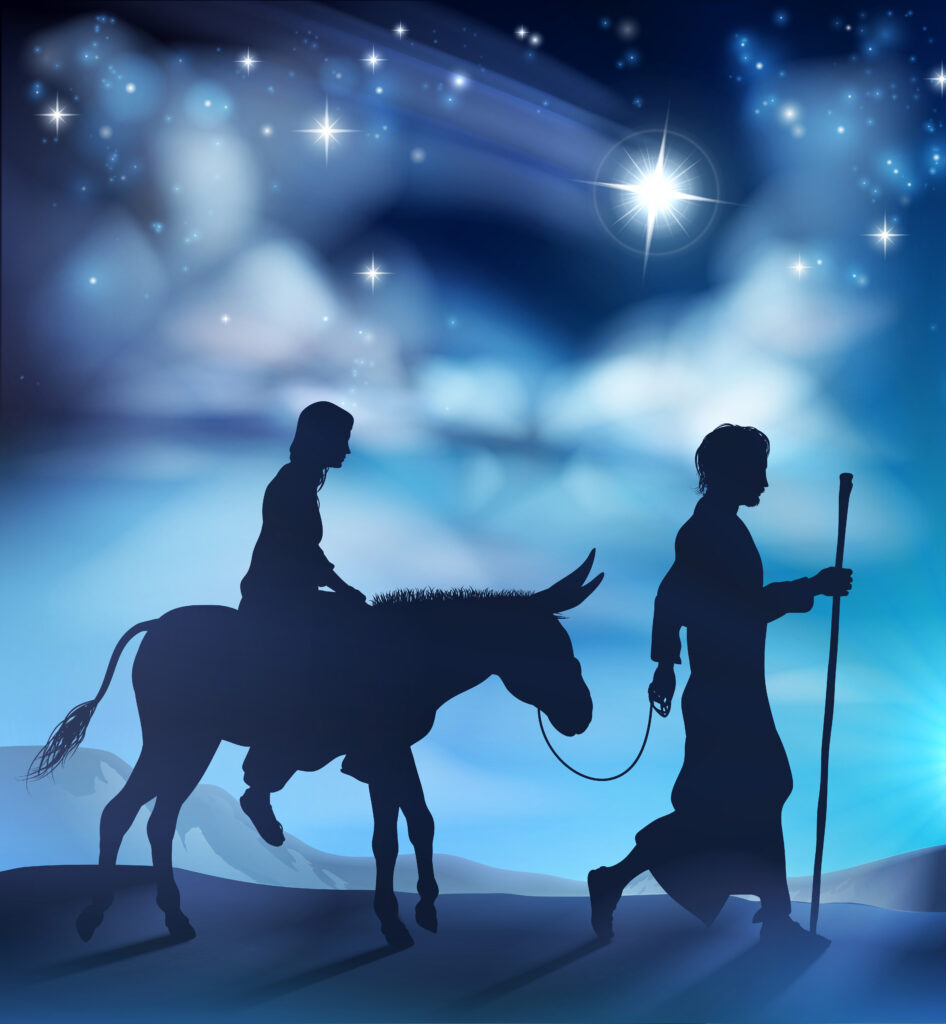
Pilgrimage is the perfect metaphor for our Advent journey. It is a journey through time to the brink of eternity. Our pilgrim companions and guides are primarily the prophets Isaiah and John the Baptist, who figure prominently in the Scriptures for the season.
Advent is an odd and unique pilgrimage, too, because it begins at the edge of our destiny at the end of time and progresses backward to the Annunciation of the Lord in view of his Birth in Bethlehem. Perhaps that is because our natural inclination during Advent is to prepare ourselves spiritually and materially to commemorate the Birth of Jesus on Dec. 25. That was the first Christmas 2,000 years ago.
However, the real focus of our Advent pilgrimage is to prepare us for the second Christmas, the coming of Christ in glory to usher in the fullness of the Kingdom of God. The Church strongly reminds us of this true goal of ours at the very outset of the Advent season so that it might remain at the forefront of our minds as we make our preparations to celebrate Christmas on Dec. 25.
The scriptural readings for the first Sunday of Advent begin with the prophet Isaiah lamenting the wandering of God’s people far from his ways. He begs the Lord to return for their sake. “Oh, that you would rend the heavens and come down.” (63:19b) Also, he prays that God might find them doing right when he does finally come.
In his first letter to the Corinthians, Saint Paul assures them they are lacking in no spiritual gift as they await the second coming, “the revelation of our Lord Jesus Christ.” (1:7) He is confident that they will remain “firm to the end, irreproachable on the day of our Lord Jesus Christ.” (1:8)
In the Gospel according to Saint Mark, Jesus says to his disciples, “Be watchful! Be alert!” (13:33) He says that in view of his second coming because no one knows when he will return.
In the Gospels for the second and third Sundays of Advent, John the Baptist, the last of the prophets, appears on the scene. He harkens back to the message of Isaiah as he proclaims, “Prepare the way of the Lord. Make straight his paths.” (Mk 1:3)
Finally, in the Gospel for the fourth Sunday, the account of the Annunciation of the Lord is proclaimed in preparation for our commemoration of his Nativity.
The readings are rich for the Sundays of Advent. A slow, prayerful reading of them throughout the season is a good practice to prepare for the celebration of Christmas on Dec. 25. But especially, such a reading is beneficial as we contemplate the second Christmas at the end of time.
Just as Dr. Thomas Avery and his fellow pilgrims on the Camino de Santiago came to a deeper knowledge of themselves, may our pilgrimage through the season of Advent lead us to a more intent focus on our final destination somewhere beyond Dec. 25.
Father Edward Kolla is a retired priest of the Diocese.




 at the bottom and then tap “Add to Home Screen”
