




Virtually all Catholics are aware that in the late winter or early spring, Mardi Gras and Ash Wednesday move each year based on counting backward from Easter. But fewer realize that months later, we are still arranging our moveable feasts in light of the lunar calendar, which determines that central celebration.
The Feast of Corpus Christi, or more technically, the Solemnity of the Most Holy Body and Blood of Christ, is also determined by the date of Easter, which is always the first Sunday after the first full moon after the Spring equinox. In our current liturgical calendar, Corpus Christi occurs on the Thursday (or Sunday in some places) after Trinity Sunday, thus 11-14 days after Pentecost, which itself is seven Sundays after Easter. One can clearly see here the centrality of the Resurrection for the whole Church, given that roughly one-third of the entire year is marked in some way by liturgical celebrations related to Christ’s victory over the grave.
Corpus Christi was officially extended to the whole Church as a solemnity by Pope Urban IV during the Orvieto pontificates that ran from 1261 to 1303, when the popes fled conflict in Rome before relocating to Avignon, France, for close to 70 years. Saint Thomas Aquinas was a key proponent of the feast. He wrote familiar hymns still associated with it like the “Pange Lingua,” “Tantum Ergo” and “O Salutaris Hostia,” as well as composing the propers for its Mass (the variable portions of the celebration like the introit, alleluia, and offertory prayers, among others).
The Catholic Church has been wrestling with how best to understand the change that takes place when the Eucharist is confected for centuries, including in the divergent views put forward by monks Radbertus and Ratramnus in the 800s AD. Even into our own day, sciences continue to tell us that there is more to reality than meets the eye. Imagine telling a pre-medieval person that light is both a particle and a wave, or that the desk at which they are seated is at a molecular level more empty space than solid matter in terms of protons and electrons, or that the universe is expanding and not static, all of which we theorize today to be true.
Though of course, as Einstein pointed out, “The scientific theorist is not to be envied. For Nature, or more precisely experiment, is an inexorable and not very friendly judge of his work. It never says ‘Yes’ to a theory. In the most favorable cases, it says ‘Maybe’ and in the great majority of cases simply ‘No.’ If an experiment agrees with a theory, it means for the latter ‘Maybe,’ and if it does not agree, it means ‘No.’ Probably every theory will someday experience its ‘No’ – most theories soon after conception.”
But the Catholic Church quite obviously teaches that Christ’s Body and Blood are really and truly present in the Eucharistic celebration, a reality we cannot prove with the scientific method, but only appreciate with eyes of faith. Interestingly, preaching connected to the feast doesn’t usually spend much time focusing on the “soul and divinity,” which are likewise there, but merely implied in its devotions. And of course, the miracle that occurs here involves mystery, for the hyperrealism that would connect this Real Presence to the finite quantity of hosts equaling Jesus’ earthly weight or that His post-Resurrection incorruptible body is broken and crushed once more by our teeth (cf. Summa III, q.77, a.7) are not in accord with the Church’s Eucharistic theology.
When Alonso Alvarez de Pineda laid eyes on the coast of Texas in 1519, more than a century before the English-speaking Mayflower pilgrims landed at Plymouth Rock, he named the region after the Catholic feast for the day. Our country is blessed then to have a permanent memorial reminding us that the Body of Christ is truly present among us in both the Blessed Sacrament and in the suffering of our neighbors daily crucified by dehumanization.
As Saint John Chrysostom put it: “Do you want to honor Christ’s body?
Then do not scorn him in his nakedness, nor honor him here in the church with silken garments while neglecting him outside where he is cold and naked. For he who said ‘This is my body,’ and made it so by his words, also said, “You saw me hungry and did not feed me, and inasmuch as you did not do it for one of these, the least of my brothers, you did not do it for me.’ Of what use is it to weigh down Christ’s table with golden cups, when he himself is dying of hunger? First, fill him when he is hungry; then use the means you have left to adorn his table. … Apply this also to Christ when he comes along the roads as a pilgrim, looking for shelter. You do not take him in as your guest, but you decorate floors and walls and the capitals of pillars. You provide silver chains for lamps, but you cannot bear even to look at him as he lies chained in captivity.”
At its fullest and most authentic, Corpus Christi is then about more than only one kind of holy sanctuary.
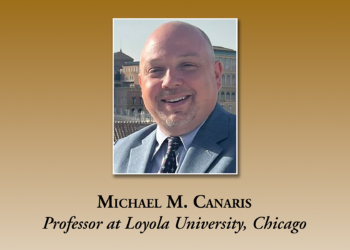
Originally from Collingswood, Michael M. Canaris, Ph.D., teaches at Loyola University, Chicago.



 at the bottom and then tap “Add to Home Screen”
