







There is substantial evidence that roughly 10,000 species go extinct every year. For Christians, this reality sits at the thorny theological knot of providence, chance, God’s gift of creation, human freedom’s response and cosmic death. However, it’s clear that we have a duty to protect our co-inhabitants of the planet where we can. Though I did have to laugh when I recently drove by a billboard advertising for an exterminator that rhetorically asked, “Really, Noah? Two mosquitos?”
One of the global conservation attempts to safeguard vulnerable species is World Lion Day, which is commemorated annually on Aug. 10. As of this year, there are probably only 23,000 of these felines left on earth, whereas in 1924, there were more than 200,000. Though they are considered apex predators in the animal kingdom, humans have continued to encroach upon their domain through poaching, intentional extermination or retaliation, and climate change, drastically thinning their numbers.
In the Book of Revelation, John refers to the Lion of the tribe of Judah, who alone is deemed worthy to break the seals and open the scroll of the Mystery of God. In an unexpected twist, John then identifies this Lion not with power and might, but with the fragility of the sacrificial Lamb. (Rev 5) Thus, any victory of the roaring lion is accomplished in and through the weakness of the lamb, for as Saint Paul says elsewhere: “That is why, for Christ’s sake, I delight in weaknesses, in insults, in hardships, in persecutions, in difficulties. For when I am weak, then I am strong.” (2 Cor 12:9-10)
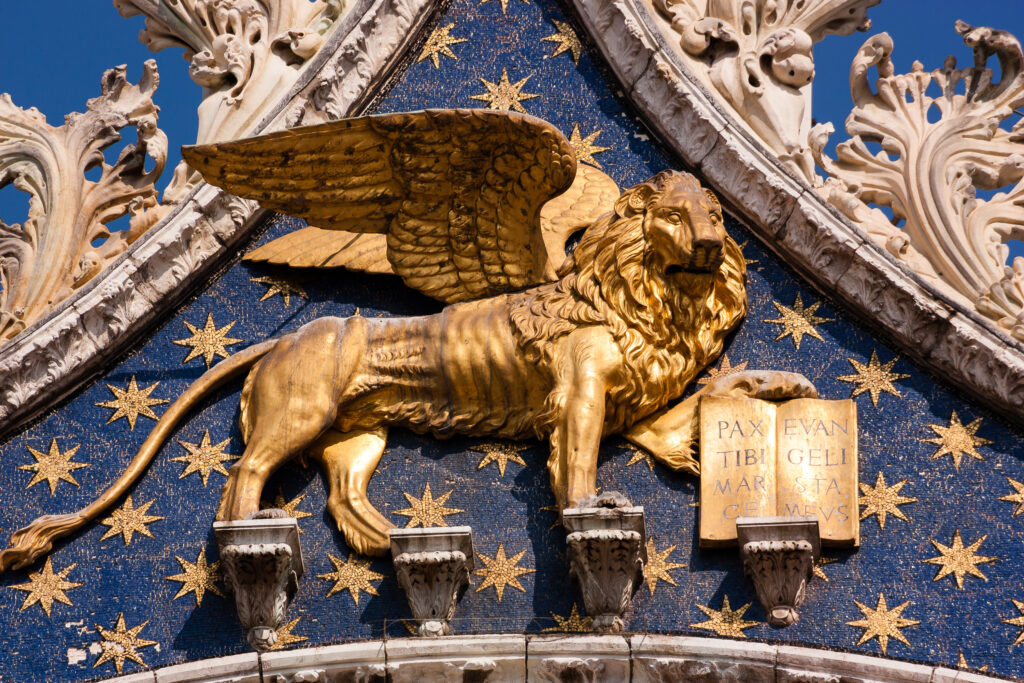
It is not only Jesus who is connected with lions in the tradition. Jacob’s son Judah is famously compared to a lion’s whelp or pup, and the prophet Daniel is of course rescued by God from their den. As anyone who has visited Venice knows well, Saint Mark is always associated with a winged lion, usually because of the opening scenes of his Gospel where John the Baptist is described as crying out, rather like a lion in the wilderness, to prepare the way of the Lord. Most interpreters then connect him with one of the four winged creatures in the vision of Ezekiel who come to represent the evangelists, in an imaginative or perhaps sometimes admittedly forced, series of analogies and iconographies.
Much of this formidable and regal imagery is why C.S. Lewis chooses the creature to serve as the literary vehicle for Christ in his “Narnia” series.
And yet, we know that there is a shadow sign to the lion’s rumbling growl. The First Letter of Saint Peter tells us that the enemy of the human spirit prowls around like a lion looking for victims to devour. A similar image appears in the Book of Job, where the adversary responds to the Lord’s question, “Where have you been?” He says he has been pacing to and fro over the face of the earth, lurking and scavenging, ruthlessly aggressive in defense of what he perceives as his own turf and able to wreak havoc and destruction on nearly anything in its path.
As with all transcendent realities, we grope for images, both positive and negative, to express the ecstasy and awe, the fear and finitude of the human condition. This most magnificent and uncontrollable of the animals has long captivated our race and provides an apt image to depict at once our own precariousness if left to face it naked and unarmed, and the impressiveness and grandeur of authentic dominion and sovereignty. In this way, there is some comparison with how inextinguishable fire is similarly used in descriptions of both heavenly and infernal realities: at once majestic, undomesticated, entrancing, life-giving and dangerous.
I read once that we can never be tempted to try to put the Lion of Judah into a petting zoo, meaning to my mind that the supremacy and broad reach of God’s will and dominion will not be caged or boxed in neatly. Woody Allen quipped that if the lion and the lamb lie down together, the sheep won’t get much sleep. It’s best that we, too, do not remain too comfortable in our assumptions about what God can and will do with us and our own feeble projections that often delude us into the belief that we are orchestrating our own lives, or the kings of our own jungle.
An alumnus of Camden Catholic High School, Cherry Hill, Michael M. Canaris, Ph.D., teaches at Loyola University, Chicago.




 at the bottom and then tap “Add to Home Screen”
