




At a recent gathering of ecumenical leaders, an interesting discussion arose about the threat of Christian nationalism and the upcoming presidential election. After doing some research, I found that there are many varieties of Christian nationalism within the Protestant world, as well as a distinctive Catholic watered-down version, often referred to as “integralists.”
In general, Christian nationalism here in the United States is the belief that we are fundamentally a Christian nation and, therefore, we should be governed by a form of government that holds fast to Christian principles. Christian nationalists believe that the government should maintain and promote a Christian identity. They are weary of Christian pluralism and oppose the separation of church and state.
One of the many shadow sides of this ideology is that it tends to marginalize non-Christians. It also restricts religious freedoms, which leads to and exacerbates social divides. The movement is different from patriotism or political views based on the tenants of Christianity because Christian nationalists believe that national identity should be synonymous with the teachings enshrined in their particular expression of Christianity.
It helps to make a distinction between Christian nationalism and Christians who consider themselves patriotic. Christian nationalists claim that a “Christian nation” was the intention of the founding of a new nation, dating back to colonial times. The patriotic Christian loves our nation and is loyal to maintaining the freedoms and rights enshrined in our founding documents. Christian nationalism advocates for a government that maintains and promotes only Christian identity. Christian nationalism can restrict religious freedoms for non-Christians, while patriotism supports constitutional freedoms for all people, regardless of their religious affiliation or lack thereof. While Christian nationalism tends to be protectionist and exclusionary, patriotism tends to bring people together, motivated by gratitude and love.
There are a number of events that have fed into the Christian nationalist rise. The rise of the Civil Rights Movement in the 1960s sparked a backlash among some white Christians who felt their cultural dominance was being threatened. The rise of the Moral Majority and Christian Right in the ’70s and ’80s increased the political influence of conservative evangelical Christians. The September 11, 2001, terrorist attacks unleashed an intensified anti-Muslim and pro-Christian government forces. The election of President Barack Obama further threatened some white Christian nationalists, while the election of President Donald Trump emboldened and empowered Christian nationalists’ ideologies and movements. The January 6, 2021, attack on the Capitol displayed overt Christian nationalists’ symbology and rhetoric.
These events reflect a longstanding tension between America’s constitutional secularism and attempts to define the nation’s identity as fundamentally Christian. The movement has gained prominence in recent years as demographic and cultural changes have made some white Christians feel their status is threatened.
Bishop Michael F. Burbidge of Arlington, Va. – chairman of the U.S. Catholic bishops’ Committee on Pro-life Activities – addressed this topic in an April podcast. When asked if Christian nationalism is compatible with Catholic teaching, he responded, “I think it’s good to distinguish between nationalism and patriotism. Of course, a good Catholic should also be a good citizen, a faithful citizen. We always say that – ‘a faithful citizen’ – and that means to be patriotic, of course. We should have a proper, healthy love for our nation because it is ours. We live in a nation that, through the sacrifices of so many people, gives us the gift of freedom, the gift of religious liberty, and we should be thankful for that.”
He added, “Christian nationalism is a confusing term because it can confuse two things that should be distinct: devotion to the nation and devotion to the Church. A Christian … never identifies oneself entirely with a particular nation. A Christian loves his nation, but within the broader and larger love for God and neighbor. That’s that distinction we’re trying to make.”
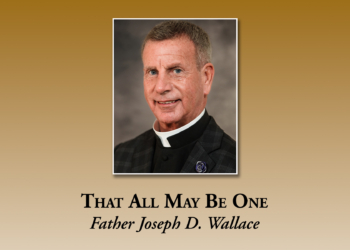
Father Joseph D. Wallace is diocesan director of Ecumenical and Inter-religious Affairs and pastor of Christ the Redeemer Parish, Atco.




 at the bottom and then tap “Add to Home Screen”
