



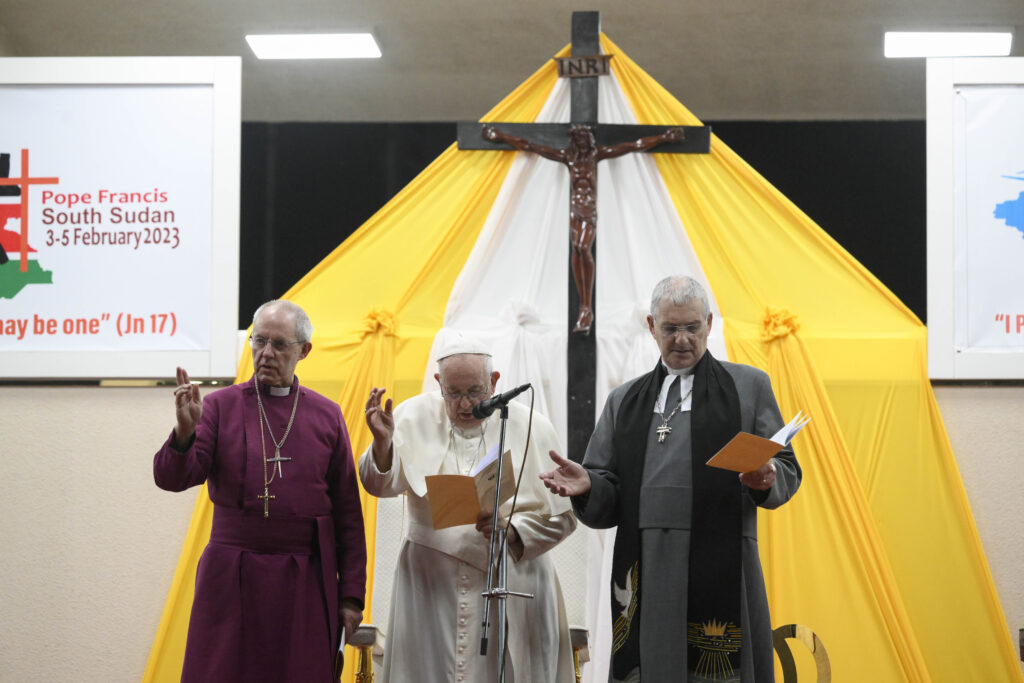
Upon returning from the historic trip to South Sudan with Pope Francis and the Rev. Iain Greenshields, head of the Church of Scotland, Archbishop of Canterbury Justin Welby was immediately involved in a major decision concerning the LGBTQ+ community.
The pope had invited Archbishop Welby and the Rev. Greenshields to visit with him to bring a message of peace to this war-torn part of Africa. While Christianity seems to be on the wane in Europe and the West in general, it is growing in leaps and bounds in Africa. Archbishop Welby said of the joint visit, “Our pilgrimage together is a sign for the world.” He added that this ecumenical approach is something “we need constantly to be reminded, and I hope this trip reminds people that the normal is for the church to work as one.”
Before the trip began, Pope Francis and Archbishop Welby upset some Church leaders and politicians in South Sudan by making statements about same-sex relationships that go against the backward and outdated laws condemning LGBTQ+ peoples. Sexual activity between men is against the law in South Sudan and punishable with sentences of up to 14 years in prison. While the law seems to only target men, trans people could also be imprisoned.
Just prior to the trip, Pope Francis, in an interview, explained that laws that criminalize homosexuality were wrong and unjust. He said, “We are all children of God, and God loves us as we are and for the strength that each of us fights for our dignity.” While clearly stating that all sexual acts outside the confines of marriage are sinful, he added, “Let’s distinguish between a sin and a crime.”
Archbishop Welby returned to England in time to preside over the General Synod of the Church of England. After a rather impassioned debate lasting more than eight hours, the Church of England officially voted 250 to 181 to back a proposal put forth by synod bishops to permit Church of England priests to bless the civil marriages of same-sex couples. The synod also agreed that the Church of England will apologize for the harm it has caused to LGBTQ+ communities over the centuries. Archbishop Welby joined the Archbishop of York, Stephen Cottrell, in saying they hope the decision will mark a “new beginning” for the Church of England, adding, “It has been a long road to get us to this point.” They said, “For the first time, the Church of England will publicly, unreservedly and joyfully welcome same-sex couples in church.”
The Church of England seems to have taken the “via media” (middle of the road) position by not sanctioning gay marriage but allowing blessings of civil marriages between people of the same sex. This decision angered those who oppose any recognition of same-sex marriage and those calling for the full recognition of same-sex marriage. The archbishops explained that “the church continues to have deep differences on these questions, which go to the heart of our human identity. As archbishops, we are committed to respecting the conscience of those for whom this goes too far and to ensure that they have all the reassurances they need in order to maintain the unity of the church as this conversation continues.”
Church of England Bishop Sarah Mullally, the bishop of London, said at the synod meeting that “this is a moment of hope for the church. I know that what we have proposed as a way forward does not go nearly far enough for many, but too far for others.”
Those favoring marriage equality see this move as a first step. Church of England Bishop Steven Croft of Oxford said, “Same-sex couples will become much more visible, and their relationships will be celebrated publicly, and that, I think, will continue to change attitudes within the life of the church.” He explained that while the amendment on marriage doctrine in the Church of England is “important to give some reassurance to those who are more conservative,” it will not stop the church from “returning to this question [of same-sex marriage]” in the future.
Those who opposed the amendment, especially the Church of England Evangelical Council, said they were “deeply saddened.” They believe “our historic and biblical understanding of sex and marriage” is being abandoned. They said the decision vote “settled nothing and has only served to deepen divisions.”
Certainly, the ongoing ecclesial and societal debate over same-sex marriage and the inclusion of LGBTQ+ people in the life of the Church will continue. May our conversations continue with civility and compassion.
Father Joseph D. Wallace is diocesan director of Ecumenical and Inter-religious Affairs and pastor of Christ the Redeemer Parish, Atco.




 at the bottom and then tap “Add to Home Screen”
