




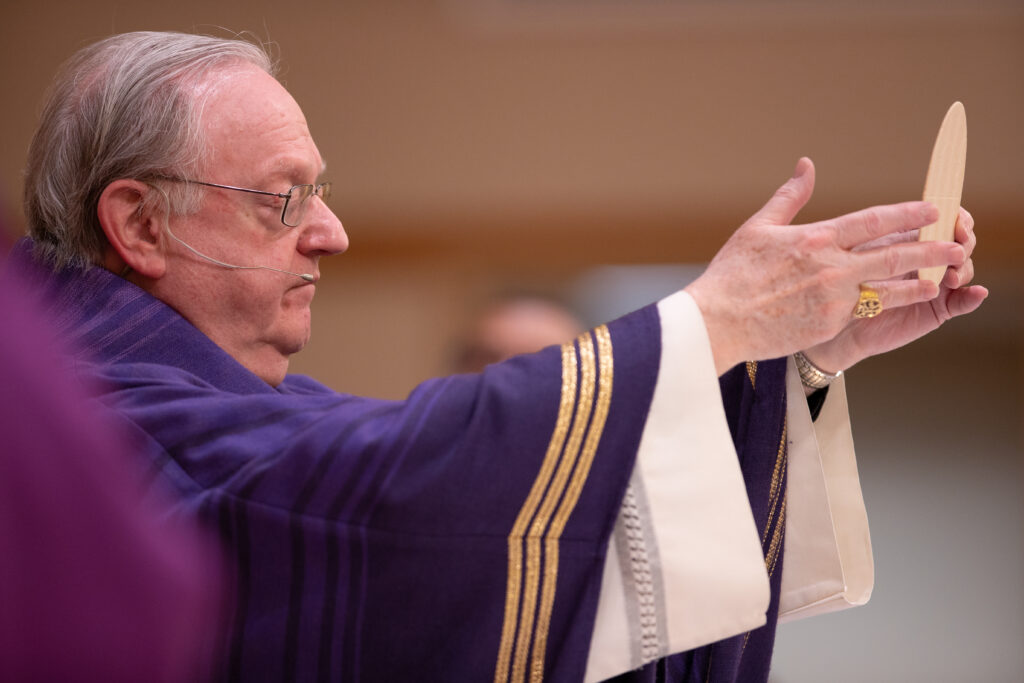
The Acts of the Apostles relates that the early Christians “devoted themselves to the teaching of the apostles and to the communal life, to the breaking of the bread and to the prayers” (Acts 2:42). During the Easter season we, the community of believers, should ponder this portrait of the early church. This portrait ought to be vividly manifest in every diocese, particularly in each parish. For the church is one in its faith (teachings of the Apostles), in the offering of ‘the prayers’ (liturgy) and the breaking of the bread (Eucharist), all of which lead to a communal life (the Church as the People of God/the Body of Christ).
The breaking of the bread can be understood as a Lukan term for the Eucharist. Recall how Jesus was known by the two disciples on the road to Emmaus in the breaking of the bread (cf. Lk 24:35). When the community gathers for the breaking of the bread, offering bread and wine by the hands of the priest in memory of Christ, Jesus is present. He is present not just in the community gathered, but in a unique way under the species of the bread and wine. The bread and wine are substantially changed into the body and blood, soul and divinity of Jesus Christ.
This mysterious substantial change, known as transubstantiation, allows the community to partake in the sacrifice of Jesus. This partaking allows the community to renew the New and Everlasting Covenant made in the Blood of Christ. Partaking in Jesus’ covenantal sacrifice allows those who partake to become a community; the Church; the Body of Christ. For this reason, one of the many names given to this great sacrament is Sacrament of Ecclesiastical Communion.
This particular name is rooted in the most common name: Holy Communion, for it is “the intimate union of the heart of God with the heart of [the receiver]” as Father Garrigou-Lagrange, OP, teaches.
Communion allows us to encounter God in a unique way. As so many doctors of the church have pointed out, in Holy Communion human-beings are fed with God-himself. Saint Thomas Aquinas teaches, in applying the effects of Christ’s sacrifice, Holy Communion does for the soul what food does for the body: sustains, restores, refreshes and gives joy (cf. Summa Theologciæ III Q. 79). Holy Communion nourishes us and allows the receiver to grow in the love of God, conforming each of those who receive to the likeness of Christ.
Being filled with the life of Jesus through a worthy reception of Holy Communion will lead the receiver to fulfill the teaching of Jesus: “Love one another as I have loved you” (Jn 13:34). Jesus took up our burdens; our pains; our sins. He gave his life so that we might inherit eternal life.
One of the fruits of the Holy Communion is the strengthening of the bonds of charity between believers. Saint Paul VI teaches that Holy Communion allows believers to “put the common good ahead of the private good, take up the cause of the community, the parish, the universal Church, and extend our charity to the whole world because we know that there are members of Christ everywhere” (Mysterium fidei, 69). This is the second part of the name mentioned above, Sacrament of Ecclesiastical Communion.
Father Garrigou-Lagrange, OP, early in the last century wrote that “each epoch has its difficulties, and, with the return of the masses to unbelief, the difficulties of our own day might before long resemble those which the early church encountered during the centuries of persecution.”
As Christians encounter division in society and sadly even within the church, it is important to recall the example of the early Christians in Jerusalem: being devoted to the teachings of the Apostles, the prayers and the Breaking of the Bread, for this leads to a true community: a body where each person has a true love for each of the members.
Each Christian should find strength in the Eucharist. The strength that comes from reception of Holy Communion is due to Jesus being really, truly present. The Eucharist is a sacrament, a true mystery: the substance of Jesus under the accidents of bread and wine. Our eyes, even our taste, sense one thing but our faith informs us of something different: Jesus! Let the profession of faith of Saint Thomas the Apostle be ours: My Lord and my God! (Jn 20:28).
When Catholics acclaim “Amen” prior to reception of Holy Communion, they are making this profession of faith: My Lord and my God. Such a profession opens the heart to receive the outpouring of love and grace Jesus won for us by his cross and resurrection. This will allow us to love God above all things and our neighbor as ourselves. Such are the fruits of Holy Communion.
Father Jason Rocks is priest secretary to Bishop Dennis Sullivan and adjutant judicial vicar for the Diocese of Camden.



 at the bottom and then tap “Add to Home Screen”
