





When Deacon David Harkins learned of the deadly shooting at a Catholic church and school in Minneapolis, he knew there was a way the Gloucester Township Police Department could provide immediate help – despite being nearly 1,200 miles away.
Deacon Harkins – Gloucester Township police chief – began coordinating plans for the department’s Community Resource K-9 and Crisis Response Canines team to support the Annunciation Catholic School and parish community.
“When the Church in Minneapolis suffers, we all suffer,” said Chief Harkins, a permanent deacon serving at Holy Child Parish, Runnemede. “We must lift each other up with prayer, love and faith.”
Two children were killed and 21 other people were injured when a gunman opened fire on Annunciation Catholic Church during an all-school Mass the morning of Aug. 27. In the hours that followed, Chief Harkins reached out to Bishop Joseph Williams, who is from the Archdiocese of Saint Paul and Minneapolis, to get in touch with archdiocesan and parish leaders there so the K-9 unit could assist.
The specially trained handler and canines work year-round in Gloucester Township – participating in community events, visiting schools and leading stress debriefings for police officers and others.
“They are therapy dogs, but they are so much more. The dogs sense those who are in pain, they sense anxiety,” Chief Harkins said. “From a therapeutic standpoint, they break down the barriers for those who are under stress. I have seen it firsthand.”
The team is led by retired New Jersey State Police Major John Hunt, who is the founder and chief operating officer of Crisis Response Canines – an organization that is based in New Jersey and mobilizes a network of canine and handler teams across 20 states. Their network of Comfort Teams participates in school, hospital, business and community events, and their Operational Deployment Teams have the advanced training and capacity to respond to crises across the country.
“When a major event happens like that [the shooting] happens, they stand by and get ready to go,” Chief Harkins said of the department. “It is a way of us giving – an act of mercy in our faith.”
Major (Ret.) Hunt, a member of Our Lady of Hope Parish, Blackwood, traveled to Minnesota with one of his three canine partners, Axel, arriving just two days after the mass shooting. They met with families and parishioners, and even attended the first Mass celebrated there since the shooting.
He explained that Axel, a working service animal, will do something like sit on someone’s feet as a form of deep pressure therapy. The person being comforted might start to pet the dog, proving a tactile distraction while being given a safe space to talk.
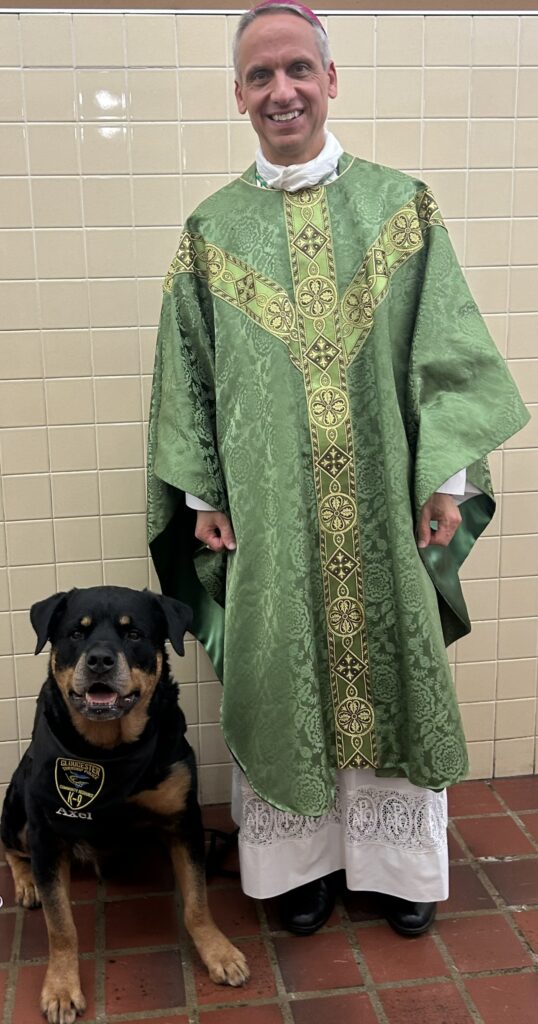
“We certainly hope to help folks take an opportunity to decompress,” he said. “We afford them the opportunity to speak, and we openly listen. One of the most profound things I can do is to listen.”
It’s not the first time that Major Hunt and his team have traveled to other communities in the wake of tragedies. In 2022, they supported the community following the deadly school shooting in Uvalde, Texas. This past July, they spent time in Texas – interacting with survivors and the parents of children who died in the flood at Camp Mystic.
He said he saw a range of emotions among those impacted by the shooting in Minneapolis.
“None of them will ever forget [what happened], but hopefully, we can help them realize that they have suffered through an abnormal event, and that they may be experiencing normal responses to that,” he said. “We will [also] encourage them to continue to talk and to hopefully get the resources that are available.”
As a Catholic himself, Major Hunt has been moved by the care that Bishop Williams has shown his former flock in Minneapolis. He said that he even ran into faithful and clergy who knew Bishop Williams while he was serving in that diocese.
For Chief Harkins, lending his department’s team to other communities in times of crisis also serves a dual purpose: helping his own agency and community learn from firsthand accounts of what happened, and what law enforcement and emergency response officials might be able to do locally to improve, and to prevent, similar incidents.
He also sees alignment between his roles as a police chief and a deacon – both centering on a call to service. Those dual perspectives have made processing what happened in Minneapolis difficult, too.
“As a law enforcement officer for over 30 years, it still angers me, and it makes me want to examine what else we can do to protect our children,” he said. “It just goes against our faith, it goes against everything that we are taught. But it also gives us the opportunity to really show our great Catholic faith.”
Chief Harkins sees the importance not only of offering a resource like the Crisis Response Canines to help other communities, but also for all faithful to pray for those affected.
“We need to pray for justice,” he said, “and we can also pray that the Lord will put us in the position to take action to prevent any of these evil acts, and to not be afraid to stand up to evil.”




 at the bottom and then tap “Add to Home Screen”
